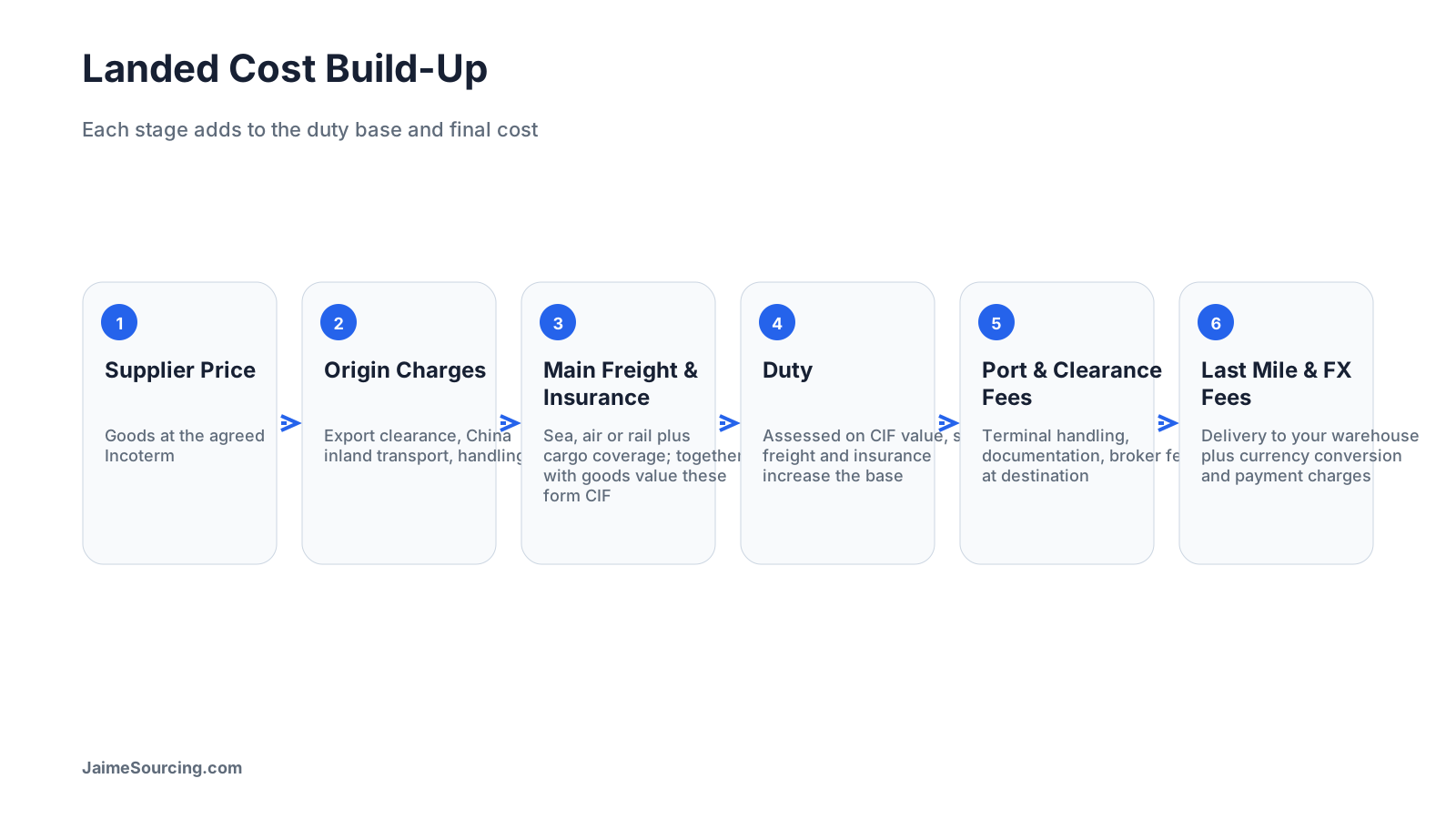
Landed cost is the total you actually pay to get goods from a Chinese supplier’s door into your warehouse or fulfillment center: supplier price, freight, insurance, duty, port and clearance charges, last-mile delivery, and the small fees most buyers forget. The formula is landed cost = supplier price + freight + insurance + duty + port/clearance fees + last-mile delivery + FX and payment fees. Price your Shopify products off the supplier invoice alone and you are likely understating cost by 10–20%.
This guide gives you the formula, two worked examples, the Incoterms traps that change who pays what, and a verification checklist to run before you place a purchase order.
The Landed Cost Formula, Line by Line
Every cost line belongs to one of three buckets: what you pay the supplier, what you pay to move the goods, and what governments and intermediaries charge at the border. Missing any line distorts your margin.
| Cost line | What it covers | Typical basis | Who usually quotes it |
|---|---|---|---|
| Supplier price | Goods at the agreed Incoterm | Per unit or per order | Chinese supplier |
| Origin charges | Export clearance, China inland transport, handling | Per shipment | Supplier or freight forwarder |
| Main freight | Sea, air or rail to destination | Per container or per kg | Freight forwarder |
| Insurance | Cargo coverage in transit | Percentage of cargo value | Insurer or forwarder |
| Duty | Customs tariff on the imported goods | Percentage of customs value | Destination customs |
| Port and clearance fees | Terminal handling, documentation, broker fees | Per container or per entry | Destination port, broker, carrier |
| Last-mile delivery | Port or airport to your warehouse | Per shipment | Trucker or courier |
| FX and payment fees | Currency conversion, bank and platform charges | Percentage of payment | Bank or payment platform |
Two structural points matter more than any single number. First, duty is normally assessed on the CIF value (cost + insurance + freight), not on the supplier invoice alone. Second, port and clearance charges at destination are frequently omitted from first-time budgets even though they can run several hundred dollars per container. Build the table above into a spreadsheet template once, and reuse it for every shipment.
Worked Example 1: Sea Freight, FOB Terms
Assume you buy $5,000 of goods FOB, sea freight is $2,000, insurance $100, duty is assessed at 10% of CIF value, destination port fees are $500 and last-mile delivery is $200.
- CIF value = $5,000 + $2,000 + $100 = $7,100
- Duty at 10% = $710
- Landed cost = $5,000 + $2,000 + $100 + $710 + $500 + $200 = $8,510
The source example uses a $1,000 duty figure for illustration; the arithmetic above applies the same 10% rate to the CIF base. The method matters more than the exact number: duty compounds on freight and insurance, so a cheap freight quote does not automatically lower your duty.
Worked Example 2: Air Freight, Higher Value Density
Assume 400 kg of goods at $5/kg air freight, a $2,000 goods value, insurance at roughly 0.5% of goods value, duty at 10% of CIF, $50 in clearance fees and $150 last-mile delivery.
- CIF value = $2,000 + $2,000 + $10 = $4,010
- Duty at 10% = $401
- Landed cost = $2,000 + $2,000 + $10 + $401 + $50 + $150 = $4,611
Air freight is usually quoted per kilogram and suits high-value or urgent cargo; sea freight is quoted per container and suits volume. Run both scenarios before you commit, because the cheaper freight mode is not always the cheaper landed cost once duty and clearance are included.
Incoterms Decide Which Lines You Own
The same supplier quote means different things under different Incoterms, and comparing quotes across terms is one of the most common costing errors.
- EXW (Ex Works): the supplier’s price covers goods at their premises only. You carry China export clearance, inland transport, main freight, duty and everything after.
- FOB (Free On Board): the supplier covers export clearance and delivery to the port; you pay main freight, insurance, duty, destination port fees and last-mile delivery.
- CIF (Cost, Insurance and Freight): the supplier arranges and pays main freight and insurance, but you still owe duty, destination port and local charges, and last-mile delivery.
- DDP (Delivered Duty Paid): the supplier or their forwarder handles everything to your door, including duty. Convenient, but you lose visibility into the underlying cost lines.
DDP carries a specific risk. A “tax-inclusive” DDP quote can be built on under-declared values or misclassified goods, which shifts customs risk onto you as the importer of record. Ask for a written cost breakdown under any DDP quote, and confirm the declared value and HS code match what you would declare yourself. For cross-border selling, Shopify documents the DDP versus DAP distinction and the checkout settings that collect duty and import tax upfront.
The Fees Buyers Forget: FX, Payment and Carrier Charges
Beyond freight and duty, three categories quietly erode margin.
Currency and payment fees. Currency conversion and payment processing typically add 0.5–2% and are easy to overlook when building a landed cost model. When you pay a Chinese supplier by T/T, your bank and the intermediary bank may each deduct fees, so agree in writing whether the supplier receives the full invoice amount or absorbs the deduction. Trade Assurance or platform fees, corporate versus personal account payments, and who pays sample-payment fees should all be settled before the first order.
Carrier disbursement and COD fees. If duty and tax are not prepaid, the carrier often advances the money to customs and charges a disbursement fee, typically a percentage of the amount advanced or a flat fee, whichever is greater. Carriers also charge a cash-on-delivery fee when they collect duty from the recipient at the door. These fees can rival the duty itself and are themselves subject to VAT in some markets.
Brokerage and entry fees. Some carriers charge separate brokerage or entry-preparation fees on ground shipments into certain markets, for example into Canada. Ask your forwarder for an all-in destination quote that names every fee, not just the headline freight rate.
Thresholds, Tax Rates and Why Your Neighbour’s Number Won’t Match
Duty and tax depend on destination country, origin country, HS code and whether the shipment falls under a de minimis threshold. Tax thresholds and duty thresholds are separate: goods can exceed the tax threshold without exceeding the duty threshold, but not the reverse. VAT and GST rules also differ by jurisdiction — the EU calculates VAT on the total order value including freight and duty, Canada applies different provincial rates, and some destinations such as Hong Kong levy no import tax.
This is why you should never copy a landed cost percentage from a forum post. Look up the current official rate for your HS code and destination, and re-check it before each order because tariff policy changes. Shopify’s guidance notes that HS code accuracy can swing duty rates significantly and that merchants should confirm current rules with local trade authorities.
What to Verify Before You Proceed
Run these checks before you release payment or book freight.
- Confirm the Incoterm in writing. Get the supplier’s quote in writing with the term stated (EXW, FOB, CIF or DDP), and compare competing quotes only on the same term.
- Get an itemised forwarder quote. Ask for main freight, origin charges, insurance, destination port fees and documentation fees as separate lines, for both sea and air where relevant.
- Verify the HS code and current duty rate. Use your destination customs authority’s official tariff tool; do not rely on the supplier’s suggested code without checking.
- Screen the supplier entity. Use the Chinese National Enterprise Credit Information Publicity System, Tianyancha or Qichacha to confirm the legal name, Unified Social Credit Code, establishment date, registered capital and whether subscribed capital has actually been paid in. A long establishment date and paid-in capital are weak but useful signals; they do not replace an audit or inspection.
- Budget insurance explicitly. Cargo insurance is usually optional but commonly budgeted at 0.2–0.5% of cargo value.
- Model FX and payment fees. Add 0.5–2% for conversion and payment costs, and confirm who bears bank charges on T/T payments.
- Check de minimis and tax thresholds. Confirm both the duty and tax thresholds for your destination and shipment value.
- Plan QC before shipment, not after. Agree an AQL inspection using ISO 2859-1 / ANSI/ASQ Z1.4, General Inspection Level II, with Critical, Major and Minor defect classes defined. Critical 0 / Major 2.5 / Minor 4.0 is a common starting point, not a universal rule — set limits based on what your customers will reject.
Frequently Asked Questions
What is the formula for landed cost on China products?
Landed cost equals supplier price plus freight, insurance, duty, port and clearance fees, last-mile delivery, and FX and payment fees. Duty is normally calculated on the CIF value, so freight and insurance increase your duty base as well as your logistics spend.
Is DDP always cheaper than FOB?
No. DDP bundles everything into one price, which is convenient but opaque, and a non-compliant DDP quote can expose you to customs risk as importer of record. FOB gives you line-by-line visibility, so compare the two on an itemised basis before deciding.
Why is my landed cost higher than my supplier’s quote plus shipping?
Because destination port fees, clearance and brokerage charges, carrier disbursement fees and currency conversion are usually excluded from both the supplier quote and the headline freight rate. These lines can add a meaningful percentage and are the most commonly omitted items.
Do I pay duty on the goods value or the shipping cost?
In most cases duty is assessed on the CIF value, which includes cost, insurance and freight, not the goods value alone. Confirm the valuation rule with your destination customs authority, because rules and thresholds vary by jurisdiction.
How often should I recalculate landed cost?
Recalculate before every purchase order and whenever freight rates, tariff policy or exchange rates move. Tariff and threshold rules change, and Shopify advises merchants to check current trade rules with local authorities rather than relying on older figures.
Where Buyers Lose Money — and How to Close the Gap
The arithmetic is simple; the execution is not. Quality drift between the approved sample and the production run, missed factory follow-ups, and the physical and time-zone distance between you and a Chinese supplier are the risks that turn a well-modelled landed cost into a loss. A supplier who under-declares value to hit a DDP price, or who ships a batch that fails inspection after you have paid, costs far more than any freight line item.
Jaime Sourcing acts as your ground team in China, covering supplier research, verification, inspection, quality control, consolidation, packing and shipment coordination. If you want a second pair of eyes on a supplier’s credentials or a review of your landed-cost workflow before your next order, talk to Jaime Sourcing and we will help you check the supplier and tighten the process.
Turn your product and order requirements into a controlled sourcing brief.
Share the product, supplier link, quantity, destination and current order stage. We will identify the practical verification, quality-control, packing and shipping steps.