A China factory quotation is rarely a single number. It is a bundle of assumptions about Incoterms, tax treatment, packaging, tooling, payment terms and who pays for what between the factory gate and your warehouse. Most factory quotes include the product, basic packaging and the factory’s own margin. They usually exclude freight, insurance, duties, import taxes, inspection, consolidation, and often tooling or custom packaging. Two quotes compared without normalising those assumptions are not comparable prices; they are different scopes.
This article breaks down what a factory quote typically contains, where hidden costs appear, and how to verify a supplier before you commit.
The anatomy of a China factory quotation
A factory quotation normally has four layers: the product cost, the terms of sale (Incoterms), the tax treatment, and the payment terms. Each layer changes the final number.
Product cost. This is the unit price for the goods, usually based on a quantity tier and a specification sheet. It should state material, dimensions, finish, packaging and any tolerances. A single-line quote with no specification is indicative only.
Terms of sale. The Incoterm tells you where the factory’s responsibility ends. EXW, FOB and DDP are the three you will see most often, and they shift cost and risk dramatically.
Tax treatment. Chinese factories may quote either tax-inclusive or tax-exclusive prices. A tax-inclusive price includes Chinese VAT and usually means the factory can issue a VAT invoice; a tax-exclusive price does not. For export buyers, the tax-exclusive price is common because export sales are generally exempt from Chinese VAT, but the invoice question still matters for the factory’s own compliance.
Payment terms. T/T deposits, balance before shipment, bank fees and FX exposure are commercial terms, not product costs, but they affect your cash flow and effective price.
EXW, FOB and DDP: what each quote actually covers
The Incoterm is the single biggest source of “hidden” cost. The table below summarises the typical split.
| Cost item | EXW | FOB | DDP |
|---|---|---|---|
| Product and factory margin | Included | Included | Included |
| Packaging (basic) | Included | Included | Included |
| Inland transport to port | Buyer | Seller | Seller |
| China export customs clearance | Buyer | Seller | Seller |
| Origin port charges | Buyer | Seller | Seller |
| Main freight | Buyer | Buyer | Seller |
| Cargo insurance | Buyer | Buyer | Seller (often minimum cover) |
| Destination port charges | Buyer | Buyer | Seller |
| Import duties and taxes | Buyer | Buyer | Seller |
| Final-mile delivery | Buyer | Buyer | Seller |
EXW (Ex Works). The factory’s obligation ends when goods are ready at its premises. You handle export clearance, freight, insurance, duties and delivery. Export clearance alone is commonly quoted at around $100–$300 per shipment, and pickup or handling fees can accumulate, especially for small volumes or factories far from major ports. EXW looks cheapest on paper and is often the most expensive in practice for first-time importers.
FOB (Free On Board). The factory delivers to the origin port and handles export clearance; you pay main freight, insurance, destination charges, duties and final delivery. FOB is the most common term for China sea freight because it balances cost and control. It also removes the $100–$300 export clearance burden from you.
DDP (Delivered Duty Paid). The seller handles everything to your door, including duties and taxes. DDP is convenient but carries compliance risk: sellers may under-declare values or misclassify goods, and if they are unfamiliar with your country’s customs rules, shipments can be delayed or penalised. Treat a DDP quote as a commercial promise that needs verification, not a guarantee.
Do not assume CIF or DDP is “all-in.” CIF covers main freight and minimum insurance but excludes destination port charges, which can run $300–$800 per container, plus duties and local delivery. Always ask for a line-item breakdown.
Hidden costs that rarely appear on the quote
Beyond freight and duties, several costs are routinely omitted:
- Tooling and moulds. Injection moulds, dies and fixtures are often quoted separately and may be amortised or charged upfront.
- Custom packaging and printing. Retail-ready packaging, inserts, barcodes and labelling usually carry setup and per-unit costs.
- Sample and courier fees. Sample costs and international courier charges are frequently excluded, and who pays is negotiable.
- Inspection and QC. Third-party inspection, lab testing and compliance documentation are rarely in the unit price.
- Consolidation and repacking. If you buy from multiple factories, consolidation, relabelling and repacking add cost.
- Bank and payment fees. T/T transfers carry sending and receiving bank fees, and FX spreads affect the effective rate. Trade Assurance fees, where applicable, are a separate cost.
- Destination charges. Terminal handling, documentation, customs brokerage and last-mile delivery are buyer-side costs under EXW and FOB.
- Duties and import taxes. These depend on HS code, origin and destination country thresholds. De minimis rules vary widely — for example, Australia’s duty threshold is A$1,000 while its tax threshold is A$0, and Canada’s is C$20 for both. Always check the current official rule for your destination.
How to normalise quotes before you compare
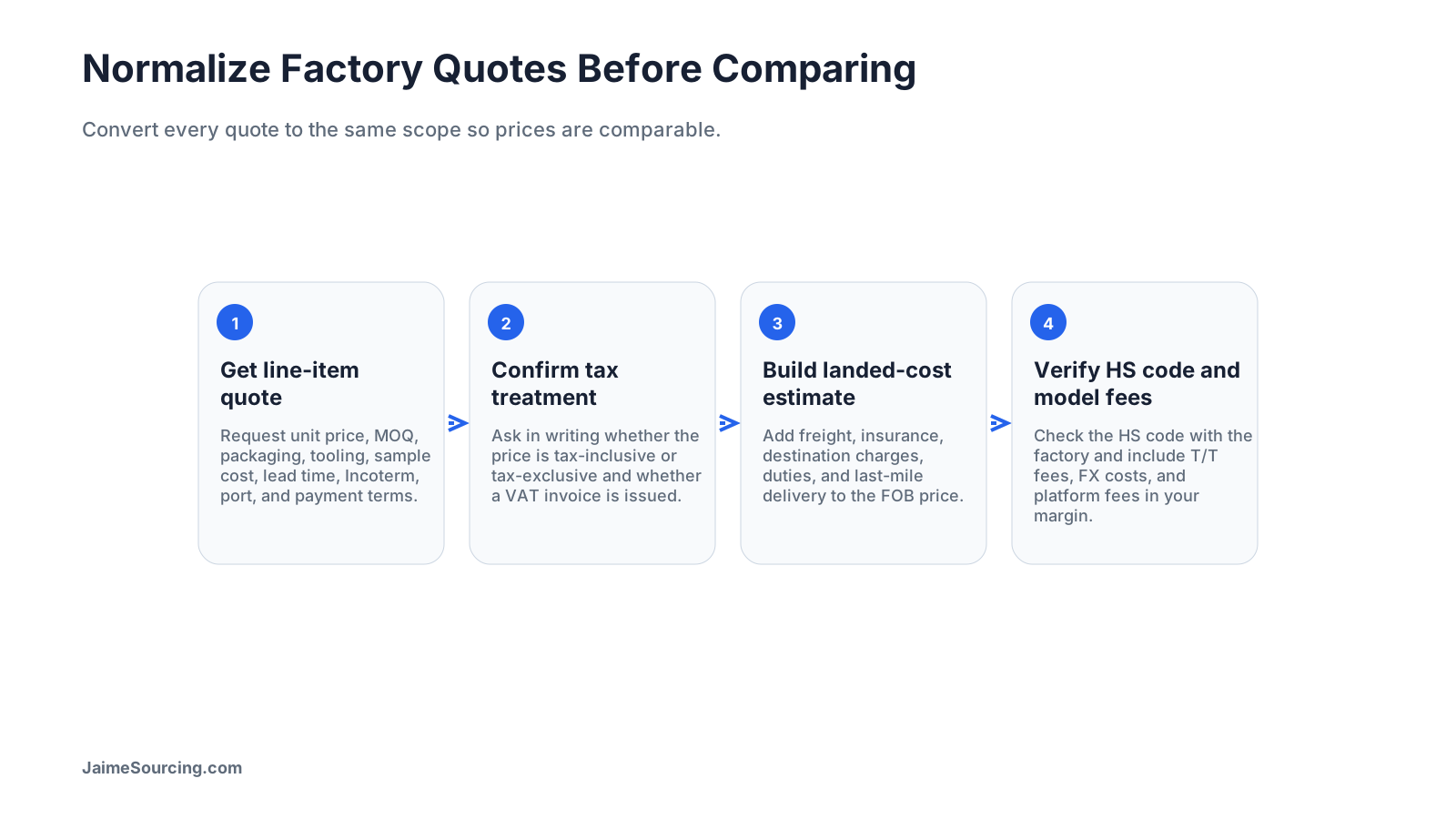
To compare suppliers fairly, convert every quote to the same basis:
- Request a line-item quote in a template: unit price, MOQ, packaging, tooling, sample cost, lead time, Incoterm, port, and payment terms.
- Ask for the tax treatment in writing — tax-inclusive or tax-exclusive, and whether a VAT invoice is issued.
- Convert to a landed-cost estimate by adding freight, insurance, destination charges, duties and last-mile delivery to the FOB price.
- Confirm the HS code with the factory and cross-check it against your destination customs tariff.
- Model payment costs — T/T fees, FX and any platform fees — into your margin.
For Shopify sellers, tax-inclusive pricing on your storefront is a separate issue from the factory’s tax treatment. Shopify supports tax-inclusive pricing by market, and the tax portion is calculated with the formula tax = (rate × price) / (1 + rate). Do not confuse your retail tax display with the factory’s Chinese VAT position.
Supplier verification before you pay a deposit
A quotation is only as reliable as the entity behind it. Before you send a deposit, verify the supplier’s legal identity.
Use the Chinese National Enterprise Credit Information Publicity System to check the company’s registration status, Unified Social Credit Code and business scope. Commercial databases such as Tianyancha and Qichacha add useful context: establishment date, registered capital, subscribed versus paid-in capital, shareholder structure and any administrative penalties. Registered capital is a subscribed figure, not cash in the bank; paid-in capital tells you how much has actually been contributed. A long establishment date and a business scope that matches the product are reassuring signals, but they do not replace a factory audit or sample testing.
Also confirm whether you are dealing with a trading company or a manufacturer. Trading companies can be perfectly legitimate, but their quotation structure and QC control differ from a factory’s.
Quality control: what the quote should say about AQL
Most factory quotes are silent on quality. That silence is a cost. Agree on an inspection standard before production.
A common approach is AQL sampling under ISO 2859-1 / ANSI/ASQ Z1.4, General Inspection Level II. Defects are classified as Critical, Major and Minor. A frequently used example is Critical 0, Major 2.5, Minor 4.0 — but this is an example, not a universal rule. Critical defects are safety or regulatory issues and should normally be zero-tolerance; Major defects affect function or saleability; Minor defects are cosmetic. Agree the classification and sample size in writing, and specify who pays for inspection.
What to Verify Before You Proceed
- Quote scope: Confirm Incoterm, port, tax treatment, packaging, tooling and sample costs in writing.
- Supplier identity: Check the Unified Social Credit Code, establishment date, registered versus paid-in capital and business scope on the National Enterprise Credit Information Publicity System, Tianyancha or Qichacha.
- Customs and tax: Verify the HS code and current de minimis and duty rules for your destination country with official sources.
- Payment: Confirm T/T terms, bank fees, FX responsibility and whether payment goes to a corporate account.
- Quality: Agree the AQL standard, defect definitions and inspection responsibility before production.
FAQ
What is usually included in a China factory quotation?
A factory quotation usually includes the product, basic packaging and the factory’s margin, plus the responsibilities defined by the Incoterm. Under FOB, it also includes inland transport and export clearance; under EXW, it does not. Freight, insurance, duties and inspection are typically excluded unless stated.
Is a tax-inclusive factory price better for overseas buyers?
Not necessarily. A tax-inclusive price includes Chinese VAT and usually means a VAT invoice is issued, while a tax-exclusive price does not. Export buyers often prefer tax-exclusive pricing, but the right choice depends on your supplier’s compliance and your documentation needs.
Why is DDP sometimes riskier than FOB?
DDP shifts customs responsibility to the seller, which is convenient but can hide under-declaration or misclassification. If the seller lacks knowledge of your country’s rules, shipments can be delayed or penalised. FOB keeps customs responsibility with you, which is more transparent.
How do I compare quotes from different factories?
Normalise every quote to the same Incoterm and tax basis, then add freight, insurance, destination charges and duties to estimate landed cost. Request line-item quotes and confirm the HS code before comparing unit prices.
Managing distance, quality drift and follow-ups
The real risk in China sourcing is not the headline unit price — it is what happens between the deposit and the delivery. Quality drift, missed follow-ups and time-zone friction are where margins disappear. A quotation that looks clean can still hide tooling delays, packaging changes or inspection failures.
Jaime Sourcing acts as your ground team in China, supporting supplier research, verification, inspection, quality control, consolidation, packing and shipment coordination. If you want a second pair of eyes on a factory quote or a workflow review before you place your next order, talk to Jaime Sourcing and let us help you verify the supplier and the scope behind the number.
Turn your product and order requirements into a controlled sourcing brief.
Share the product, supplier link, quantity, destination and current order stage. We will identify the practical verification, quality-control, packing and shipping steps.