If a new China supplier pushes you to pay a personal account over WeChat, refuses a video walkthrough of the factory floor, or sends an invoice from a domain that differs by one letter from their website, treat the deal as unverified until you have independently confirmed the company. The most reliable China supplier scam red flags in WeChat, WhatsApp and email conversations are not dramatic—they are small inconsistencies in identity, payment routing and communication behavior that appear before money moves. This guide explains what to look for, how to test each signal, and where the real operational risk sits for a Shopify reseller placing a first or repeat order.
Why chat apps and email are the highest-risk channels
Chat apps compress trust. A WeChat or WhatsApp conversation feels personal and fast, which is exactly why fraudsters use it. The platform itself is not the problem—identity on these channels is easy to fake and hard to verify.
A documented case shows how far this can go. Hong Kong police reported a crypto OTC company that lost more than HK$4 million after fraudsters hijacked an employee’s WhatsApp account, blocked the real client group, and recreated a near-identical group using copied names, avatars and chat history to issue a fake transfer instruction. The employee only caught the problem when a balance check failed and a phone call to the real client confirmed no instruction had been given. Over a two-week period, Hong Kong police recorded more than 150 reports of messaging-account hijacking with combined losses above HK$15 million.
You are not trading crypto, but the lesson transfers directly. The attack worked because the victim relied on a single channel, skipped independent verification, and trusted a reconstructed identity. For product sourcing, the equivalent risk is paying a deposit to an account that belongs to a fraudster impersonating your supplier—or to a “supplier” who never had a factory at all.
The red flags to watch for in each channel
WeChat red flags
- Personal account only, no company presence. A legitimate trading company or factory will usually have a business license and a verifiable company name. If the contact cannot or will not share a Unified Social Credit Code, slow down.
- Refusal to move to a traceable channel. Insisting that all negotiation, quotes and payment instructions stay in WeChat—and resisting email or a signed contract—removes your paper trail.
- Profile inconsistencies. A brand-new account, generic avatar, no Moments history, or a display name that does not match the company name on the quote.
- Pressure and urgency. “Price valid today only,” “deposit needed before the factory slot closes,” or repeated voice notes instead of written terms are classic pressure tactics.
WhatsApp red flags
- A number that changes. The supplier’s WhatsApp number differs from the one on their website, invoice or Alibaba profile, with an explanation like “my work phone is broken.”
- Group chat instructions. Payment or bank-detail changes delivered inside a group chat, especially where the group was recently created or membership shifted. This mirrors the hijack pattern reported in Hong Kong.
- Voice-only confirmations. Fraudsters prefer voice because it leaves no written record and is harder to compare later.
- Bank details sent as an image. Screenshots of bank cards or account details are easy to alter and hard to audit.
Email red flags
- Lookalike domains.
supplier-name.comversussupplier-name.cnor a single swapped letter. Check the full header, not just the display name. - Free email for a “factory.” A Gmail, Outlook or QQ address is not automatically fraudulent, but a factory claiming years of export experience should have a company domain.
- Bank-detail change emails. Any mid-order message saying “our account has changed, please remit to this new account” is the single most common business email compromise pattern. Verify by phone using a number you already had—never a number supplied in the suspicious email.
- Reply-to mismatch. The “From” address is the supplier, but replies route to a different address.
A practical verification workflow before you pay
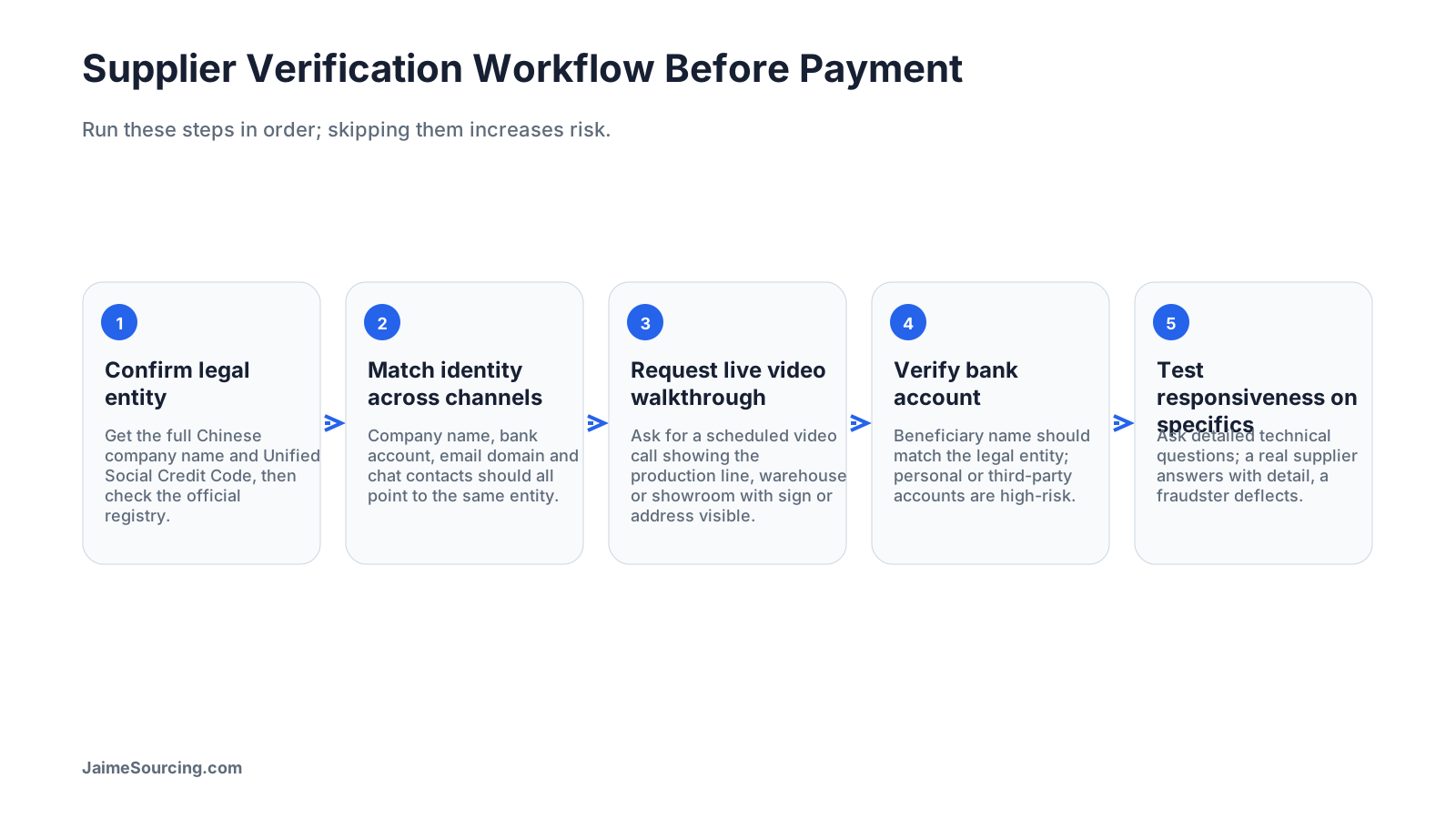
Run these steps in order. Each one is cheap; skipping them is not.
- Confirm the legal entity. Ask for the full Chinese company name and Unified Social Credit Code. Check it in the Chinese National Enterprise Credit Information Publicity System (the official registry). Cross-check with Tianyancha or Qichacha for a faster read on registration history.
- Read the registry data correctly. Registered capital is a subscribed figure, not cash in the bank. Look at whether subscribed and paid-in capital differ, when the company was established, whether its registered scope covers your product category, and whether it hasabnormal (abnormal) operating listings or frequent legal disputes. A company established last year with minimal paid-in capital and a scope that does not mention your product deserves questions.
- Match identity across channels. The company name on the business license, the bank account name, the email domain and the WeChat/WhatsApp contact should all point to the same entity. A mismatch is not always fraud, but it must be explained in writing.
- Request a live video walkthrough. Ask for a scheduled video call showing the production line, warehouse or showroom, with the company sign or address visible. Pre-recorded clips prove nothing.
- Verify the bank account. The beneficiary name should match the legal entity. Payments to a personal account, a third-party name, or a Hong Kong account with no stated relationship to the factory are high-risk.
- Test responsiveness on specifics. Ask technical questions about materials, tolerances, packaging or lead time. A real supplier answers with detail; a fraudster deflects or copies generic text.
Payment, contract and logistics signals that separate professionals from risks
Communication red flags often show up in how a supplier handles money and terms.
| Signal | Lower-risk behavior | Higher-risk behavior |
|---|---|---|
| Bank account name | Matches the legal entity on the license | Personal name, third party, or unexplained offshore account |
| Payment terms | Written T/T split (e.g., deposit and balance against inspection) | 100% upfront, or pressure to pay before any contract |
| Contract | Signed PI or sales contract with company chop | WhatsApp messages only, no written terms |
| Incoterm | Clear EXW, FOB or DDP with named port | Vague “door-to-door” with no customs explanation |
| Bank fees | Stated who pays sending/receiving fees | Fees silently deducted from your payment |
| Sample payment | Sample and freight costs itemized | Sample fee demanded with no refund policy stated |
On payment mechanics for overseas buyers paying Chinese suppliers: T/T is standard, but confirm whether fees are shared (OUR/SHA/BEN), because bank charges and FX conversion can quietly reduce the amount the factory receives and trigger a “short payment” dispute. Trade Assurance on platforms adds a fee and a dispute process—useful for small first orders, but it does not replace entity verification. On shipping, EXW leaves origin charges and export clearance with you; FOB puts origin charges on the supplier up to the named port; DDP means the supplier handles delivery and duty, but non-compliant “tax-inclusive” DDP arrangements can create customs and liability problems. Confirm the Incoterm and who is the importer of record in writing.
For quality control, agree on an inspection standard before production. AQL sampling under ISO 2859-1 / ANSI/ASQ Z1.4, General Inspection Level II, is the common baseline. Critical, Major and Minor defects should be defined in your spec—Critical 0 / Major 2.5 / Minor 4.0 is a common starting example, not a universal rule, and should be adjusted to your product’s risk.
What to Verify Before You Proceed
- Legal identity: full company name, Unified Social Credit Code, establishment date, registered vs. paid-in capital, and registered business scope—checked in the official registry and cross-checked in Tianyancha or Qichacha.
- Channel consistency: email domain, WeChat/WhatsApp number, business license and bank beneficiary all point to the same entity.
- Bank details: verified by phone using a number you already held, never a number from a suspicious email or chat message.
- Factory reality: live video walkthrough or third-party inspection confirming the site exists and matches the claimed capability.
- Written terms: signed PI or contract covering price, Incoterm, payment split, inspection standard and defect definitions.
- Sample and deposit trail: itemized sample costs, refund policy, and a payment route that matches the contract.
FAQ
What is the biggest China supplier scam red flag in chat apps?
The biggest red flag is a request to pay a personal or third-party bank account that does not match the supplier’s legal company name. Legitimate suppliers invoice from the entity on their business license. A mismatch is sometimes explainable, but it must be documented and independently verified before any deposit leaves your account.
Can a supplier be legitimate if they only use WeChat?
Yes, many genuine suppliers prefer WeChat for daily communication, but legitimacy requires verifiable identity beyond the app. Ask for the business license, check the company in the official registry, and insist on email or a signed contract for quotes and payment terms. A supplier who refuses any traceable channel is the one to worry about.
How do I check a Chinese supplier’s company registration?
Ask for the full Chinese company name and Unified Social Credit Code, then look it up in the Chinese National Enterprise Credit Information Publicity System. Tianyancha and Qichacha offer faster cross-checks. Review establishment date, registered versus paid-in capital, business scope and any abnormal operating or legal records before proceeding.
What should I do if a supplier emails new bank details mid-order?
Stop and verify by phone using a contact number you already had—never a number from the email. Bank-detail change requests are a common fraud pattern. Confirm directly with a known contact, and if the change is genuine, get it confirmed in a signed document before remitting any funds.
Is DDP always safer for a small buyer?
DDP can simplify delivery, but non-compliant “tax-inclusive” DDP arrangements can create customs and liability exposure. Confirm who is the importer of record, how duty and tax are declared, and get the Incoterm in writing. For first orders, FOB with a clear freight quote is often easier to audit.
Manage the distance, not just the paperwork
Verification catches the obvious frauds, but most losses for small ecommerce brands come from quieter problems: quality drift between the sample and mass production, unanswered follow-ups during peak season, and the time-zone gap that turns a two-day fix into a two-week delay. Those risks are managed on the ground—with factory visits, inspection scheduling and someone who can physically stand at the loading dock.
Jaime Sourcing supports overseas buyers with supplier research, verification, inspection, quality control, consolidation, packing and shipment coordination. If you are about to place a first order or want a second opinion on a supplier’s chat behavior, talk to Jaime Sourcing for a supplier check or a workflow review before your deposit goes out.
Turn your product and order requirements into a controlled sourcing brief.
Share the product, supplier link, quantity, destination and current order stage. We will identify the practical verification, quality-control, packing and shipping steps.