
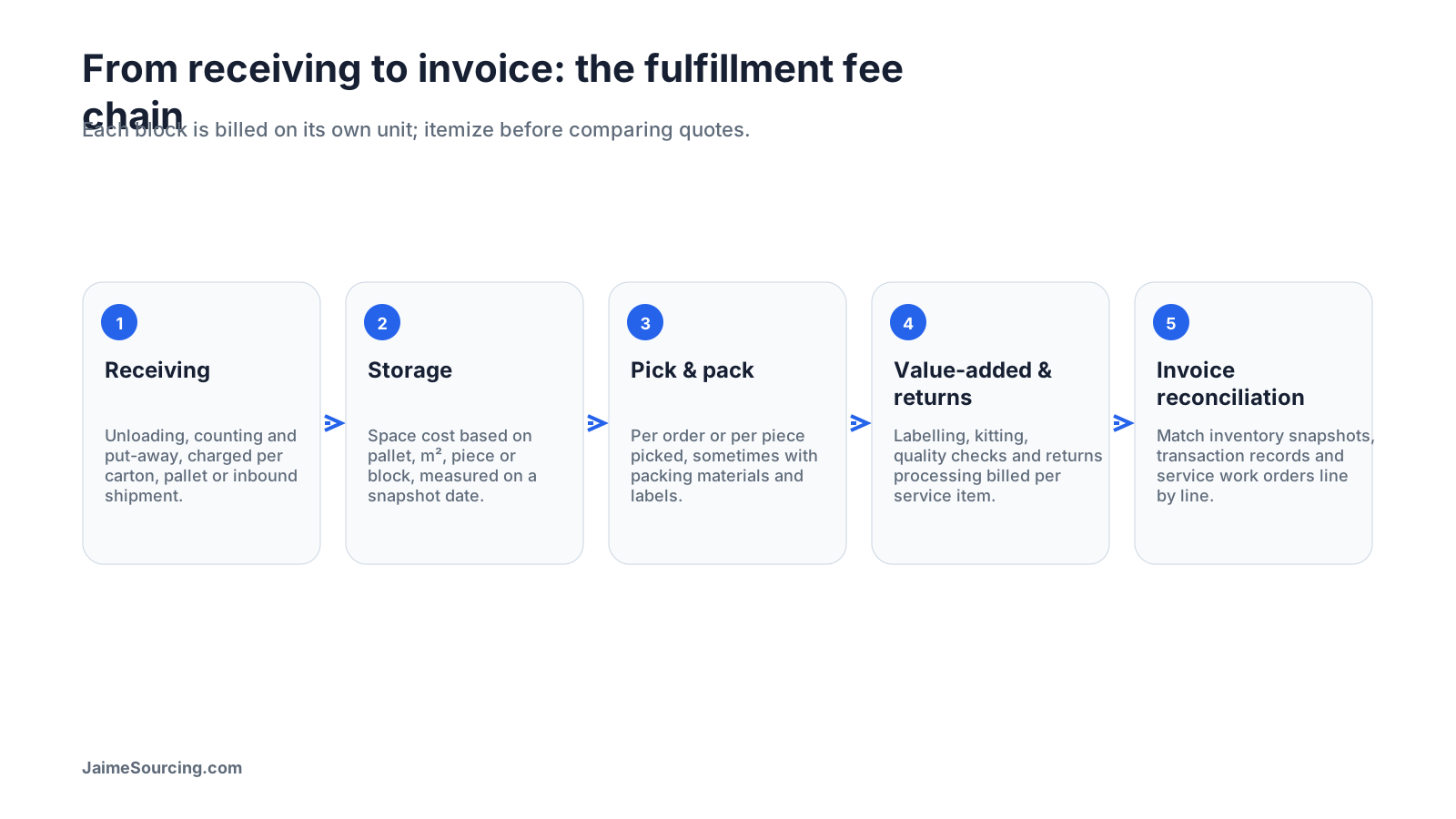
If you are a Shopify reseller using a China warehouse, the number that matters is not the headline storage rate — it is the total of receiving, storage, pick and pack, and value-added charges, each billed on its own unit. A warehouse storage fee is the payment a cargo owner makes for space and warehousing labor, and it is normally built from three blocks: space rental, handling/operations, and value-added services, with the billing model and unit prices set by the contract. Most invoice disputes come from unclear definitions rather than from high prices: the buyer assumes “storage fee” means rent only, while the bill also contains handling and value-added charges, and the billing unit (per pallet or per piece) was never written into the contract. Before you compare quotes, get every line itemised on the same unit.
The four billing models you will be quoted
Warehouses price space in different ways depending on your product type and turnover. The table below summarises the common models and where each fits.
| Billing model | How it is calculated | Typical fit |
|---|---|---|
| Per pallet | Rate per pallet per day or per month, summed across pallets in stock | Standard palletised goods |
| Per square metre | Occupied area × rate per m² | Oversized, irregular or dedicated storage areas |
| Per piece | Rate per piece in stock, or per piece in/out | Small-piece, ecommerce pick-and-pack |
| Whole-warehouse / block | Fixed monthly fee for a whole warehouse or fixed zone | Stable volume, long-term cooperation |
Mixed models are common: rent charged per pallet or as a block, handling charged per piece, and value-added services charged per occurrence. With a mixed model, write each fee’s billing unit, billing trigger and unit price separately into the contract, so the month-end total can be checked line by line rather than arriving as one opaque number.
What sits inside the fee: three cost blocks
Space rental. The cost of occupying warehouse resources, calculated per pallet, per square metre, or as a block fee. It reflects space, not labor.
Handling and operations. Inbound unloading, put-away, picking, checking, packing and loading are charged per occurrence or per piece and reflect labor and equipment input. For a Shopify seller, this block usually grows fastest, because it scales with order count rather than with inventory.
Value-added services. Labelling, kitting, quality checks and returns processing are charged per service item. Warehouses may also bill consumables (cartons, tape, dunnage) and returns handling as miscellaneous lines — all of which should appear as individual items on the contract’s fee schedule.
Breaking the fee into these blocks is useful in both directions. A high rent share suggests slow turnover; a high handling share suggests complex operations or heavy value-added work. Either signal tells you where to negotiate.
Why two quotes for the same goods differ so much
Identical cartons can produce very different quotes. The main variables are product type and storage requirements (irregular shapes, temperature zones or high-density storage cost more), turnover rate (fast-moving goods spread unit cost thin, while slow movers occupy space and warehouses often apply age-based surcharges or negotiate higher unit rates), seasonal peaks (peak-season congestion risk gets priced in), and service level (tighter time commitments, more frequent stock counts and reverse logistics all raise the fee).
This is why you cannot compare a per-pallet quote against a per-piece quote at face value. Convert your forecast volume into the same unit before comparing, and ask each warehouse to quote the same service scope.
Receiving, storage and pick and pack: what each line should contain
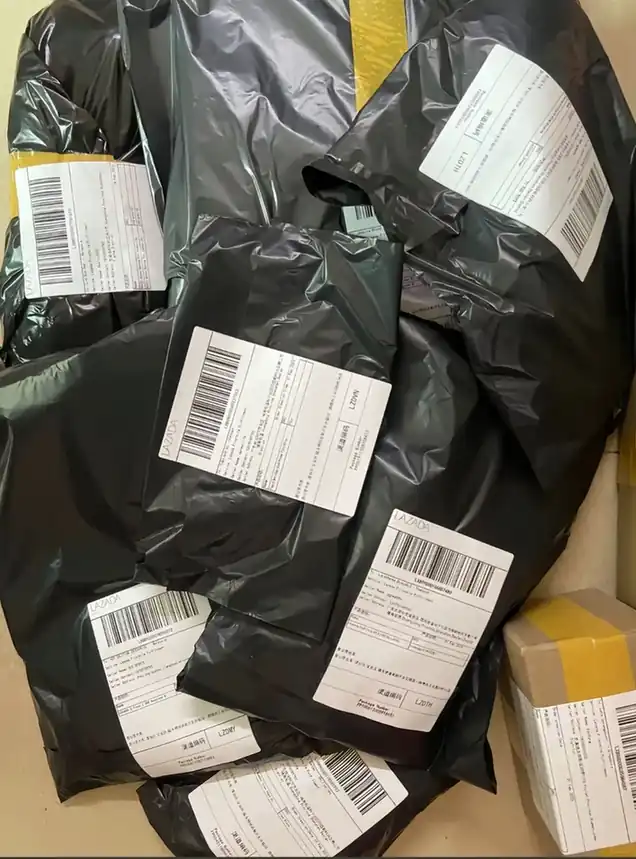
Receiving. Expect charges for unloading, counting and put-away. Ask whether the fee is per carton, per pallet or per inbound shipment, and whether it changes when a supplier delivers without an advance shipping notice or with mismatched carton labels. Those exceptions are where receiving costs quietly multiply.
Storage. Confirm the billing unit (pallet, m², piece or block), the snapshot date used to measure inventory, and whether seasonal or age-based rates apply. If the warehouse bills on a daily inventory snapshot, your storage cost is a direct function of how long goods sit — which links straight back to your reorder discipline.
Pick and pack. Typically charged per order or per piece picked, sometimes with separate lines for packing materials and label application. Ask for the definition of an “order” (single-SKU versus multi-line) and whether a minimum charge applies to low-volume days.
Value-added and returns. Labelling, kitting, quality checks and returns processing are billed per service item. If you handle returns through the China warehouse, get the returns workflow and its fee defined in writing before the first return arrives.
For context on how marketplace warehouses structure the same categories, Amazon FBA separates fulfillment fees (charged per unit by size tier and weight), monthly inventory storage fees (charged by cubic volume, with peak-season rates from October to December), long-term storage fees on inventory held beyond 365 days, removal/disposal fees, and returns processing fees for certain categories. Third-party platforms follow similar logic: storage priced per cubic foot per day, with higher peak-season rates and long-term storage surcharges on aged units. You do not need to match these structures, but they are a useful checklist for spotting a missing line in a China 3PL quote.
Reconciling the invoice: the three data sets you need
Reconciliation rests on traceable billing data, and there are three sets:
- Inventory snapshots — how many pallets or pieces were in stock on the billing date. These drive rent.
- Transaction records — how many inbound and outbound orders and pieces moved on each day. These drive handling.
- Service work orders — evidence for each value-added charge.
If all three can be tied back to business documents, the bill can be checked line by line. The common discrepancies are billed quantities that do not match operational records, unit prices that differ from the contract, and fee items with no corresponding service record — align those three categories and most disputes resolve on the spot.
Ask your warehouse for a sample invoice and the underlying reports before you sign. If they cannot produce a per-SKU inventory report and a per-order handling report, you will be reconciling from memory.
Total cost: how the warehouse line fits your landed cost
Warehouse fees are one layer of landed cost, and they interact with your Incoterms. Under EXW, your costs and risk start at the supplier’s premises, so you carry origin handling and export clearance. Under FOB, the supplier delivers to the named port and handles export clearance, while you carry main freight, insurance and destination charges. Under DDP, the seller quotes a delivered price including duty — and this is where non-compliant “tax-inclusive” arrangements appear: a low DDP quote may rely on under-declared values or informal clearance channels, leaving you exposed to customs queries, seized goods or unexpected duty bills in your destination jurisdiction. Confirm who is the importer of record and check the current official customs rule for your destination country before accepting any all-in DDP number.
On payment mechanics, overseas buyers paying Chinese suppliers typically use T/T with a deposit and balance against inspection or shipping documents. Budget for bank charges at both ends, note that FX exposure sits with whoever bears the conversion, and check whether any platform Trade Assurance fee applies. Pay the company account named on the business licence rather than a personal account, and agree in advance who absorbs sample-payment fees — small amounts, but they recur on every new supplier.
Supplier and warehouse checks before you commit
When you verify the trading company or warehouse operator behind a quote, use the Chinese National Enterprise Credit Information Publicity System, Tianyancha or Qichacha. Read four fields carefully:
- Unified Social Credit Code — the identifier that ties the licence to the entity; confirm it matches the name on your contract and bank details.
- Registered capital — a registration figure, not cash in the bank. Do not treat it as a proxy for capability.
- Subscribed versus paid-in capital — subscribed is what shareholders committed to contribute; paid-in is what has actually been contributed. A large gap is worth a question, not an automatic rejection.
- Establishment date — a very young entity handling your inventory deserves more documentary checks.
For quality control on goods moving through the warehouse, agree an inspection plan using ISO 2859-1 / ANSI/ASQ Z1.4 at General Inspection Level II, with defects classified as Critical, Major and Minor. Critical 0 / Major 2.5 / Minor 4.0 is a common starting example, not a universal rule — set the AQLs against your product’s risk and your customer’s tolerance, and write them into the inspection brief.
What to Verify Before You Proceed
- Fee schedule in writing. Every line — receiving, storage, pick and pack, value-added, consumables, returns — with its billing unit, billing trigger and unit price.
- Billing data access. Confirm you will receive per-SKU inventory snapshots and per-order handling reports, not just a monthly total.
- Seasonal and age rules. Ask explicitly whether peak-season rates or long-term storage surcharges apply, and from which date.
- Entity and bank match. Verify the Unified Social Credit Code, registered versus paid-in capital, and establishment date via the National Enterprise Credit Information Publicity System, Tianyancha or Qichacha; pay only the corporate account.
- Incoterm and importer of record. Confirm EXW, FOB or DDP in writing, identify who clears customs, and check the current official rule in your destination market before accepting a “tax-inclusive” DDP quote.
- Inspection standard. Agree AQL levels, defect definitions and who pays for re-inspection before the first batch arrives at the warehouse.
FAQ
What is usually included in a China warehouse fulfillment fee?
A China warehouse fulfillment fee normally combines space rental, handling and operations (receiving, put-away, picking, packing, loading), and value-added services such as labelling, kitting and returns processing, with consumables billed separately. The billing model and unit prices are set by contract, so ask for each line itemised rather than a single blended rate.
Is the storage fee the same as rent?
No. Rent covers only the space occupied, while the full storage charge usually also includes inbound and outbound handling and value-added services. Confirm each item at signing, because treating rent as the whole fee is one of the most common sources of invoice disputes.
Is per-pallet or per-piece billing cheaper?
It depends on the goods. Palletised standard products are clearer to bill per pallet, while small-piece, break-bulk ecommerce stock is fairer per piece. Convert your forecast volume into the same unit before comparing quotes — comparing headline unit prices across different models tells you nothing.
Why do warehouse rates rise in peak season?
Peak-season warehouse capacity is tight, and congestion risk plus temporary labor costs get reflected in pricing; some contracts use peak-season rates or age-based surcharge clauses. Confirm the seasonal rate rules at signing so the increase is not a surprise.
What data do I need to reconcile a warehouse bill?
Three sets: daily inventory snapshots (for rent), inbound and outbound transaction records (for handling), and service work orders (for value-added charges). When all three tie back to business documents, most billing discrepancies can be resolved line by line.
Managing the distance, not just the invoice
Fee schedules are the easy part. The harder risks are quality drift between the first approved sample and the fifth production run, factory follow-ups that stall when nobody is physically present, and the time-zone and language friction that turns a two-day fix into a two-week one. A warehouse in China does not solve any of that for you — it only stores what your suppliers ship.
Jaime Sourcing works as your ground team in China, covering supplier research and verification, inspection and quality control, consolidation, packing and shipment coordination. If you are evaluating a China warehouse quote or want a second pair of eyes on a supplier before you commit inventory, talk to Jaime Sourcing about a supplier check or a workflow review. </ARTICLE_TO_EDIT>
Turn your product and order requirements into a controlled sourcing brief.
Share the product, supplier link, quantity, destination and current order stage. We will identify the practical verification, quality-control, packing and shipping steps.