Yes — a China-based warehouse or third-party logistics (3PL) provider can receive returned goods, inspect them, refurbish or repackage them, and restock the sellable units. The economics only work in specific scenarios, and the process is less “one-click” than most buyers assume. In practice, fewer than 30% of returned items can go straight back into stock without rework or repacking, and inspection alone typically runs $150–$350 per batch. For a Shopify reseller, the real question is not whether a China warehouse can do this, but whether it makes sense for your product, your return rate and your margin.
This guide breaks down the workflow, the cost structure, the verification steps and the risks — so you can decide before you commit inventory.
What a China Warehouse Can Actually Do With Returns
A capable China 3PL or returns partner typically offers a defined sequence: receive the return, log it against the original order, inspect it, classify it, then route it to resale, refurbishment, liquidation or disposal. The classification step is where most of the value — and most of the cost — sits.
Typical handling categories include:
- Unopened / as-new returns — inspected, relabelled if needed, restocked.
- Lightly damaged or repairable units — cleaned, repaired, repackaged, then restocked.
- Functional but cosmetically imperfect units — often routed to a secondary channel or sold as open-box.
- Faulty or unsellable units — liquidated, recycled or disposed of.
A well-run facility will photograph the item, record its condition and sync the result back to your inventory system via API or ERP integration so you don’t oversell stock that no longer exists. That data trail matters more than most buyers realise: without it, your storefront and your physical inventory drift apart.
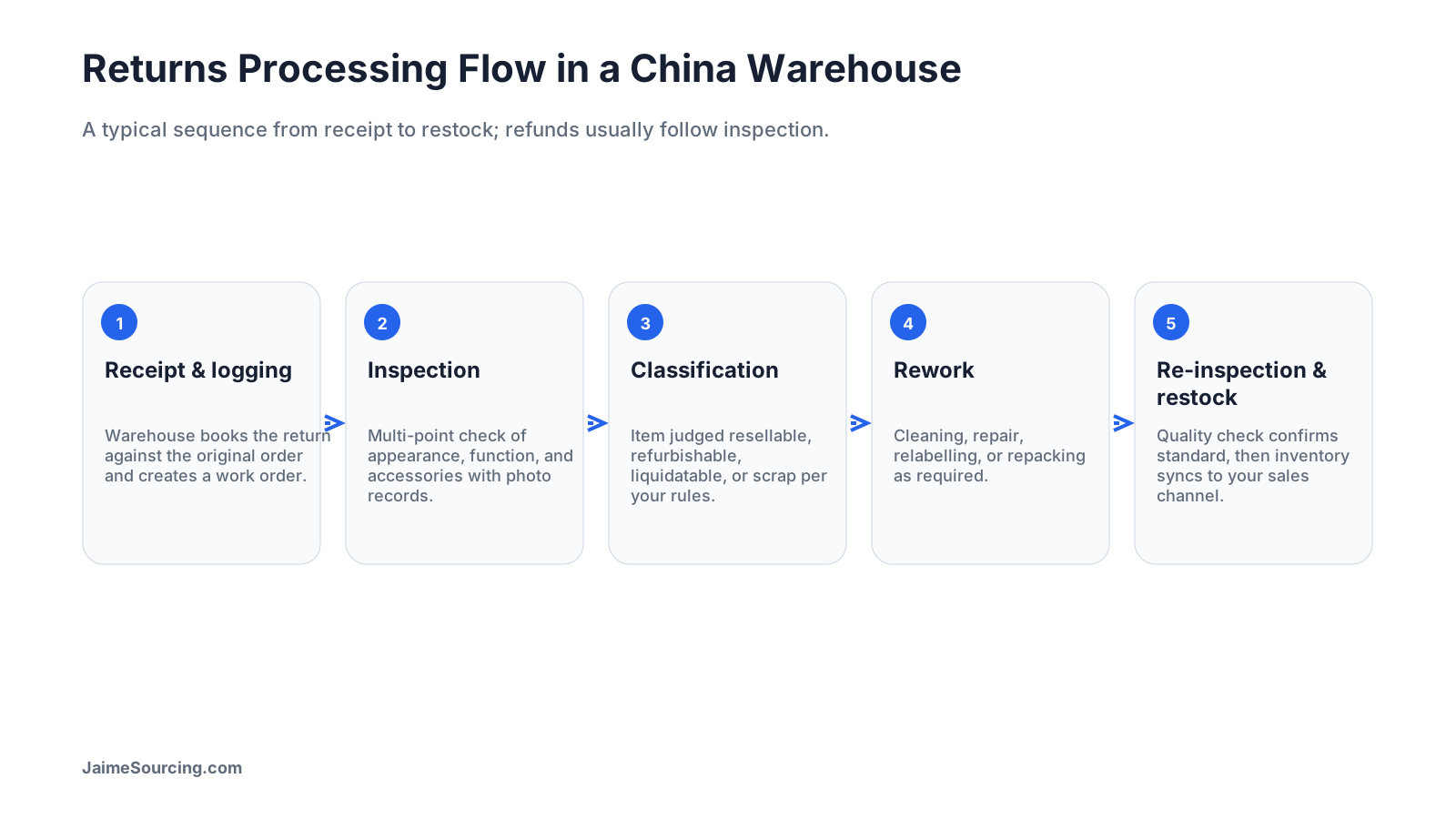
The Real Workflow: From Return Receipt to Restock
Understanding the sequence helps you set realistic timelines and avoid promising customers refunds you can’t yet fund.
- Receipt and logging. The warehouse books the return against the original order and generates a work order.
- Inspection. Multi-point checks cover appearance, function and accessories, with photo records for traceability.
- Classification. The item is judged resellable, refurbishable, liquidatable or scrap.
- Rework. Cleaning, repair, replacement of parts, relabelling and repacking as required.
- Re-inspection. A second quality check confirms the item meets your resale standard.
- Restock and sync. Inventory is updated in your WMS/ERP and pushed to your sales channel.
Refunds typically follow inspection, not receipt. One source puts refund processing at 3–10 business days after a passed inspection, with inspection itself taking 1–3 business days after arrival. Treat those as planning figures, not guarantees — they depend on the provider, the batch size and documentation quality.
The Cost Structure You Need to Model
Returns processing is a cost centre, and the fees stack up quickly. The table below summarises the figures cited in the research; confirm current rates directly with any provider before budgeting.
| Cost item | Typical range cited | Notes |
|---|---|---|
| Return inspection (per batch) | $150–$350 | Required before any restocking |
| Restocking / handling fee | 5%–20% of item value | Covers labour, storage and re-inventorying |
| Rework / repacking | Charged per unit or per hour | Varies by provider and complexity |
| Payment transaction fees | ~2%–5% | Applies to refunds via payment providers |
| Currency conversion loss | Variable | Relevant for cross-border refunds |
Two things stand out. First, inspection is a fixed cost per batch — so consolidating returns into fewer, larger batches improves your unit economics. Second, the restocking fee is a percentage of item value, which means high-ticket products carry proportionally higher handling costs. Model both against your average selling price before assuming returns processing is “cheap because it’s in China.”
Compare this against processing returns in your destination market. Overseas warehouses exist precisely to shorten the last-mile and handle returns locally, and local processing avoids the international freight of shipping a returned item back to China. For low-value items, the round-trip freight alone can exceed the product’s value — in which case local liquidation or disposal is usually the rational choice.
China Warehouse vs. Overseas Warehouse Returns: Which Fits?
The decision hinges on product value, return rate and where your customers are.
| Factor | China-based returns processing | Overseas (destination-market) warehouse |
|---|---|---|
| Freight to process a return | International round-trip | Local/domestic only |
| Best suited to | High-value, repairable, low-volume returns | High-volume, low-value, fast-turnaround returns |
| Refurbishment depth | Often deeper (access to component suppliers) | Usually lighter (clean, repack, relabel) |
| Restock speed to customer | Slow (weeks) | Fast (days) |
| Cost predictability | Batch-based inspection fees | Per-unit handling fees |
Overseas warehouses are built for speed and local fulfilment, and many now offer returns handling, relabelling and repacking as value-added services. A European returns centre, for example, can complete inspection and classification within 24–48 hours and sync results to Shopify, Amazon or an ERP. That speed is hard to match from China.
The China option makes most sense when the returned item is high-value, repairable, and benefits from proximity to the original supplier or component ecosystem — or when you’re already consolidating a batch of returns for other reasons. For a $15 accessory with a 20% return rate, shipping it back to China rarely pencils out.
Setting Up the Workflow: Practical Steps
If you decide China-based returns processing is right for you, treat it like any other supplier relationship — with written standards and verification.
Define your disposition rules in writing. Specify, SKU by SKU, what counts as resellable, what triggers refurbishment, and what gets scrapped. Ambiguity here is where disputes and margin leakage begin.
Agree the inspection standard. For batch inspection, reference AQL sampling under ISO 2859-1 / ANSI/ASQ Z1.4 at General Inspection Level II, and distinguish Critical, Major and Minor defects. A common starting point is Critical 0 / Major 2.5 / Minor 4.0, but this is an example, not a universal rule — set limits that reflect your product’s risk and your customer’s expectations.
Require photo and data records. Insist on photographic evidence per unit and API/ERP sync so your storefront inventory reflects reality. Without this, you risk overselling restocked items that failed re-inspection.
Vet the provider like a factory. Use the Chinese National Enterprise Credit Information Publicity System, Tianyancha or Qichacha to check the legal entity. Look at the Unified Social Credit Code, establishment date, registered capital, and — critically — subscribed versus paid-in capital. A company with high registered capital but minimal paid-in capital may be thinly funded. Confirm the business scope actually covers warehousing and value-added logistics.
Clarify Incoterms and customs responsibility. If returns cross borders, understand who is the importer of record. Under EXW the buyer bears origin charges and export clearance; under FOB the seller handles origin and export; under DDP the seller covers delivery and import duties. Be wary of vague “tax-inclusive DDP” arrangements that may under-declare value — the compliance risk lands on you, the importer. Check the current official customs rule in your jurisdiction.
Handle payments carefully. For overseas buyers paying Chinese suppliers, agree T/T terms in writing, confirm who bears bank fees, and note FX exposure between order and settlement. Pay into corporate accounts, not personal ones, and clarify whether sample-payment fees are deducted from the bulk order. If using platform Trade Assurance, factor in its fees.
What to Verify Before You Proceed
- Legal identity and standing — cross-check the provider on the National Enterprise Credit Information Publicity System, Tianyancha or Qichacha; confirm paid-in capital and business scope.
- Written disposition rules — get SKU-level resale/refurbish/scrap criteria signed off before the first batch.
- Inspection standard — agree AQL levels (ISO 2859-1 / ANSI/ASQ Z1.4, General Inspection Level II) and defect definitions.
- Data integration — confirm API/ERP sync and photo records are included, not optional extras.
- Fee schedule — obtain inspection, restocking, rework and storage rates in writing; model them against your ASP.
- Customs and Incoterms — confirm importer of record and check current official rules for your destination market.
- Payment terms — corporate account, T/T terms, bank fee allocation and FX handling agreed upfront.
Frequently Asked Questions
Can a China warehouse restock returned items directly?
Only a minority of returns can be restocked without rework — under 30% by one estimate — so most need inspection, repacking or refurbishment first. Plan for a rework step rather than assuming direct restock.
How long does returns processing in China take?
Inspection typically takes 1–3 business days after arrival, with refunds processed 3–10 business days after a passed inspection. Documentation errors can add up to two weeks, so keep paperwork clean.
Is it cheaper to process returns in China or overseas?
It depends on product value and volume. Low-value, high-volume returns are usually cheaper to handle locally; high-value, repairable items may justify China processing despite international freight.
What should I check before choosing a China returns provider?
Verify the legal entity via official credit systems, confirm paid-in capital and business scope, and get disposition rules, AQL standards and fee schedules in writing before shipping any returns.
Manage the Distance, Not Just the Cost
Returns processing in China is workable, but it concentrates risk in three places: quality drift between batches, follow-up gaps when you’re not on the ground, and the physical and time-zone distance that turns a small inspection dispute into a weeks-long delay. A provider that inspects well on batch one may drift by batch five without someone checking.
That’s where having a ground team matters. Jaime Sourcing supports overseas buyers with supplier research, verification, inspection, quality control, consolidation, packing and shipment coordination — the operational follow-through that keeps a returns and restocking workflow honest. If you’re weighing a China returns process or want a supplier check before you commit, talk to Jaime Sourcing about a workflow review.
Turn your product and order requirements into a controlled sourcing brief.
Share the product, supplier link, quantity, destination and current order stage. We will identify the practical verification, quality-control, packing and shipping steps.