If a Chinese supplier ships the wrong SKU or defective units, freeze the shipment’s condition and build a traceable evidence file before you touch, rework, resell or return anything. A dispute turns on whether you can connect a specific batch to a specific agreed standard, prove when the defect existed, and show you notified the supplier in writing within the applicable window. Buyers who skip that sequence often have a legitimate complaint but no recoverable claim.
This guide is written for overseas buyers and Shopify resellers, not for Chinese exporters. It covers what to capture, how to notify, which platform and legal clocks apply, and where the practical limits sit.
The Direct Answer: Preserve First, Negotiate Second
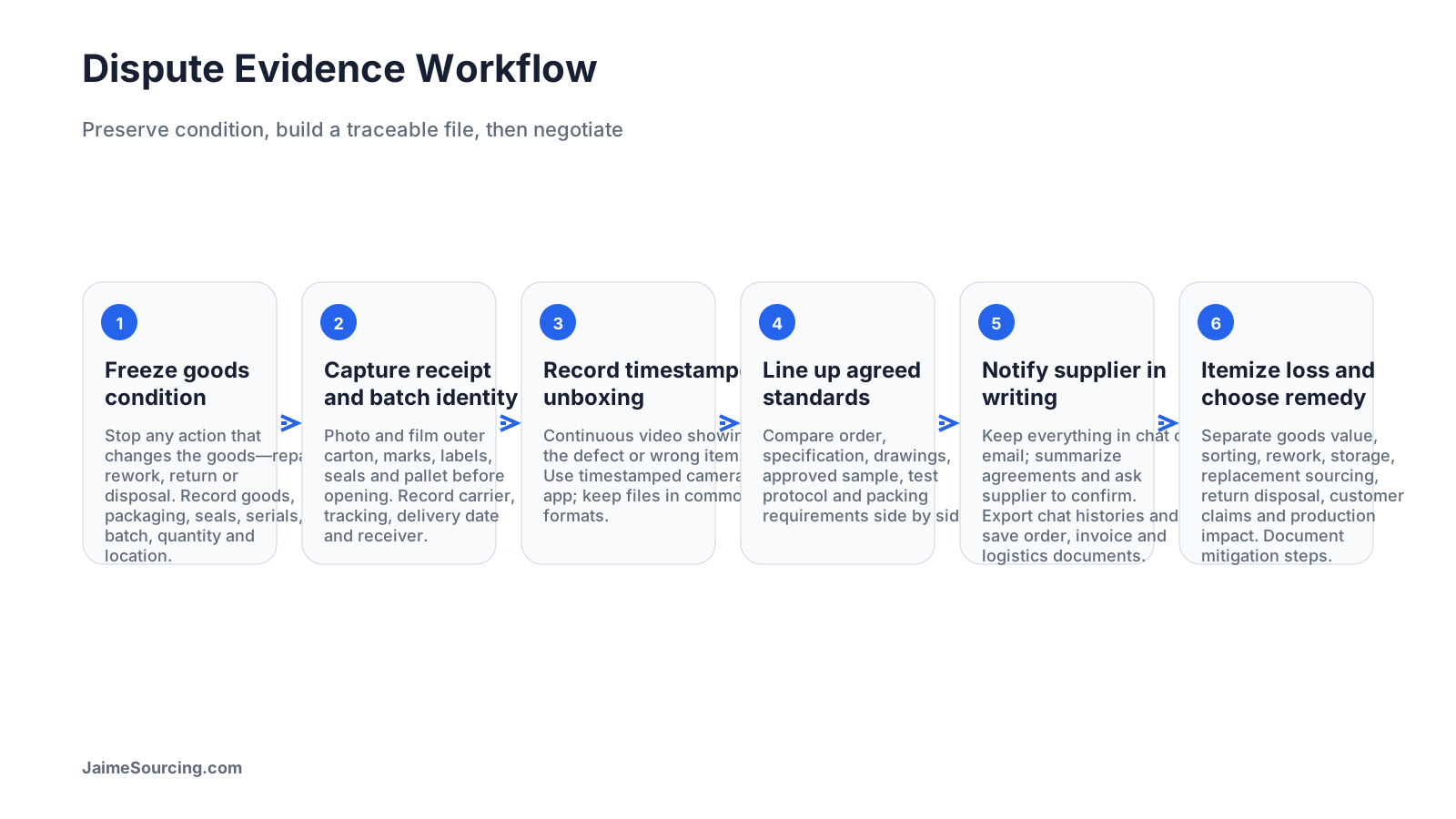
Treat a wrong-goods or defective-goods event as an evidence problem before it becomes a negotiation. Stop any action that changes the state of the goods—repair, rework, blending with other stock, return shipment or disposal—and record the goods, packaging, seals, serial numbers, batch codes, quantity, location and storage conditions. Then line up the order, technical specification, drawings, approved sample, test protocol and label/packing requirements side by side so each claim maps to a documented standard. Only after that should you decide between replacement, partial refund, price reduction, return or a formal claim.
Photos can show a problem exists, but they rarely prove who is responsible or how much is owed. A quality claim has to connect the agreed standard, the delivered condition, timely notice and a specific remedy.
Build the Evidence File: What to Capture and How
A defensible file has separate, timestamped layers. Missing any one of them is where most claims weaken.
Batch identity and receipt condition. Photograph and film the outer carton, shipping marks, labels, seal integrity and pallet condition before opening. Record the carrier, tracking number, delivery date and who received the goods. If goods arrive at a China fulfillment warehouse, capture the waybill, carton marks, counted quantity and receiving time in the same session.
Unboxing video. Record a continuous unboxing that clearly shows the defect or the wrong item. Use a timestamped camera or a timestamp app, and keep files in common formats such as JPG, PNG and MP4. Vague or untimestamped evidence is a leading reason refund requests fail.
Representative samples and controls. Keep defective units, known-good comparison units, the approved golden sample, packaging and original photos. Document how samples were drawn, stored and tested so the supplier cannot later dispute sample origin or method.
Test design. Decide the disputed question first—what defect, when it existed, what caused it—then choose sampling, the applicable standard, the lab and the retention method. Invite or at least notify the supplier so they can observe, which reduces later arguments about method.
Written communication. Keep everything in chat or email rather than phone calls, summarize each agreement in writing and ask the supplier to confirm, and export chat histories where the platform allows. Save order confirmations, invoices and logistics documents as PDFs.
Loss calculation. Itemize goods value, sorting and rework, storage, replacement sourcing, return disposal, customer claims and production impact separately, and record reasonable mitigation steps.
Know Which Clock You Are On
Four different time controls run at once, and confusing them is a common and expensive error: the contractual inspection period, the warranty period, the legal inspection-and-notice requirement, and the limitation period for suing or arbitrating.
Under the CISG, Article 39 sets an outer two-year notice period, but that is not a limitation period; where Chinese law applies, the limitation period for international sale contracts is generally assessed separately, commonly cited as four years. Under Chinese law, Civil Code Articles 620–624 require inspection within the agreed period, or promptly if none is agreed, and notice within a reasonable time after discovery. Absent an agreed inspection period, a buyer who gives no notice within two years of receipt generally faces the goods being treated as conforming, unless a quality warranty period applies or the supplier knew or should have known of the non-conformity.
Whether the CISG applies at all depends on the parties’ places of business, applicable-law rules, contract choice and any exclusion clause—China and many major trading nations are contracting states, but that does not settle it automatically. Check the governing law and dispute clause in your contract before assuming a framework.
Platform Disputes: Alibaba, 1688 and Fulfillment Services
Platform mechanics differ enough that the same evidence can succeed on one and fail on another.
| Channel | Typical dispute route | Evidence emphasis | Practical note |
|---|---|---|---|
| Alibaba (Trade Assurance) | Open dispute from the order page, state issue type, upload evidence, supplier responds, platform mediates | Timestamped photos/video, order records, chat logs | English-friendly; quality and delay are common dispute categories |
| 1688 | Chinese-language dispute console, detailed evidence required | Timestamped photos/video, clear documents | Often needs agent support and translation |
| Fulfillment/automation services | Ticket system inside the account | Clear timestamped evidence | Ticket-based handling, typically faster response |
Reported outcomes vary by source and case; treat any success-rate figure as indicative rather than a promise. What is consistent across channels is that incomplete or untimestamped evidence sharply reduces the chance of recovery. Full refunds are usually reserved for serious quality failures, missing items or lost parcels, while minor defects and delays more often settle as partial compensation. Returning goods to China is frequently uneconomic, so refunds or replacements are the more common resolution.
Supplier Checks Before You Escalate
Before you escalate, confirm who you are actually dealing with. Use the Chinese National Enterprise Credit Information Publicity System for the official registration record, and Tianyancha or Qichacha for cross-checks and related-entity history. Read the fields carefully:
- Unified Social Credit Code — the identifier that ties the contracting entity to the official record; confirm it matches your contract and bank beneficiary.
- Establishment date — a very recent entity trading under an established brand name deserves a follow-up question.
- Registered capital vs. subscribed vs. paid-in capital — registered capital is a registration figure, subscribed capital is what shareholders committed, and paid-in capital is what has actually been contributed. A high registered figure with low paid-in capital tells you little about ability to fund a claim.
- Business scope and status — check the entity is active and that the scope covers the goods you bought.
These checks do not prove quality, but they help you judge whether a dispute is a commercial negotiation or a recovery problem. Where a supplier takes payment and then fails to deliver, the line between breach of contract, civil fraud and criminal contract fraud turns on intent and its timing—for example, whether false capacity claims or fabricated shipping documents were used to induce further payment. Not every breach is a crime, and a signed contract does not by itself rule out deliberate fraud. That is a question for qualified China counsel, not a self-assessment.
What to Verify Before You Proceed
- Governing law and dispute clause. Confirm whether the CISG is excluded and which forum applies before drafting a claim.
- The quality benchmark. Separate contract specifications, approved samples, drawings, intended use and packing requirements; your internal standard does not automatically become the supplier’s obligation.
- Notice deadlines. List the contractual inspection period, warranty, statutory notice requirement and limitation period as separate dates.
- Causation. Rule out transport, storage, installation or use damage, and check whether you supplied design, material or process instructions the supplier may blame.
- Carrier and insurance notices. Do not miss them while focused only on the supplier.
- Entity identity. Match the Unified Social Credit Code on the contract to the official registry and the bank account.
- Payment trail. Keep T/T records, bank fees and FX details; pay the contracting entity rather than a personal account unless you have documented why.
FAQ
How long do I have to report defective goods from a Chinese supplier?
Notice must generally be given within the agreed inspection period, or promptly after discovery if none is agreed, and Chinese law commonly treats silence for two years from receipt as acceptance absent a warranty period. The CISG’s two-year outer notice period is separate from the limitation period for suing. Diarize every deadline at order placement, not at delivery.
Will photos alone win my Alibaba dispute?
Photos help but rarely decide a case alone; timestamped photos and video combined with order records and chat logs are what platforms weigh. Untimestamped or unclear evidence is a frequent reason claims fail. Pair visuals with the agreed specification and a written notice naming the batch.
Should I return defective goods to China?
Usually not, because return freight and re-import costs often exceed the goods value, so refunds or replacements are the more common outcome. If you must return, document condition, seals and quantities before handover. Get written agreement on who bears freight and duties first.
Does a third-party inspection report settle the dispute?
No. An inspection report is useful but does not automatically decide a case; its value depends on the standard used, the sampling method and whether the tested units are tied to the disputed batch. Share the test plan with the supplier in advance where possible. Keep retained samples.
What if the supplier simply took payment and never shipped?
That may be breach of contract, civil fraud or criminal contract fraud depending on intent and when it formed, including whether false capacity or shipping documents were used. Preserve all communications and payment records. Consult qualified China counsel before any criminal complaint.
Manage Quality Drift Before It Becomes a Dispute
Most wrong-goods and defect disputes are cheaper to prevent than to win. Quality drifts between the approved sample and mass production, follow-ups get missed across time zones, and physical distance means you often learn about a problem only when a carton lands at your door. A written specification, a pre-production sample sign-off, an agreed inspection standard such as ISO 2859-1 / ANSI/ASQ Z1.4 at General Inspection Level II with clearly defined Critical, Major and Minor defects, and a documented notice workflow all reduce the evidence gap you face later.
Jaime Sourcing acts as your ground team in China, supporting supplier research and verification, inspection and quality control, consolidation, packing and shipment coordination—so issues are caught and documented before they become disputes. If you are reviewing a supplier or tightening your QC and dispute workflow, talk to Jaime Sourcing about a supplier check or workflow review.
Turn your product and order requirements into a controlled sourcing brief.
Share the product, supplier link, quantity, destination and current order stage. We will identify the practical verification, quality-control, packing and shipping steps.