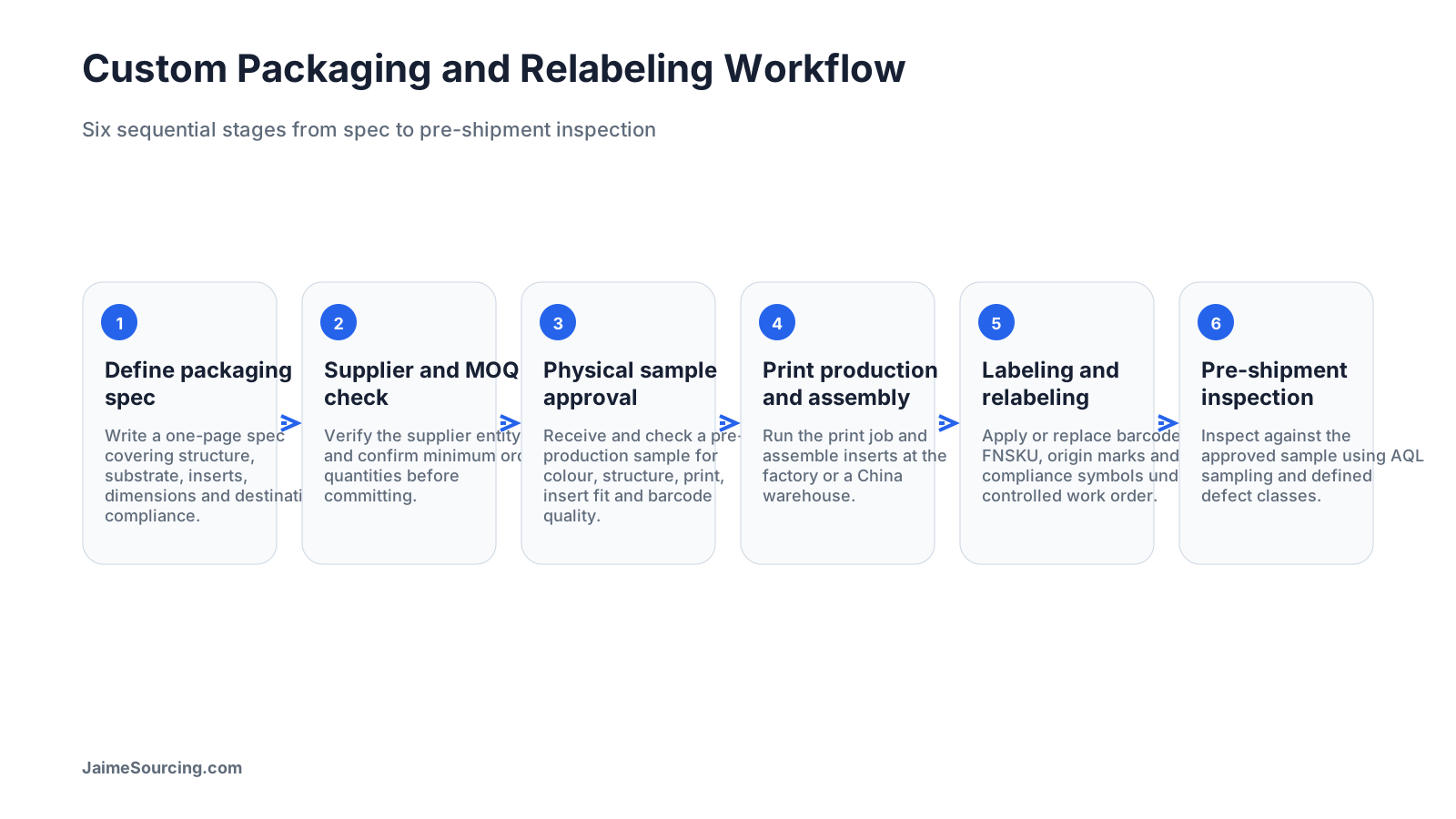
Custom packaging, inserts, labeling and relabeling in China fulfillment work as one sequence, not four separate purchases. You approve packaging and insert artwork, confirm physical samples, print and assemble at or near the factory, apply barcodes and compliance labels, then inspect and ship. The order matters: a barcode applied before the box is sealed is easy to fix; the same barcode discovered wrong at an Amazon fulfillment center is a rejection or a rework bill. Plan the whole chain before you pay a deposit, because most failures come from decisions made out of sequence.
Map the Workflow Before You Request Quotes
A workable sequence for a Shopify reseller or small brand looks like this:
- Define the packaging spec — box, mailer, sleeve or printed bag, plus material, dimensions and print method.
- Define inserts — thank-you card, care or instruction card, discount card, QR card, warranty or compliance card.
- Confirm MOQ and tooling — custom packaging typically starts at 500–1,000 units, inserts often at 300–500, and complex designs with multi-color print, embossing or foil can require 2,000+ units plus a one-time tooling fee.
- Approve a physical sample — usually 7–15 days to receive, and skipping it is how brand errors, color drift and poor material quality get baked into a production run.
- Print and assemble — decide whether the factory, a third-party printer or a China warehouse handles this.
- Apply labels — barcodes, “Made in China” origin marking, safety marks, retailer-compliant barcodes.
- Inspect — packaging and labeling checked alongside the product, not after it.
- Consolidate and ship — confirm carton dimensions, because packaging changes freight.
The most common planning error is treating packaging as a last-minute add-on after the product is finished. Custom packaging can add roughly $0.10–$0.50 per unit and inserts about $0.03–$0.20 per unit, with tooling fees commonly in the $100–$500 range. Those numbers are manageable at 1,000 units and painful at 100, which is why MOQ drives the decision more than unit price does.
Choose the Right Packaging and Insert Mix for Your Order Size
Not every brand needs a printed box. For a first production run, a printed sleeve over a plain mailer, or a branded sticker on a stock box, can deliver most of the unboxing effect at a fraction of the tooling cost. Printed bags suit apparel and accessories; rigid or folding boxes suit electronics, cosmetics and higher-ticket goods.
Inserts are the cheaper lever and usually the better first investment. Common types include instruction sheets, warranty or compliance cards, promotional cards with a QR code, and handwritten or printed thank-you notes. A thank-you card is described as one of the simplest, cheapest and most personal inserts, and it is particularly effective for young brands competing against larger companies. Discount cards printed at business-card size are cited as one of the most cost-efficient options.
Two cautions. First, inserts are not free of compliance risk: instruction and warranty cards may carry legal obligations in your destination market, so treat them as documents, not decoration. Second, sustainability claims are now a purchase factor — 58% of global shoppers say they have avoided products with excessive packaging. If you plan to market recyclable or plastic-free packaging, verify the material and ink actually meet that claim in your market rather than repeating a supplier’s assertion.
| Element | Typical MOQ signal | Typical unit cost signal | Main risk |
|---|---|---|---|
| Custom printed box | 500–1,000 units | $0.10–$0.50 | Tooling fee, color drift, volume increase |
| Printed sleeve or mailer | 500–1,000 units | Lower than rigid box | Fit and durability |
| Insert cards | 300–500 units | $0.03–$0.20 | Wrong wording, compliance gaps |
| Barcode / compliance labels | Per unit | Low | Wrong standard, wrong placement |
| Relabeling at warehouse | Per unit | Labor-based | Mixed SKUs, damaged cartons |
Figures reflect commonly cited ranges for China private-label orders and should be treated as planning benchmarks, not quotes.
Decide Where Labeling and Relabeling Happen
Labeling is where packaging meets compliance, and it is the step most often left to whoever happens to be holding the carton. Three locations are possible: at the factory during production, at a China warehouse before export, or at a destination warehouse after import. Each has a different cost and error profile.
Factory labeling is cheapest per unit but hardest to correct, because the goods are already packed and often already in export cartons. Warehouse relabeling in China is more flexible: a warehouse can receive bulk goods, apply new labels, re-bag, re-box or re-palletize, and then ship. Destination relabeling is the most expensive and slowest, but it is sometimes the only way to meet a retailer’s exact requirement.
For Amazon FBA, the labeling rules are specific and unforgiving. Labels are typically 1–2 inches high and 2–3 inches wide, printed in black ink on non-reflective adhesive paper, ideally with a 300 DPI laser printer, and placed on a smooth flat surface away from corners, edges and curves. Existing manufacturer barcodes such as UPC, EAN or ISBN must be covered so they cannot be scanned by mistake. Poly bags need a suffocation warning when the opening is larger than 5 inches, and sharp, fragile, ceramic or glass items should be bubble-wrapped rather than bagged, with the label on the outside of the wrap. Amazon may reject, return or rewrap non-compliant shipments at the seller’s cost.
If you sell through retail channels in the US or EU, GS1-standard barcodes are commonly required on packaging. Confirm the current requirement with the specific retailer, because this is a commercial requirement that changes, not a fixed rule.
Control Cost, Volume and Compliance Together
Packaging decisions ripple into freight. Custom packaging typically increases shipment volume by 10–20%, which raises sea freight costs by a similar order of magnitude because carton sizes grow and container utilization falls; air freight is more sensitive still, with cost increases that can reach around 15% because volumetric weight drives billing. A brand that budgets packaging per unit but not freight per cubic meter will be surprised at the invoice.
Compliance is the second ripple. Most destination markets require origin marking such as “Made in China” on outer packaging, and children’s products, electronics and food-adjacent goods may need specific safety marks. Some markets, notably the EU, restrict certain plastics and inks. One source estimates that around 5% of custom-packaged shipments hit customs delays or returns due to labeling or material problems, which can lead to storage fees, fines or destruction. Treat that figure as an illustration of exposure rather than a precise rate, and verify the actual rule for your product and destination with the relevant authority before production.
Incoterms belong in the same conversation. Under EXW, you take responsibility from the factory door, including origin charges and export clearance. Under FOB, the supplier handles export clearance and loading, and your risk transfers at the ship’s rail. Under DDP, the supplier or forwarder handles delivery and duty — and this is where non-compliant “tax-inclusive” arrangements appear. A DDP quote that does not clearly state who is the importer of record, which duty rate was used and how VAT or sales tax is handled can leave you legally exposed even though you never touched a customs form. Ask for the importer-of-record name in writing.
Payment mechanics matter too. For overseas buyers paying Chinese suppliers, T/T is standard, but bank fees on both ends and FX exposure are yours to manage. Confirm whether the supplier quotes in USD or RMB, whether the account is a corporate account matching the company name on the contract, and who absorbs sample and courier fees. Trade Assurance-style platform protection may carry a fee and covers only transactions routed through that platform — it is not a substitute for supplier verification.
Verify the Supplier, Not Just the Sample
A good sample proves the supplier can make one good unit. It does not prove they can make 1,000 identical ones, or that the company you are paying is the company you think it is.
Start with corporate identity checks using the Chinese National Enterprise Credit Information Publicity System, Tianyancha or Qichacha. Confirm the legal entity name matches the contract and the bank account, read the Unified Social Credit Code, check the establishment date, and compare registered capital with subscribed versus paid-in capital. A high registered capital figure with little paid-in capital is a signal to ask more questions, not a guarantee of capability. Check whether the business scope covers packaging or printing if that is what you are buying, and whether the company has any abnormal-operation listings.
Then verify capability directly. Ask for photos of previous custom packaging work, ask whether packaging is produced in-house or outsourced to a third party — outsourcing can cause delays or quality problems — and ask which export markets they have shipped to. If the supplier cannot show prior export packaging, that is not disqualifying, but it changes your inspection plan.
Inspect Packaging and Labels with AQL
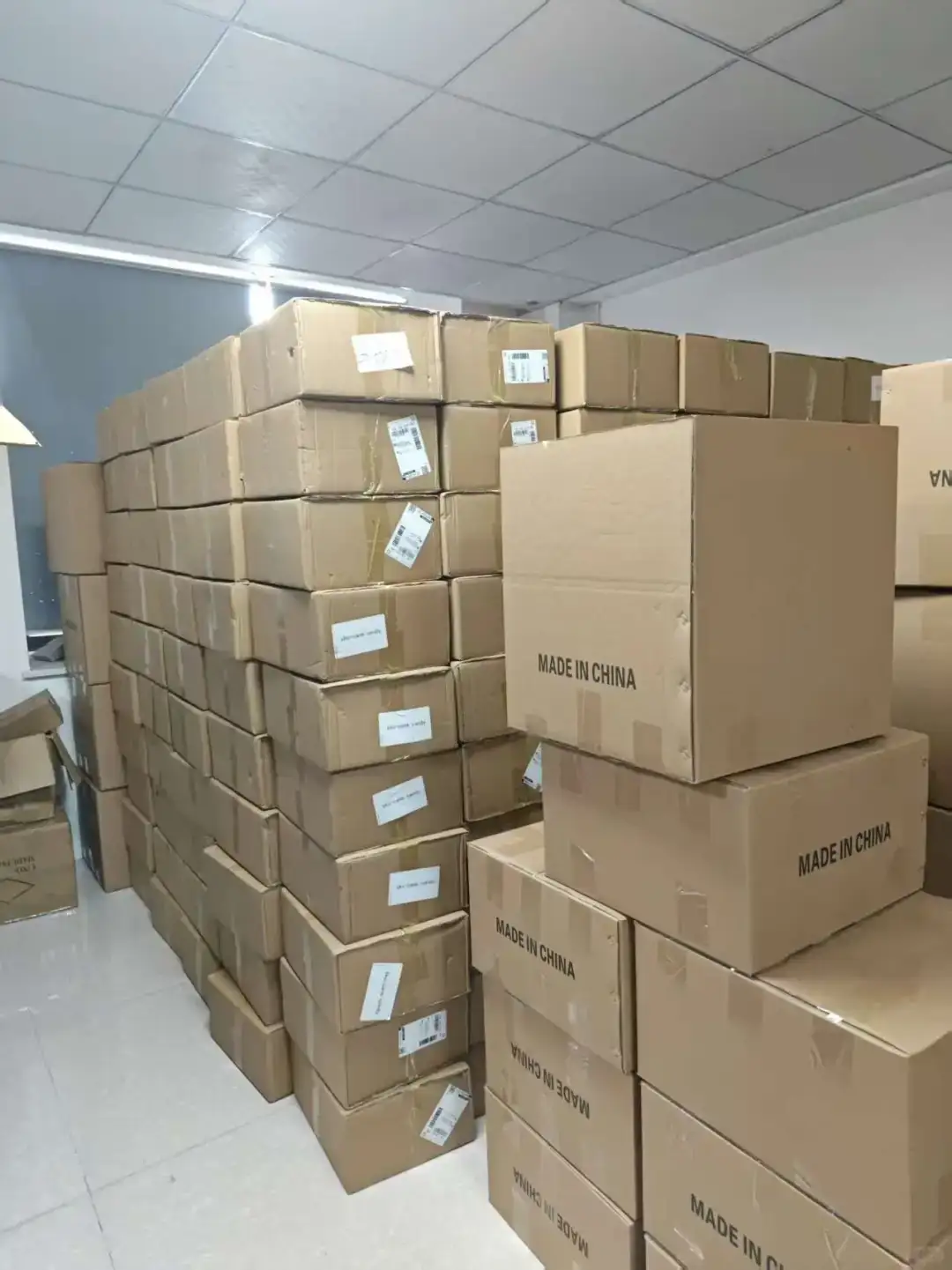
Packaging and labeling defects are cheap to catch in China and expensive to catch abroad. Use an AQL-based inspection referencing ISO 2859-1 / ANSI/ASQ Z1.4 at General Inspection Level II, and define defect classes before the inspection, not after.
A common starting point is Critical 0, Major 2.5, Minor 4.0 — but this is an example, not a universal rule. Critical defects are those that make the product unsafe or illegal to sell, such as a missing required safety mark or a wrong origin label. Major defects affect function, saleability or the customer’s ability to identify the product, such as a wrong barcode, wrong SKU on a carton, missing insert or illegible print. Minor defects are cosmetic and do not affect sale, such as slight color variation or a scuff on an inner flap. Set tighter limits for barcode and compliance labels than for cosmetic print, and write the sampling plan into the inspection request so the factory knows the standard in advance.
Inspect at the right moment. If packaging is assembled at the factory, inspect after packing but before cartons are sealed and palletized. If relabeling happens at a China warehouse, inspect after relabeling and before export. Photograph label placement, barcode scans and insert counts, because these are the disputes that are hardest to resolve from a different time zone.
What to Verify Before You Proceed
- Legal entity and bank account match. Cross-check the company name, Unified Social Credit Code and account name on the proforma invoice using the National Enterprise Credit Information Publicity System, Tianyancha or Qichacha.
- Paid-in capital and establishment date. Distinguish registered from paid-in capital, and note how long the entity has operated.
- Physical sample approved in writing. Confirm material, print method, colors and insert wording against a signed-off proof.
- MOQ, tooling and lead time in the contract. Include who owns the tooling and what happens to it if you change suppliers.
- Label specification confirmed with the final retailer or marketplace. Verify barcode standard, size, placement and origin marking against the current official requirement for your destination.
- Incoterm and importer of record named. Get the DDP breakdown in writing, including duty rate and tax treatment.
- Inspection plan agreed. State AQL level, defect definitions and inspection point before production starts.
- Freight impact modeled. Recalculate carton dimensions and volumetric weight after packaging is finalized.
Frequently Asked Questions
What is the minimum order for custom packaging from China?
Custom packaging typically starts at 500–1,000 units, inserts often at 300–500, and complex designs with special print or materials can require 2,000 units or more. Tooling fees of roughly $100–$500 are common. Confirm the exact MOQ and tooling cost in writing before paying a deposit, because these ranges vary by supplier and specification.
Can a China warehouse add thank-you cards and relabel my goods?
Yes. China warehouses commonly receive bulk goods, apply new labels, insert cards, re-bag or re-box, and re-palletize before export. This is useful when packaging or labeling changes after production. Confirm the warehouse’s process, inspection step and cut-off dates, and specify label placement and insert counts in writing so the work is checkable.
Do I need a physical sample before mass production?
Yes, for any custom packaging or printed insert. A physical sample, usually 7–15 days, is how you catch brand errors, color drift and poor material quality before they are repeated across a production run. Approve it against a written spec and keep a reference copy for the inspection.
How much does custom packaging add to shipping cost?
Custom packaging typically increases shipment volume by 10–20%, which raises sea freight costs by a similar order and can raise air freight costs by up to around 15% because volumetric weight drives billing. Model the freight impact after carton dimensions are final, not before.
Is a DDP quote from a Chinese supplier safe?
It can be, but only if the importer of record, duty rate and tax treatment are stated in writing. Non-compliant “tax-inclusive” DDP arrangements can leave you legally exposed even when you never handle a customs form. Ask who is the importer of record and confirm the arrangement with a customs broker in your destination market.
Managing Quality Drift Across Time Zones
The real risk in custom packaging, inserts, labeling and relabeling is not the first order — it is the third. Print colors drift between runs, insert wording goes stale after a promotion ends, a new warehouse applies labels slightly differently, and a factory substitutes a material because a shipment was late. None of these are visible from a Shopify dashboard, and all of them are cheaper to catch in China than in a fulfillment center in the US, UK, EU, Canada or Australia.
That is the gap Jaime Sourcing is built to close. We support supplier research and verification, inspection and quality control, consolidation, packing and shipment coordination — so packaging specs, insert proofs, label placement and carton dimensions are checked on the ground before goods leave China. If you are planning a packaging or relabeling run, send us the spec and the supplier details for a workflow review or a supplier check before you pay the deposit.
Turn your product and order requirements into a controlled sourcing brief.
Share the product, supplier link, quantity, destination and current order stage. We will identify the practical verification, quality-control, packing and shipping steps.