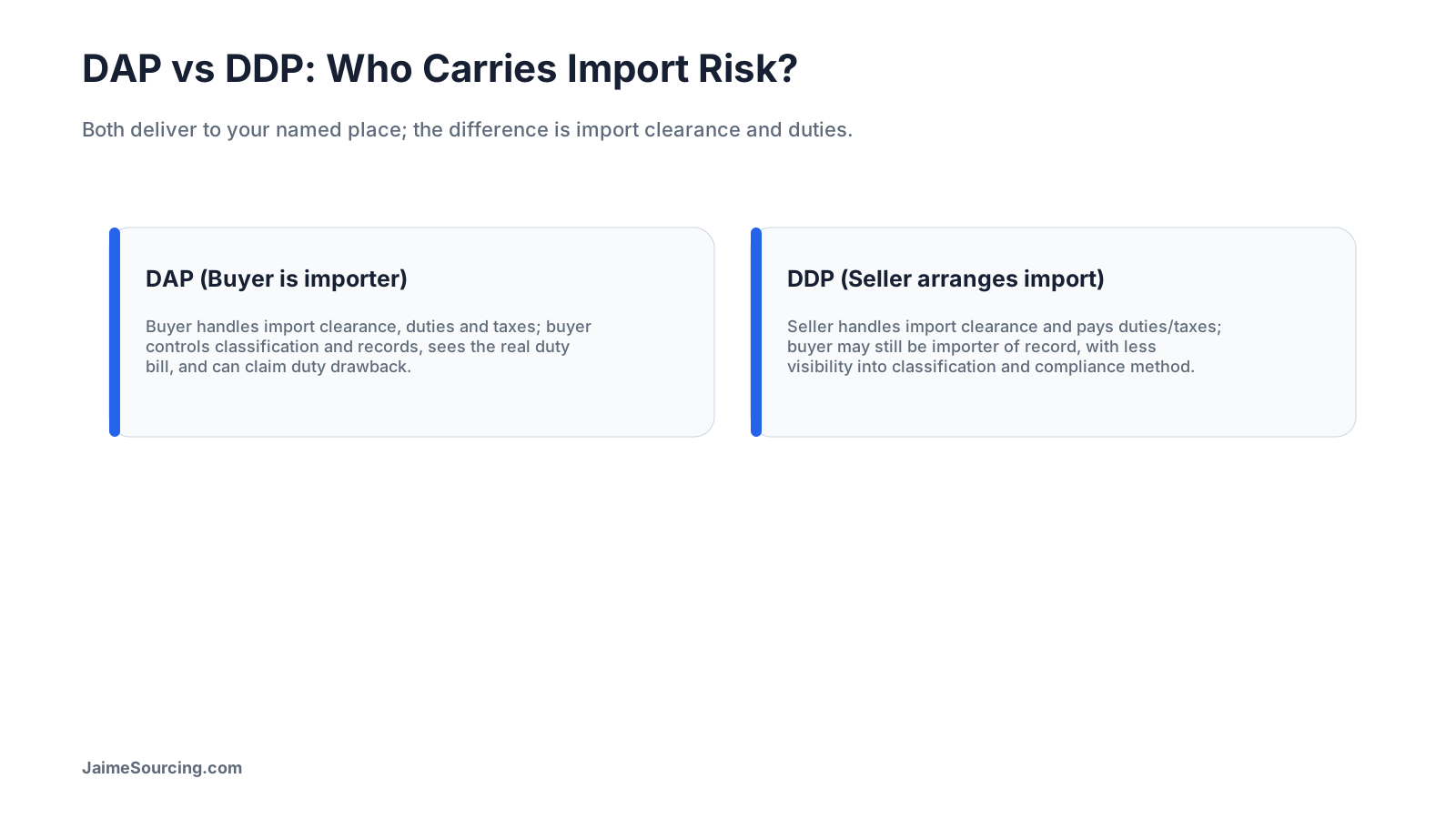
Under DAP (Delivered at Place), you — the overseas buyer — are the importer of record and carry the duty, tax and clearance risk. Under DDP (Delivered Duty Paid), the seller takes on import clearance and duties, which sounds simpler but shifts a different set of risks onto you, including compliance exposure you may not see until customs asks questions. The two terms differ on exactly one axis — who handles import clearance and import duties/taxes — while transport and risk transfer to the named destination are otherwise the same. For a Shopify seller, the real decision is not “which is cheaper” but “which party can legally and practically act as importer, and who absorbs the downside when the estimate is wrong.”
This article is written for overseas buyers and resellers importing from China into the US, UK, EU, Canada or Australia. It is not about mainland sellers exporting. It explains where the risk actually sits, how “tax-inclusive DDP” quotes can go wrong, and what to verify before you sign.
The one real difference — and why it matters more than the price
DAP and DDP are both “D” terms: the seller delivers to a named destination in your country. Under DAP, the seller handles export clearance, international freight and delivery to the named place, but you handle import clearance, duties and taxes. Under DDP, the seller additionally handles import clearance and pays import duties and taxes, making it the term with the heaviest seller obligation in Incoterms 2020.
Two clarifications that trip up new importers:
- DDU is retired. DDU (Delivered Duty Unpaid) was an Incoterms 2000 term replaced by DAP from 2010 onward. People still say “DDU” conversationally, but contracts should state DAP + named place + (Incoterms 2020).
- Neither term includes unloading or insurance. Under both DAP and DDP the buyer unloads, and neither requires the seller to buy cargo insurance — the seller only bears transport risk to the destination.
DDP is not “DAP with free shipping.” It is a different allocation of legal responsibility for import, and that responsibility is where the risk lives.
Risk comparison for a Shopify seller: DAP vs DDP
The table below maps the risks a reseller actually feels — not just who pays the duty.
| Risk area | DAP (buyer is importer) | DDP (seller arranges import) |
|---|---|---|
| Import clearance | Buyer appoints broker / files | Seller or its agent files |
| Duty and VAT/GST payment | Buyer pays directly | Seller pays, then recovers in price |
| Importer of record | Buyer | Often still the buyer, even when the seller pays the carrier |
| Duty estimate accuracy | Buyer sees the real bill | Seller estimates; errors surface later |
| Product compliance (FDA, CPSC, EPA, etc.) | Buyer controls records and filings | Seller may not understand agency rules |
| Duty drawback eligibility | Buyer, as importer, can claim on re-export | Seller is importer, so buyer generally cannot |
| Surprise fees at delivery | Buyer knows the cost upfront | Risk of hidden fees or under-declaration |
| Control over HS classification | Buyer | Seller or agent |
The most misunderstood row is importer of record. Paying duties through a carrier account does not automatically make the seller the importer — the consignee can remain the importer of record even when the seller funds the duty. Under a DDP arrangement you may therefore still be legally exposed for classification, valuation and compliance, while having less visibility into how the entry was filed.
Why “tax-inclusive DDP” quotes can carry hidden compliance risk
A DDP quote that looks like a single landed price is attractive for a Shopify store because customers expect an all-in delivered price with no surprise duty bill at the door. But some low-cost “double-clearance, tax-inclusive” channels achieve their price through under-declaration or borrowing a third party’s tax ID (especially EU VAT). If customs audits, the goods can be detained, duties and penalties assessed, and the actual consignee — you — may struggle to distance yourself from the filing.
This is the core DDP risk for a reseller: the price is fixed, but the compliance method behind the price is invisible. A legitimate DDP arrangement requires the seller (or its agent) to have a real ability to clear customs and pay taxes in your destination country — and that capability is the part most often underestimated in DDP pricing.
There is also a structural limit. Where duty rates on Chinese goods are high and volatile, a seller cannot reliably absorb them into a DDP price. One analysis notes that Section 301 tariffs on many Chinese consumer goods run 7.5–25%, with an additional 12.5% forced-labor tariff cited as effective from 24 July 2026, and argues that asking a Chinese supplier to absorb such rates under DDP is often unrealistic. Treat those specific rates as time-sensitive and jurisdiction-specific — verify the current HTS classification and any exclusions with a licensed broker or the official customs authority before relying on them. The exact number matters less than the structural point: high, changing duty makes DDP pricing fragile, and a fragile DDP price tends to be protected by cutting corners somewhere.
When DAP is the lower-risk choice — and when DDP is
Neither term is universally safer. The right choice depends on your import maturity and product category.
DAP tends to reduce risk when:
- You already have a customs broker and a continuous bond (US) or equivalent setup, and want control over classification and valuation.
- Your product is regulated (FDA, USDA, EPA, CPSC in the US) and requires importer-held records a foreign seller may not manage correctly.
- You may re-export goods and want to claim duty drawback — only the importer of record can claim, which under DDP is generally the seller.
- You source from multiple countries and want one consistent compliance standard.
DDP tends to reduce risk when:
- You are a first-time importer without a broker and want to test a product with minimal setup.
- You sell direct-to-consumer and need a predictable all-in price so customers are not hit with duty at delivery.
- Duty rates are low and stable, so the DDP premium is small and the convenience wins.
DDP typically costs more than DDU/DAP — one source cites roughly 3–7% higher — because the seller prices in the clearance burden and duty uncertainty. That premium is not automatically bad value; it is the price of transferring operational work. The question is whether the seller can actually carry it compliantly.
Landed cost: separating EXW, FOB and DDP so you compare like with like
Shopify sellers often compare a DDP quote against an FOB quote and conclude DDP is “only a little more.” That comparison is usually wrong because the terms cover different cost stacks.
- EXW (Ex Works): you pay origin handling, export clearance, freight, import clearance and duty. Maximum control, maximum work.
- FOB (Free On Board): the seller covers costs to the port of shipment and export clearance; you cover ocean/air freight, insurance, import clearance and duty. This is the standard B2B import structure for buyers with a broker.
- DDP: the seller covers everything to your door including import clearance and duty — but you lose visibility into the duty line and, potentially, control over classification.
To compare fairly, build a landed cost sheet for each option that includes: goods cost, origin charges, freight, insurance, duty, VAT/GST, broker/clearance fees, DDP or advance fees, and any destination port charges. Note that carriers may charge a DDP fee and an advance fee — one source cites a $15 DDP fee at UPS and DHL in the US, with FedEx and some postal consolidators not charging it. Fees vary by carrier and destination, so confirm with your carrier representative rather than assuming.
Also separate who the carrier bills from who the Incoterm says should pay. Incoterms allocate cost and risk between buyer and seller, but they do not bind a shipping line to collect from a particular party; freight prepaid vs collect and destination charges must be agreed at booking.
What to Verify Before You Proceed
Before you accept any DDP or DAP quote from a Chinese supplier, work through this checklist.
- Confirm the exact term and version in writing. The contract and proforma invoice should read “DAP + named place + (Incoterms 2020)” or “DDP + named place + (Incoterms 2020),” plus a line stating who bears import duty, VAT/GST and import charges. Verbal “DDU” is fine in chat; put the current term on paper.
- Ask who is the importer of record. Under DDP, confirm whether the seller or its agent will be the importer, or whether you remain the consignee. If you remain importer, you still carry compliance exposure.
- Ask how the DDP price is built. Request the declared value basis, the HS code used, and confirmation that the seller’s agent uses a legitimate tax ID and declaration. A refusal to explain is a red flag.
- Check the seller’s real identity and standing. Use the Chinese National Enterprise Credit Information Publicity System to confirm the legal entity, Unified Social Credit Code and establishment date. Cross-check on Tianyancha or Qichacha for registered capital, and distinguish subscribed capital (promised) from paid-in capital (actually contributed) — a high subscribed figure with low paid-in capital tells you little about operational capacity. Confirm the entity name matches the bank account and contract.
- Verify product compliance responsibility. For regulated goods, confirm which party holds the records and filings required by the destination agency (e.g., FDA, CPSC, EPA in the US).
- Model the downside. If duty is reassessed, who pays? If the shipment is detained, who is liable? Put the answer in the contract, not in an email.
- Check current duty rules for your HS code. Tariff rates and exclusions change; confirm with a licensed broker or the official customs authority in your jurisdiction before pricing.
FAQ
Is DDP always more expensive than DAP for a Shopify seller?
Usually yes, because the seller prices in clearance work and duty uncertainty — one source cites roughly 3–7% higher. The gap depends on duty rates and product category, so compare full landed cost rather than headline freight.
If I buy DDP, am I still the importer of record?
Not always, but often yes. Paying duty through a carrier account does not automatically make the seller the importer — the consignee can remain importer of record even when the seller funds the duty. Confirm this in writing, because it determines your compliance exposure.
Can I claim duty drawback if I import under DDP?
Generally no, because drawback is claimed by the importer of record, which under DDP is typically the seller. If you re-export goods or use them in export manufacturing, DAP usually preserves your ability to claim.
Why do some DDP quotes look suspiciously cheap?
Some low-cost “tax-inclusive” channels cut costs through under-declaration or borrowed tax IDs, especially EU VAT. If audited, goods can be detained and penalties assessed against the actual consignee. Ask how the price is built before trusting it.
Is DDU still a valid term to put in a contract?
No. DDU was replaced by DAP from Incoterms 2010 onward. Use “DAP + named place + (Incoterms 2020)” in contracts, even if you say “DDU” in conversation.
The risk you cannot outsource: distance, drift and follow-up
Whichever Incoterm you choose, the risks that hurt Shopify sellers most are not on the customs form. They are quality drift between the approved sample and mass production, factory follow-ups that stall when nobody is physically present, and time-zone and language friction that turns a two-day fix into a two-week delay. A DDP price does not protect you from a batch that fails inspection; a DAP setup does not protect you from a supplier who stops responding after deposit.
That is where a ground team in China changes the risk profile. Jaime Sourcing supports overseas buyers with supplier research, supplier verification, inspection, quality control, consolidation, packing and shipment coordination — the physical, on-the-ground work that sits between your purchase order and your fulfillment center. If you are weighing DDP against DAP, or want a second pair of eyes on a supplier before you wire a deposit, talk to Jaime Sourcing about a supplier check or a workflow review.
Turn your product and order requirements into a controlled sourcing brief.
Share the product, supplier link, quantity, destination and current order stage. We will identify the practical verification, quality-control, packing and shipping steps.