
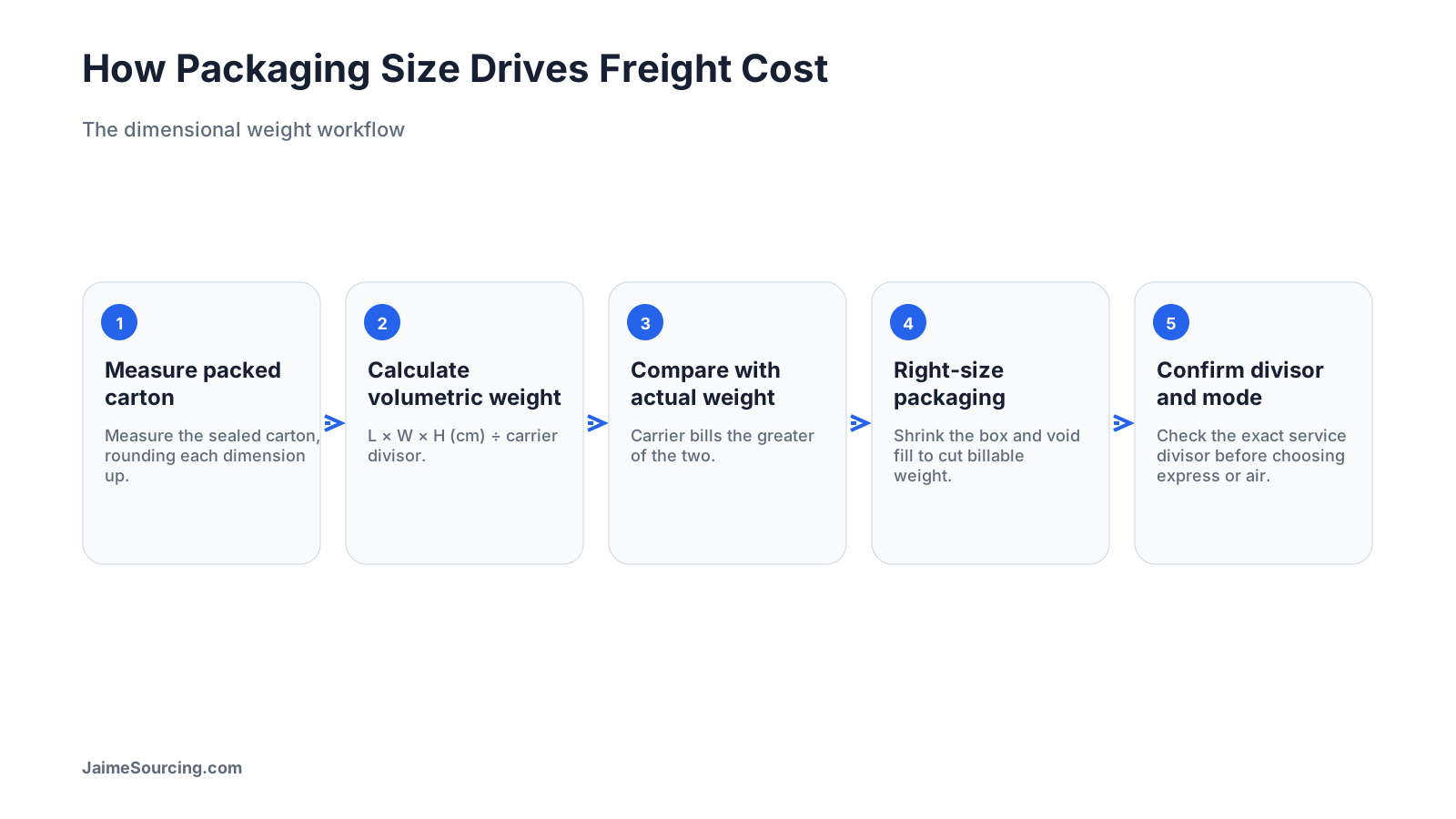
If your product is light but bulky, the carrier bills you on the space it occupies, not the number on the scale. Dimensional (DIM) weight—also called volumetric weight—is calculated by multiplying a parcel’s length × width × height and dividing by a carrier-set divisor; the carrier then charges whichever is higher, actual weight or volumetric weight. For a Shopify reseller shipping pillows, luggage, foam products or loosely packed textiles from China, that single rule can turn a US$300 freight quote into US$900. Calculate both weights before you book, then shrink the box—not just the product.
The Core Formula and Why the Divisor Matters
Volumetric weight = (L × W × H in cm) ÷ divisor, expressed in kilograms. The divisor decides how punishing the calculation is. Common values in China-origin international shipping:
| Mode / carrier | Typical divisor (cm³/kg) | 1 CBM converts to | Notes |
|---|---|---|---|
| Air freight (general) | 6000 | ~167 kg | Standard air cargo convention |
| FedEx / UPS express | 5000 | ~200 kg | Common for China export express |
| DHL (some services) | 4000 | ~250 kg | Lower divisor = higher billable weight |
| US domestic (UPS/USPS retail) | 166 (in³/lb) | — | Applies to US-origin legs, not China export |
The same 60 × 40 × 30 cm carton becomes 14.4 kg under a 5000 divisor but 18 kg under 4000 —a 25% swing on identical goods. Confirm the divisor for the specific service and account tier before you compare quotes; DHL itself notes that the coefficient depends on the official product and contract.
Volumetric vs Actual Weight: Which One You Pay
Carriers bill on the greater of the two, so low-density cargo (textiles, foam, footwear, soft furnishings) is almost always charged on volume, while dense cargo (electronics, metal parts, machinery) is charged on actual weight. A parcel weighing 8 kg but measuring 60 × 40 × 30 cm bills at 14.4 kg (FedEx/UPS) or 18 kg (DHL). At China-to-US/EU express rates in the 21–70 kg band, that can double your cost per unit.
Two measurement habits protect you:
- Round each dimension up to the nearest whole unit before multiplying—UPS explicitly instructs rounding each dimension to the nearest integer.
- Measure the packed, sealed carton, including any bulge from tape, labels or soft goods compression—not the flat box.
Where Packaging Size Quietly Inflates Your Bill
Most China-origin cost overruns come from oversized cartons chosen for supplier convenience, not shipping efficiency. Reducing a carton from 60 × 40 × 30 cm to 50 × 30 × 25 cm cuts volumetric weight from 14.4 kg to 7.5 kg under a 5000 divisor—roughly halving the billable weight. Practical levers:
- Right-size the box to the product, not to a standard carton the factory already has.
- Keep a small range of box sizes matched to your best-selling SKUs and bundles.
- Swap heavy void fill (corrugated inserts, foam peanuts, thick film) for thin foam sheets or minimal bubble wrap on non-fragile goods.
- Knock down or flat-pack furniture-style items and pack components separately.
- Use poly mailers for books and apparel to eliminate dead space entirely.
For consolidated shipments, the same logic applies at pallet and master-carton level: a carton that is 10% too large in every dimension adds roughly 33% to its volume.
Express vs Air Freight: Different Divisors, Different Economics
Express (DHL/FedEx/UPS) and general air freight use different divisors, so the cheaper mode depends on density. Air freight conventionally uses 6000, meaning 1 CBM ≈ 167 kg; express often uses 5000 or 4000. For a low-density shipment, express can therefore be disproportionately expensive, while for dense goods the divisor barely matters because actual weight governs. Before choosing a mode, calculate chargeable weight under each divisor and compare against the per-kg rate for that band—not the headline rate alone.
Incoterms, Landed Cost and the DDP Trap
Freight quotes only make sense against your Incoterm. Under EXW, you bear origin pickup, export clearance and all freight; under FOB, the supplier covers delivery to the named Chinese port and export clearance, and you control the main leg; under DDP, the seller quotes a delivered, duty-paid price—convenient, but the risk is that “tax-inclusive” DDP arrangements sometimes under-declare value or use non-compliant clearance routes, leaving you exposed to customs penalties and seizure. For law, tax and customs treatment, confirm the current official rule in your destination jurisdiction (US CBP, HMRC, EU customs authorities, CBSA or ABF) rather than relying on a supplier’s assurance.
On payment, overseas buyers typically pay Chinese suppliers by T/T, often 30% deposit and 70% before shipment. Budget for bank fees on both ends, FX exposure between quote and payment, and platform fees if you use Trade Assurance. Pay corporate accounts to corporate accounts where possible—personal-account payments complicate disputes and refunds—and agree in writing who absorbs sample-payment fees.
Supplier and Factory Checks That Protect Freight Budgets
Packaging discipline is a supplier behaviour, so verify the supplier before you trust their carton dimensions. Use the Chinese National Enterprise Credit Information Publicity System to confirm legal existence and the Unified Social Credit Code, and cross-check on Tianyancha or Qichacha for establishment date, registered capital, and—critically—subscribed versus paid-in capital, since a high registered figure with minimal paid-in capital signals thin financial substance. Confirm the business scope covers your product category and that the entity name matches the contract and bank account.
For quality control, agree an inspection plan referencing ISO 2859-1 / ANSI/ASQ Z1.4, General Inspection Level II, with defects classified as Critical, Major and Minor. A common starting point is Critical 0 / Major 2.5 / Minor 4.0, but treat this as an example to be agreed per product—not a universal rule. Inspect the packed carton dimensions as part of the check, because a correct product in an oversized box still costs you money.
What to Verify Before You Proceed
- Divisor and service tier confirmed in writing by the carrier or forwarder for your exact route.
- Packed dimensions measured on a sealed carton, each side rounded up.
- Chargeable weight calculated under both express and air divisors before choosing a mode.
- Incoterm stated on the quote, with origin charges, duty and clearance responsibility itemised.
- Supplier identity matched across the credit system, contract and bank account, including paid-in capital.
- Inspection plan agreed with AQL levels and carton-dimension checks built in.
FAQ
How is dimensional volumetric weight calculated for international shipping?
Multiply length × width × height in centimetres, then divide by the carrier’s divisor (commonly 6000 for air freight, 5000 for FedEx/UPS express, 4000 for some DHL services). The carrier bills the greater of this figure and actual weight.
Why is my light parcel charged at a much higher weight?
Carriers price the space your parcel occupies, not just its mass. Low-density goods like textiles, foam and footwear are routinely billed at two to four times their actual weight. Shrinking the carton is the fastest fix.
Does packaging really change my freight bill that much?
Yes. Cutting a carton from 60 × 40 × 30 cm to 50 × 30 × 25 cm reduces volumetric weight from 14.4 kg to 7.5 kg under a 5000 divisor—roughly half the billable weight. Right-sizing boxes and using thin protective materials are the main levers.
Is DHL always more expensive than FedEx or UPS for bulky goods?
Not always, but DHL’s 4000 divisor can produce up to 25% more billable weight than a 5000 divisor on identical dimensions. For dense goods the difference narrows because actual weight governs. Compare chargeable weight per service, not headline rates.
Can I avoid volumetric weight by shipping by sea instead?
Sea freight is priced on volume (CBM) rather than a DIM divisor, so bulky goods often cost less per unit—but transit is far slower and minimum volumes apply. For samples and small bulky batches, compare air and express chargeable weight before assuming sea is cheaper.
Freight surprises rarely come from the rate card. They come from quality drift, packaging decisions made without you, and the physical distance and time-zone gap between your desk and a factory floor in China. That gap is where cartons get oversized, dimensions get misreported and inspection windows get missed. Jaime Sourcing acts as your ground team in China, covering supplier research and verification, inspection and quality control, consolidation, packing and shipment coordination—so the box that ships is the box you approved. Request a supplier check or workflow review before your next production run.
Turn your product and order requirements into a controlled sourcing brief.
Share the product, supplier link, quantity, destination and current order stage. We will identify the practical verification, quality-control, packing and shipping steps.