A factory’s own inspection report is not evidence that your order is correct. It is a record of what the factory chose to check, against a standard the factory controls, written by people whose payment depends on the shipment passing. That does not make every factory dishonest, but it does mean self-inspection answers a different question than independent inspection. Self-inspection asks “did we find anything we consider a problem?” Third-party inspection asks “does this batch meet the specification the buyer agreed to?” For a Shopify reseller whose product reviews and return rates depend on the second question, the two are not interchangeable.
The core difference is independence and objectivity: factory self-inspection is performed internally by the producer, which has an interest in the goods passing, while third-party inspection is carried out by an outside party with no stake in that outcome. The conflict shows up in specific, recurring ways, and the fix is to structure inspection so it actually protects you — and to verify what you are relying on before you rely on it.
Where factory self-inspection breaks down
Self-inspection is not useless. A factory that runs incoming-material checks, first-article review and in-line patrols will generally produce more consistent goods than one that does not. The problem is what happens when the factory’s commercial interest and your quality standard diverge.
Industry write-ups on supplier deception describe recurring patterns concentrated in three areas — raw material purchasing, the production process and final delivery. The commonly cited methods include substituting cheaper materials late in production, preparing “perfect” samples for inspection while mass production differs, concentrating defective units in corners or unreported areas so they escape AQL sampling, falsifying material reports or test certificates, and passing outsourced or temporary-line output off as own-capacity production. Each of these exploits information asymmetry: the buyer is far away, cannot see the floor, and has no independent means of verification.
Self-inspection does not close that gap, because the same party controls both the production and the record of its quality. A self-issued “100% pass” report tells you the factory believes the goods are fine — or wants you to believe it.
What independent inspection actually adds
Third-party inspection is a service performed by an organisation independent of both buyer and seller, assessing quality, quantity, specification and packaging against agreed standards — the model built for cross-border purchasing where the buyer cannot be at the production site. Independent inspection providers position themselves as a quality gatekeeper, supplying the buyer with information on product quality and compliance rather than a self-assessment.
The practical value is not a “guarantee.” It is a second, disinterested data point at a defined moment, using a defined sampling method, against a defined specification. That is what lets you make a release-or-rework decision before goods leave China rather than after they reach a fulfilment centre.
It also changes supplier behaviour. Suppliers respond to buyers who control the rules of the game — not necessarily the largest buyers, but those who verify credentials, write standards into the contract, inspect during production rather than only at the end, and use independent inspection instead of relying on factory self-checks.
Inspection is not the same as a factory audit
A frequent and expensive confusion is treating an audit and an inspection as one activity. They answer different questions at different stages:
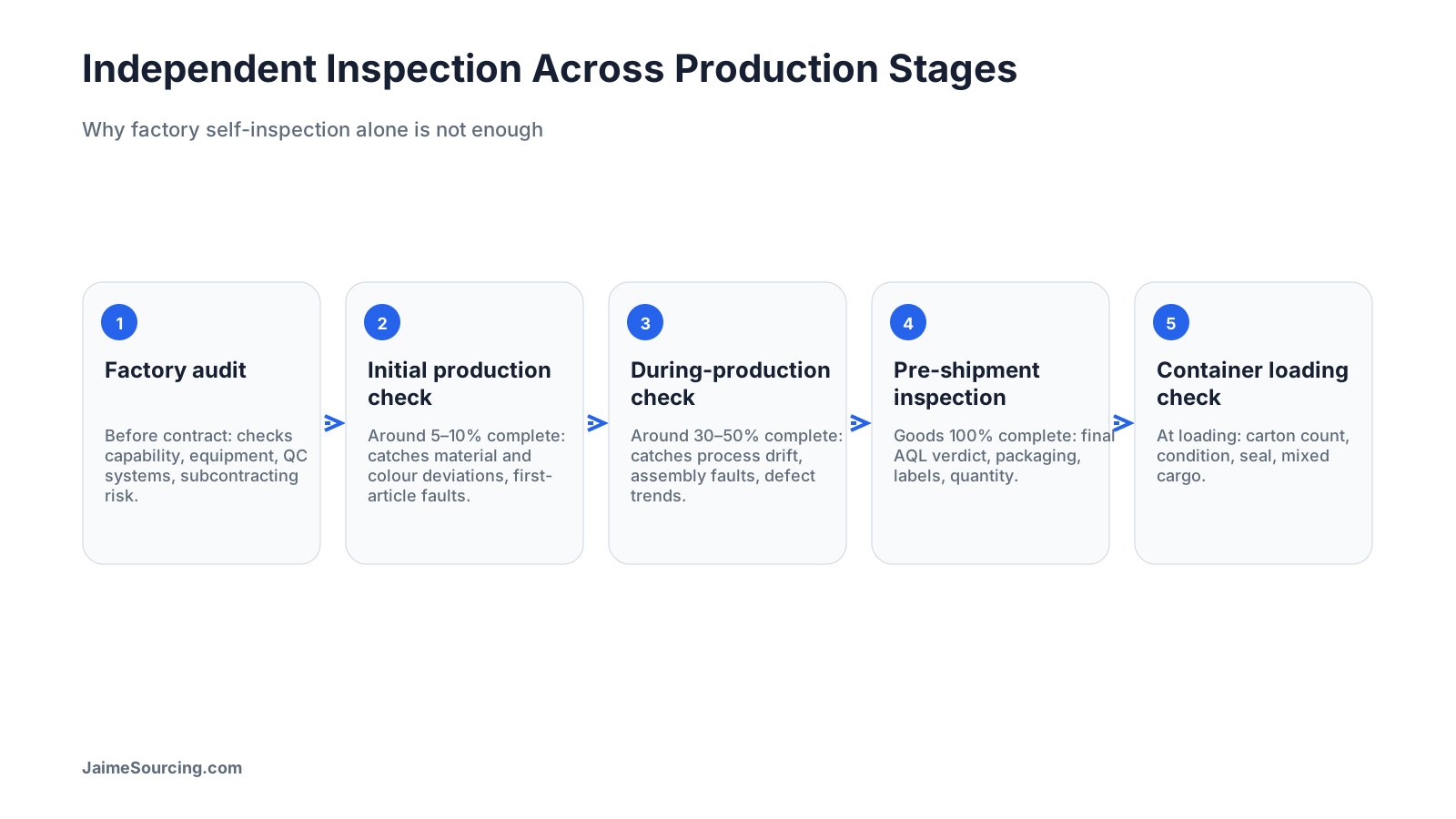
- A factory audit happens before you place the order. It asks whether this factory is worth working with — credentials, capacity, equipment, quality-management systems, site management, sampling capability and basic compliance.
- An inspection happens during and at the end of order execution. It asks whether this specific batch conforms — appearance, workmanship, function, dimensions, packaging, marks and quantity.
Neither substitutes for the other. Passing an audit does not mean a given order will be produced well, because the factory may switch crews, materials or schedules once the order is running. Conversely, inspecting goods without ever auditing a new supplier means you discover capacity or capability problems only when rework and re-sourcing are no longer affordable. Supplier risk management and product inspection are complementary, not alternative, controls.
One further risk worth naming: a supplier that passed an audit may still use non-compliant subcontracting, which can produce unstable quality, delays and compliance exposure — which is why some providers offer unannounced checks specifically to detect outsourcing.
Building an inspection plan that holds up
1. Fix the specification before production starts
Most quality disputes are not sabotage; they are disagreement about what “acceptable” means. Put measurable requirements in the purchase order — material, dimensions, performance, appearance — and attach a signed, retained golden sample as the comparison baseline. Without a sealed sample and a colour/dimension tolerance, “the colour is wrong” versus “the sample was this colour” is unresolvable.
2. Inspect during production, not only before shipment
Waiting until everything is finished is the most common and most costly mistake: rework is expensive, the schedule is gone, and buyers end up accepting defects or absorbing delay. A staged structure is standard practice:
- Initial production check (IPC): around the first 5–10% of the batch, or first-article review, to catch problems before mass production locks them in.
- During-production check (DUPRO/DPI): at roughly 30–50% completion, to catch drift while it can still be corrected.
- Final random inspection (FRI/PSI): when production is complete and typically around 80% of goods are packed, before shipment.
- Container loading supervision: where the risk of swapped or short-shipped cargo justifies it.
A documented example from a European bag order: an initial production check caught out-of-tolerance fabric colour, the factory adjusted dyeing overnight, and the bulk order passed — where a pre-shipment-only check would have meant scrapping thousands of finished units.
3. Use AQL properly, and know its limits
Sampling inspection is normally run to ISO 2859-1 / ANSI/ASQ Z1.4, commonly at General Inspection Level II, with defects classified as:
- Critical: a defect that could cause harm, breach a mandatory requirement, or make the product unusable — often set at zero acceptance.
- Major: a defect likely to cause failure or a clear customer complaint, or to make the product unsaleable.
- Minor: a deviation from specification that does not materially affect function or saleability.
A common starting point is Critical 0 / Major 2.5 / Minor 4.0, but this is an example, not a universal rule — acceptance levels should reflect your product category, price point and return tolerance. Two limits matter:
- AQL is statistical. It accepts that a defined proportion of defects may pass, so it does not prove a batch is defect-free.
- Some risks cannot be judged on site at all. Chemical and safety items — formaldehyde, heavy-metal migration, azo dyes, electrical safety, mandatory certification — require laboratory testing of samples and fall outside the scope of a visual on-site inspection.
If a supplier’s self-inspection report claims to cover those chemical or certification items without a laboratory test behind it, treat the claim as unverified.
4. Make the report decision-ready
A useful inspection report states the sampling plan, the defect classification, the count found against the acceptance number, photographic evidence, and a clear pass / fail / rework recommendation. A report that says “quality good” without those elements cannot support a release decision.
Comparing the two models
| Dimension | Factory self-inspection | Independent third-party inspection |
|---|---|---|
| Who performs it | Factory’s own QC staff | Organisation independent of buyer and seller |
| Whose standard applies | Factory’s internal standard | Buyer’s agreed specification and sampling plan |
| Conflict of interest | Producer has an interest in goods passing | No stake in the pass/fail outcome |
| Typical timing | Internal, often undocumented to buyer | IPC, during-production, final random, loading |
| Sampling basis | Factory’s discretion | ISO 2859-1 / ANSI/ASQ Z1.4, e.g. Level II, defined AQLs |
| What it can verify | Appearance and function the factory chooses to check | Appearance, workmanship, function, dimensions, packaging, marks, quantity |
| What it cannot verify | Anything the factory does not disclose | Chemical/safety compliance without lab testing |
| Best use | Routine in-line discipline between inspections | Release decision on your order, and supplier behaviour pressure |
What to Verify Before You Proceed
- The legal entity, not just the trading name. Ask for the business licence and check the company on the Chinese National Enterprise Credit Information Publicity System, and cross-check on Tianyancha or Qichacha. Confirm the Unified Social Credit Code, establishment date, registered capital, and — critically — subscribed versus paid-in capital. A high registered figure with little paid-in capital tells you less about financial substance than the headline number suggests. Check that the stated business scope covers what you are buying.
- Certificate validity and scope. If a supplier cites ISO 9001 or a product certificate, verify the certificate number with the issuing body and confirm the scope matches your product — a certificate for metal stamping does not cover injection moulding.
- The inspection scope in writing. Confirm which stages are covered, the sampling standard and AQLs, defect definitions, and whether lab testing is included or separate.
- The sealed sample. Confirm a signed golden sample exists and that the inspector will compare against it.
- Who pays and who instructs the inspector. The inspector should take instructions from you, not the factory.
- Incoterm and customs responsibility. Under EXW the buyer carries essentially all origin handling and export obligations; under FOB the supplier clears export and delivers to the vessel, with origin charges defined to that point; under DDP the seller arranges delivery and import clearance. Be cautious with “tax-inclusive” DDP arrangements that do not clearly identify the importer of record, the duty and tax actually paid, or the classification used — non-compliant structures can leave you exposed even when the price looks complete.
- Payment mechanics. For T/T, agree the deposit/balance split, state clearly who absorbs bank charges at each end, and note FX exposure between order and balance payment. Pay the company account matching the contracting entity, not a personal account, unless you have verified and documented why. If a platform escrow or Trade Assurance service is used, confirm its current fee terms directly with the provider. Agree in advance whether sample and courier costs are deducted from the bulk order.
Regulations, tariff treatment and platform rules can change. This guide was reviewed on November 8, 2026. Confirm the current requirements with the destination-country authority, customs broker or qualified compliance adviser before placing an order.
Frequently Asked Questions
Can a factory’s own inspection report be trusted at all?
It can be treated as an internal record, not as independent evidence of conformity, because the producer has an interest in the goods passing. Use it as one input alongside your own staged checks and, for higher-risk orders, independent inspection. Where a self-report claims chemical or certification compliance, ask for the underlying laboratory test.
Is third-party inspection worth it for small Shopify orders?
It often is when the cost of a failed batch — returns, reviews, ad spend wasted on a bad product — exceeds the inspection fee, which is most likely on first orders and new suppliers. For repeat orders from a proven supplier with stable history, a lighter schedule such as final random inspection may be proportionate. Decide per order, not by habit.
Does a passed inspection mean the goods are defect-free?
No. AQL sampling is statistical and accepts a defined proportion of defects within the acceptance number, so a pass means the batch met the agreed sampling criteria. It does not certify zero defects, and it does not cover chemical or safety compliance unless laboratory testing was included.
What is the difference between a factory audit and a product inspection?
An audit evaluates the supplier before you order — capability, systems, capacity and credentials — while an inspection evaluates one specific batch during or after production. Passing an audit does not guarantee a given order, and inspecting goods does not tell you whether the factory can reliably supply you next quarter.
How do I check a Chinese supplier’s company details?
Request the business licence and verify the entity on the National Enterprise Credit Information Publicity System, cross-checking on Tianyancha or Qichacha. Confirm the Unified Social Credit Code, establishment date, registered versus paid-in capital, business scope and any abnormal-operation or penalty records before you pay a deposit.
Manage quality drift before it reaches your customers
The real risk is rarely a single dramatic fraud. It is drift: a material quietly substituted, a tolerance loosening across batches, a crew change mid-order, a defect cluster that a factory’s own report never mentions. Add physical distance and a 12-hour time-zone gap, and problems surface days after they could have been fixed — usually as returns and one-star reviews.
Jaime Sourcing works as the buyer’s ground team in China, covering supplier research and verification, inspection and quality control, consolidation, packing and shipment coordination. If you are weighing factory self-inspection against independent checks, or want your current inspection and follow-up workflow reviewed, get in touch to arrange a supplier check or a workflow review.
Turn your product and order requirements into a controlled sourcing brief.
Share the product, supplier link, quantity, destination and current order stage. We will identify the practical verification, quality-control, packing and shipping steps.