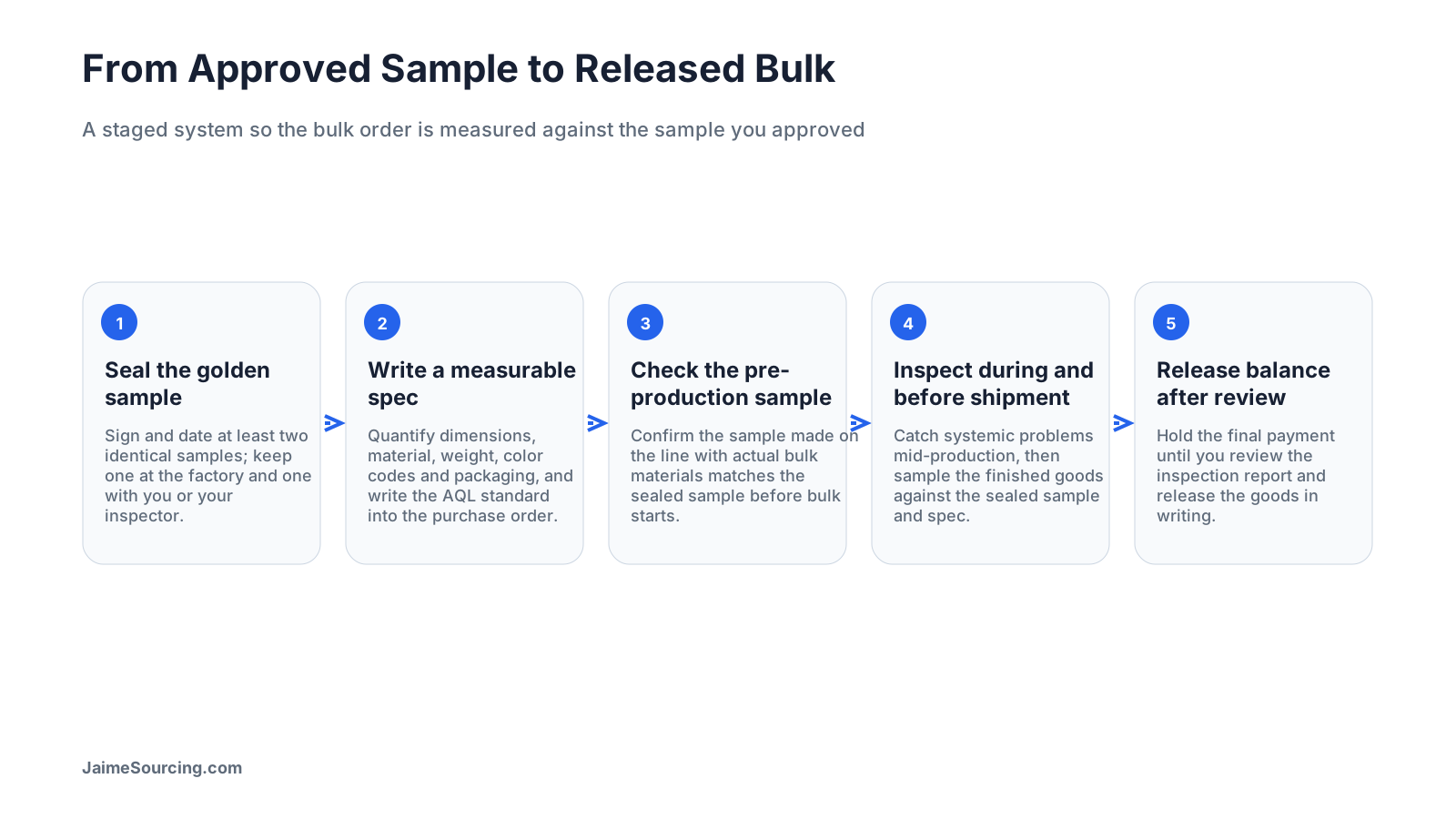
The approved sample is not the product you will receive. It is a reference point that only protects you if you convert it into a signed physical standard, a measurable written specification, and a payment lever you control. A sample that lives in your inbox and a factory’s memory is not a quality control system. The fix is procedural: seal the sample, quantify the spec, check the bulk against both at defined production stages, and withhold final payment until you release it in writing.
This article explains why bulk quality drifts from the sample, what “bait and switch” looks like in practice, and the steps a small ecommerce brand can run without a full-time QC team in China.
Why a Perfect Sample Does Not Guarantee a Perfect Bulk Order
A sample is usually made under favorable conditions: the factory’s most experienced worker, material bought specifically for one unit, and the owner watching. Bulk production runs on a line, with a bulk-purchased material lot, sometimes partly subcontracted, and under the price pressure you negotiated. None of that requires bad intent. Dye lots shift between batches, a zipper or thread gets substituted for a cheaper equivalent, a mold wears and dimensions slowly drift, and a packaging supplier change alters the carton.
There is also a structural gap in how samples are made. Factories sometimes use a different production line for the sample than for the bulk order, which is why buyers are advised to request a production sample rather than a “stock sample”. The sample proves what the factory can do; it does not prove what the line will do at volume.
The bait-and-switch risk is highest in three situations:
- New suppliers, especially from 1688 or Alibaba, where you have no transaction history.
- Price-driven negotiations, where an aggressive target price is met by downgrading inputs rather than improving process.
- Products with invisible components — the internal part, coating, or material grade that determines return rates but cannot be seen in a product photo.
Turn the Approved Sample Into a Golden Sample (sealed sample)
The single highest-leverage step is to seal the approved sample as a signed, dated physical standard — the “golden sample” or sealed sample. The mechanics matter more than the label.
- Make at least two identical sealed samples. Label each one, have both you and the factory sign and date them, and keep one at the factory and one with you or your inspector.
- Photograph from every angle with a scale in frame. This gives you a visual record that survives shipping, staff turnover and later disputes.
- Resolve every future disagreement by placing the bulk unit next to the sealed sample. This removes the “that’s within normal tolerance” argument, because the comparison is physical, not verbal.
- Do not let the golden sample be the only reference. Pair it with a written quality manual or checklist that factory staff actually work from, because a single physical unit cannot communicate tolerances, defect definitions or packaging requirements.
For small orders — a few hundred units for an Etsy shop or a new Shopify brand — the same discipline applies. A signed sealed sample, a one-page spec with dimensions and color codes, and a photo of the bulk unit next to the sample before shipment is a workable minimum.
Write a Spec That Can Be Measured, Not Interpreted
A sample without a written specification is a conversation; a specification is a contract. The spec should quantify what the sample demonstrates:
- Dimensions with plus/minus tolerances
- Material and grade
- Weight
- Color with Pantone codes plus a physical color swatch
- Stitching or surface finish details
- Labels and packaging, down to carton shipping marks
This is the practical core of a quality standard document: it converts your requirements intoillustrated, data-based and measurable form rather than a vague pass/fail list. Vague complaints are hard to win; specific, evidence-backed ones are not.
Two execution details are routinely skipped:
- Send the checklist before production and ask the factory whether anything is unclear. Cultural differences mean factory staff may not volunteer confusion, so confirm repeatedly.
- Write the inspection standard into the purchase order. Reference ISO 2859-1 inspection levels and the acceptance quality limit (AQL) in the order itself, so the pass/fail rule is agreed before anyone starts counting defects.
AQL in plain terms
AQL sampling under ISO 2859-1 (the international counterpart of ANSI/ASQ Z1.4) lets you judge a batch from a random sample rather than inspecting every unit. Most consumer-goods inspections use General Inspection Level II. Defects are graded by severity:
| Defect class | What it means | Common example limit |
|---|---|---|
| Critical | Unsafe, illegal, or unusable — poses harm or triggers recall/regulatory exposure | 0 |
| Major | Likely to cause a return, complaint, or functional failure | 2.5 |
| Minor | Cosmetic or tolerance deviation the customer may notice but tolerate | 4.0 |
Critical 0 / Major 2.5 / Minor 4.0 is a common starting example, not a universal rule. Tighten or loosen it by product category, price point and return sensitivity, and agree the numbers in writing before inspection. A third-party inspection company can help you set sampling plans and defect classification rules if you are unsure.
Inspect at the Right Moments, Not Just at the End
Pre-shipment inspection alone is reactive. By the time production is finished, a preventable defect may already affect most of the order. A staged approach catches different failure modes:
- Pre-production sample (pre-production sample): made on the line with the actual bulk materials, not in the sample room. This is your first chance to see whether the fabric, resin, board or components bought for your order match the approved sample. Confirm in writing, or list corrections, before bulk starts.
- During production (during-production inspection): catches systemic problems — wrong material, out-of-tolerance dimensions — while only part of the order is made and the rest can still be corrected.
- Pre-shipment inspection (pre-shipment inspection): random sampling against the sealed sample and spec, with defects reported by severity against your limits, once goods are finished and largely packed.
For color-critical goods (printing, dyeing, coated products), confirm the bulk material’s color under the same lighting you will sell under, because a color that matches on a sample card can shift in a full dye bath.
Who should do the inspection?
| Option | What it gives you | Main limitation |
|---|---|---|
| Supplier self-inspection | Fast, low cost, basic visual/functional check | Internal reports are often less rigorous; risk of sample/bulk divergence |
| Sourcing agent coordination | Photos/video evidence, batch inspection arrangement, sometimes negotiation support | Only about 40–50% of agents include QC as standard — confirm scope before ordering |
| Independent third-party inspection | Objective on-site inspection against your checklist, detailed report usable in disputes | Cost; typically around US$80–300 per inspector-day in major Chinese cities |
A single inspector-day usually covers roughly 200–400 units depending on complexity; high-value or regulated goods may justify full inspection, while ordinary consumer goods are usually sampled by AQL. Treat those figures as planning ranges, not quotes — confirm current pricing and scope with the provider.
Use Payment Terms and Evidence as Your Leverage
Inspection findings only change outcomes if you still hold leverage when you receive them. The most reliable lever is withholding the final balance until you have reviewed the inspection report and released the goods in writing. That is what gives a factory an incentive to rework a failed batch; once the balance is paid, most of that leverage disappears.
Build the remedies into the purchase order before production, so they are agreed next steps rather than post-shipment negotiations:
- Factory-funded sorting and rework, followed by re-inspection
- Remaking the affected portion
- A documented price reduction for acceptable minor deviations
- Rejection if the goods are unsaleable
Evidence discipline decides how fast a dispute resolves. Average dispute handling with Chinese suppliers runs roughly 7–21 days from first complaint to refund, replacement or compensation, and clear inspection reports with photo/video evidence speed it up. Document every defect with photos, video and the third-party report where available, and anchor the claim to the contract and checklist rather than a general complaint. If a supplier asks for the defective goods to be returned, note that international return freight is often uneconomic — a partial refund or replacement shipment is usually the practical outcome.
On payment mechanics for overseas buyers paying Chinese suppliers: T/T is standard, but budget for bank fees on both ends and FX exposure between order and balance payment. Trade Assurance on Alibaba adds a fee and covers only orders placed and paid through the platform — it does not protect off-platform transfers. Pay the company’s corporate account matching the contracting entity, not a personal account, and agree in writing who absorbs sample and courier fees before the sample ships.
What to Verify Before You Proceed
Before you place the bulk order, verify the counterparty and the paper trail:
- Legal identity. Use the Chinese National Enterprise Credit Information Publicity System to confirm the company exists and matches the contracting name. Cross-check with Tianyancha or Qichacha for a fuller picture.
- Registered capital vs. paid-in capital. Registered (subscribed) capital is a pledged figure; paid-in capital is what has actually been contributed. A high registered figure with low paid-in capital tells you less about real capacity than it appears to.
- Establishment date. A very recently established entity trading under an older brand name deserves a direct question about which entity signs the contract.
- Unified Social Credit Code. Confirm it on the contract, invoice and bank account beneficiary — mismatches are a red flag.
- Scope of business. Check that the registered business scope plausibly covers manufacturing or trading in your product category.
- Certification claims. An ISO 9001 certificate does not prove the standard is practiced; certificates can be obtained through lax bodies or improper audits. A factory audit against the standard is more informative than the certificate alone.
- Incoming material controls. Ask how the factory qualifies sub-suppliers and checks incoming materials — this is where many quality problems originate, before your order is even touched.
- Inspection scope in your agent agreement. If you use an agent, confirm in writing whether QC is included, since only about 40–50% include it by default.
Frequently Asked Questions
What is a golden sample in China sourcing?
A golden sample is the approved, signed and dated physical reference unit that bulk production must match. At least two identical sealed samples are kept — one at the factory, one with the buyer or inspector — and every later dispute is settled by placing the bulk unit beside it.
Is a pre-shipment inspection enough to prevent quality problems?
No. Pre-shipment inspection is reactive: by the time production ends, a preventable defect may already affect most of the order. Pair it with a pre-production sample made from actual bulk materials and a during-production check, so systemic issues are caught while the rest of the order can still be corrected.
What AQL should I use for my first order?
There is no universal number. Critical 0 / Major 2.5 / Minor 4.0 under General Inspection Level II is a common starting example, not a rule. Set limits by product category, price point and return sensitivity, and write them into the purchase order before production begins.
How much does a third-party inspection cost in China?
Third-party inspection in major Chinese cities is typically around US$80–300 per inspector-day, with one inspector-day covering roughly 200–400 units depending on complexity. Treat these as planning ranges and confirm current pricing and scope directly with the provider.
What can I do if the bulk order does not match the sample?
Gather evidence first — bulk unit beside the sealed sample, measurements against tolerance, defect counts in the inspection report — then choose a remedy while the goods are still at the factory and the balance is unpaid: rework and re-inspection, partial remake, documented price reduction, or rejection.
The Real Risk Is Drift, Not Deception
Most bulk quality failures are not dramatic switches. They are slow drifts: a substituted thread, a worn mold, a new carton supplier, a dye lot that shifted two shades. Those drifts are invisible from 8,000 km away and across a 12-hour time difference, and they compound order after order if nobody is physically checking against the sealed sample and the written spec.
That is the gap Jaime Sourcing is built to close. We support overseas buyers with supplier research and verification, inspection and quality control coordination, consolidation, packing and shipment coordination — acting as your ground team in China so the sample you approved is the standard the bulk order is actually measured against. If you are about to place a bulk order, or you have a supplier whose quality has slipped between orders, talk to us about a supplier check or a workflow review before the next payment leaves your account.
Turn your product and order requirements into a controlled sourcing brief.
Share the product, supplier link, quantity, destination and current order stage. We will identify the practical verification, quality-control, packing and shipping steps.