Every physical SKU you ship internationally needs an HS code, and the code you declare is the basis for duty, tax and border controls at destination. Misclassification is not a paperwork nuisance: it can change your landed cost, trigger examinations and delays, and expose you to duty reassessment and penalties. Treat classification as a buyer-owned decision, not something to copy blindly from a supplier’s invoice, and document why each code was chosen before the first shipment leaves China.
Regulations, tariff treatment and platform rules can change. This guide was reviewed on November 8, 2026. Confirm the current requirements with the destination-country authority, customs broker or qualified compliance adviser before placing an order.
What an HS Code Actually Is — and Where National Codes Diverge
The Harmonized System is a standardized product classification maintained by the World Customs Organization (WCO), used by more than 200 countries and territories to set tariffs, VAT/GST and regulatory requirements. The first six digits are internationally consistent; most countries add two to four more digits for national tariff and statistical purposes. The WCO updates the system roughly every five years.
That structure creates the first real risk for an ecommerce seller: a six-digit code that is correct globally may be incomplete at destination. In the US, importers use the 8–10 digit HTS, where the seventh and eighth digits carry the duty rate and the ninth and tenth support statistical reporting. The EU maintains its own tariff database (TARIC), and the US publishes the Harmonized Tariff Schedule through the USITC. Shopify’s own documentation makes the same point: where a country-specific code exists, it is used to calculate duty; where it does not, the six-digit code applies.
One source notes that China expanded its own commodity codes to 13 digits from 2018, increasing specificity but also the chance of classification disputes. Treat that as a China-side export detail to confirm with your forwarder rather than a rule you can assume applies to your destination declaration.
How to Determine the Right Code: A Repeatable Workflow
Classification is often described as partly subjective and manual — trained professionals can reach different conclusions on similar products. That is exactly why you need a documented process rather than a one-time guess.
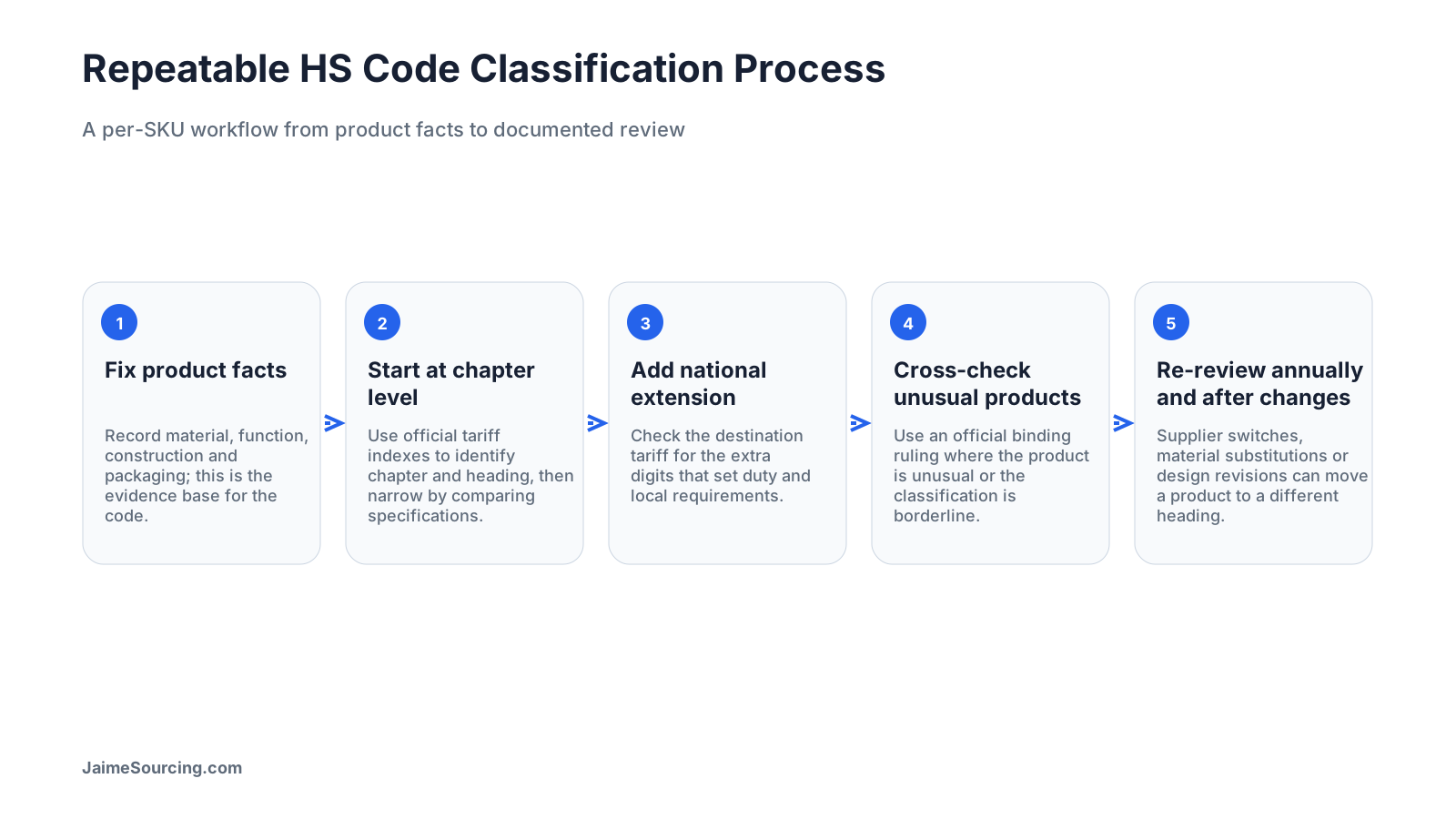
- Identify the chapter and heading. Start from the WCO index or your destination customs website, match your product’s function and material to the heading description, then narrow to subheadings.
- Check the destination extension. Add the national digits for each market you sell into — US HTS, EU TARIC, and the equivalent national tariff for the UK, Canada and Australia.
- Cross-verify with official sources. Use published tariff schedules and, for unusual or high-value products, consider a formal ruling — binding tariff information in the EU or a CBP ruling in the US.
- Build an evidence file per SKU. Customs may ask for specifications, catalogues, technical data sheets, material composition, production process or even samples, especially for electronics, textiles and composite goods.
- Re-review annually and on change. Revisit codes when you switch suppliers, change materials or redesign a product.
A worked example from the research: for an LED table lamp, you would start in Chapter 85 (electrical machinery), move to heading 8513 (portable lamps), then select the subheading matching the LED type — not classify by feel.
For Shopify specifically, HS codes and country of origin can be added per product, by CSV or bulk editor, or at label purchase, and country-specific codes can be layered on top of the six-digit base. Country of origin is where the product is manufactured or assembled into the form you sell — not where components were sourced. Getting origin wrong is a separate error from getting the code wrong, and both affect duty.
| Decision point | What to check | Why it matters |
|---|---|---|
| Six-digit HS code | WCO index, heading and subheading text | Global baseline for classification |
| National extension | US HTS, EU TARIC, UK/CA/AU national tariff | Duty rate and controls are set at national level |
| Country of origin | Manufacturing or final assembly location | Drives FTA eligibility and origin marking |
| Evidence file | Specs, materials, process, photos, samples | Supports the code if customs challenges it |
| Review trigger | New supplier, new material, redesign | Codes can become stale |
The Real Cost of a Wrong Code: Duties, Delays and Penalties
The consequences fall into four buckets, and they compound.
Duty and tax miscalculation. The code determines the tariff rate, VAT/GST and whether trade remedies, anti-dumping duties or free-trade-agreement preferences apply. Under-declaring means you owe the difference plus penalties; over-declaring means you overpay and erode margin. One source illustrates the spread with ceramic versus plastic tableware attracting different rates — a reminder that material and function, not product marketing, drive classification.
Penalties. The research cites fines of roughly US$100 to US$10,000 per shipment depending on destination and the nature of the error, with repeat violations potentially leading to audits or enhanced scrutiny. Treat those figures as indicative ranges from a commercial source, not a statement of any specific country’s penalty schedule — penalty regimes are set nationally and should be confirmed with a broker or the destination authority.
Delays and examinations. Misclassification is cited as a leading cause of clearance delays, with up to 15% of imports flagged for HS-related errors or mismatches in one source’s estimate. Detained shipments can take days to weeks to resolve depending on how fast you supply supporting documents, and that delay can wipe out the time saved by choosing faster freight.
Ongoing scrutiny. Repeated flags can lead to continued review, mandatory pre-clearance or loss of simplified clearance privileges. For a small brand, that is an operational tax on every future shipment.
Note the disagreement in the sources on scale: one commercial source puts HS-related interception at up to 15% of imports, while others describe misclassification risk qualitatively without a figure. The percentage is not an official statistic and should be treated as directional only.
Supplier-Provided Codes: Useful Input, Not Verification
Suppliers often know which codes their other customers use, and it is reasonable to ask. But the same source warns that a supplier’s incentive is to sell product and that a lower-duty code may look more attractive to you — the importer remains responsible for confirming the code with the destination customs authority. In the US, CBP is the agency that interprets the HTS and issues binding classification rulings.
Practical supplier checks that support classification and reduce counterparty risk:
- Verify the legal entity using the Chinese National Enterprise Credit Information Publicity System, and cross-check with Tianyancha or Qichacha. Confirm the Unified Social Credit Code matches the entity on your contract and invoice, check the establishment date (a very new entity warrants more caution), and read registered capital alongside subscribed versus paid-in capital — registered capital is a commitment, not proof of cash on hand.
- Match the business scope to what you are buying; a trading company and a factory carry different verification implications.
- Request a product specification sheet with materials, dimensions, components and manufacturing process — the same document your broker needs for classification.
- Ask for the code they use on past exports to your market, then verify it independently rather than adopting it.
Landed Cost, Incoterms and the DDP Trap
Your HS code feeds directly into landed cost, so the commercial terms you agree with a Chinese supplier determine who carries classification risk. Under EXW, the buyer arranges and pays origin charges, export clearance, freight and destination duty. Under FOB, the supplier covers costs to the named port and export clearance, while the buyer handles main carriage, import duty and customs responsibility. Under DDP, the seller nominally handles everything to your door — but a non-compliant “tax-inclusive” DDP arrangement can mean the seller declares a code or value that understates duty, leaving you as importer of record exposed to reassessment. If you accept DDP, require the declared HS code and duty calculation in writing and confirm who is the importer of record.
On payment mechanics for overseas buyers paying Chinese suppliers: agree T/T terms explicitly (deposit and balance triggers), clarify who absorbs bank charges at each end, and note FX exposure if invoicing in USD while the supplier’s costs are in RMB. Where a platform escrow or Trade Assurance-style service is used, its fee is a real cost to factor into unit economics. Pay the legal entity’s corporate account, not a personal account, and agree in advance how sample-payment fees are allocated.
What to Verify Before You Proceed
- The six-digit HS code and the destination-specific extension for each market you sell into, checked against official tariff schedules.
- Country of origin recorded correctly per SKU in Shopify, separate from the HS code.
- An evidence file per SKU: specs, materials, process, photos, and any prior ruling.
- The supplier’s legal identity, Unified Social Credit Code, establishment date and paid-in capital via the National Enterprise Credit Information Publicity System, Tianyancha or Qichacha.
- The Incoterm and, for DDP, the declared code and duty basis in writing.
- A calendar reminder to re-review codes annually and after any product or supplier change.
FAQ
How do I find the HS code for a product I import from China?
Start with the WCO index or your destination customs site, match function and material to the heading, then add the national digits for each market. Verify against the official tariff schedule and keep a specification file, because customs can ask you to justify the code.
Can I just use the HS code my Chinese supplier gives me?
Use it as an input, not a final answer. Suppliers may favour lower-duty codes, and the importer remains responsible for confirming classification with the destination authority. Cross-check independently and, for high-value or unusual goods, consider a formal ruling.
What happens if my Shopify store ships with the wrong HS code?
Expect possible duty reassessment, penalties, examinations and delays, with repeat issues leading to enhanced scrutiny. Penalty amounts vary by country and are set nationally, so confirm the specific regime with a broker or the destination authority rather than relying on generic figures.
Do I need a different HS code for the US, EU, UK, Canada and Australia?
The six-digit base is the same, but each destination adds its own digits for duty and statistics, and those national codes govern the rate. Shopify lets you store a base code plus country-specific codes per product.
How often should I review my HS codes?
At least annually, and whenever you change supplier, material or product design. The WCO also revises the system roughly every five years, so a code that was correct at launch may need updating.
Managing Classification Risk Across a Long Supply Chain
Classification errors rarely happen in isolation. They surface alongside quality drift, undocumented material substitutions and factory follow-up gaps — the everyday friction of buying from China across time zones and physical distance. A code that was right for your first sample can quietly become wrong when a factory swaps a component or changes assembly.
Jaime Sourcing acts as your ground team in China, supporting supplier research and verification, inspection and quality control, consolidation, packing and shipment coordination. If you want a second pair of eyes on supplier documentation before you commit to a code and a purchase order, talk to Jaime Sourcing about a supplier check or a workflow review.
Turn your product and order requirements into a controlled sourcing brief.
Share the product, supplier link, quantity, destination and current order stage. We will identify the practical verification, quality-control, packing and shipping steps.