Kitting, bundling and subscription box assembly in China means a warehouse receives your individual SKUs from one or more suppliers, combines them into a new sellable unit against a bill of materials (BOM) you provide, and then ships the finished unit internationally. For a Shopify reseller, this is doable in China, but it is a component-control problem, not a packing problem. Every kit consumes component stock and creates a new SKU, so if your BOM, assembly sequence or finished-goods labelling is unclear, you get mismatches, shortages and inventory that no longer reconciles. The rest of this article covers the operating discipline that prevents that.
Why kitting changes your inventory, not just your packaging
A simple pick-and-pack order moves existing stock. Kitting transforms it. Two or more component SKUs are consumed and one new bundle SKU appears. Three consequences follow:
- Your stock counts split. The same component may feed several bundles. If it is not flagged as shared in your BOM, the warehouse can mis-allocate it during picking.
- Your sellable inventory becomes dependent on the scarcest component. One missing insert stalls the whole bundle line.
- Your traceability window shrinks. Once components are sealed inside a box, you cannot inspect them without destroying the unit.
Subscription boxes add a fourth: a fixed shipping window. Subscription fulfillment is component control tied to a recurring dispatch date — components arrive, are assembled to an agreed BOM, and the finished boxes ship on schedule. Miss the window and you are not late on one order; you are late on a cohort.
Build the BOM and assembly brief before you book anything
The single highest-leverage document is a table you hand the warehouse. At minimum it should contain, per bundle: bundle SKU, component SKU, component description, quantity per bundle, and a flag for any component shared across multiple bundles. Add unit weight and dimensions per component if you are calculating freight, and a photo of each component so there is no ambiguity about which variant is meant.
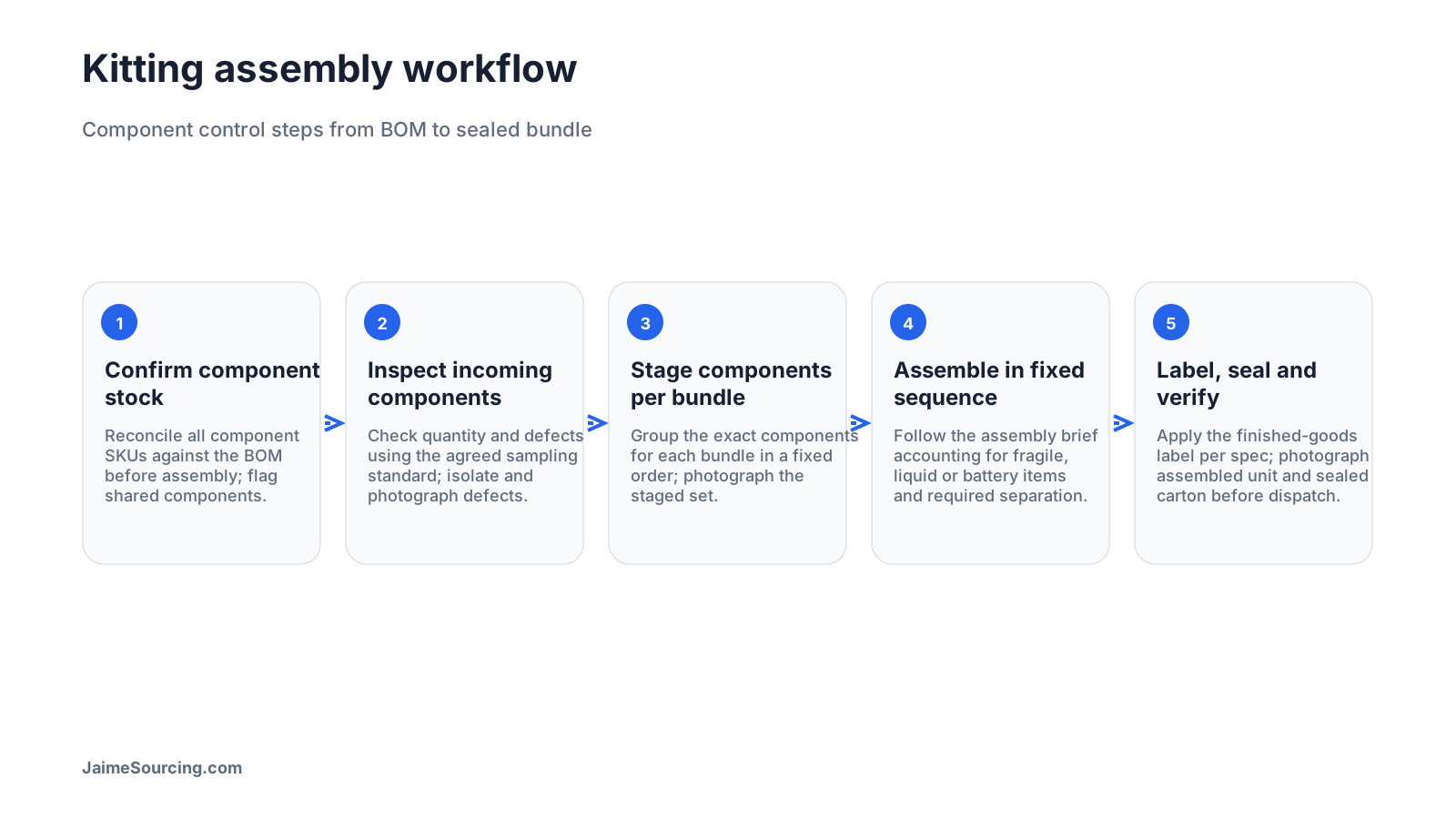
Then write the assembly sequence. A workable default order is: confirm component stock against the BOM, stage components per bundle, assemble in a fixed order, then label and seal. If your bundle contains fragile items, liquids or batteries, the sequence also has to account for cushioning and separation — and whether the combination can legally ship at all depends on the destination country’s rules and the carrier’s own restrictions, so confirm both rather than assuming.
Two documents are routinely skipped and routinely cause disputes:
- A finished-goods labelling spec. State the bundle SKU, barcode symbology, where the label sits, and what must not be covered (ingredients, warnings, batch codes). Unclear finished labelling is the most commonly overlooked step and leads to the wrong bundle being picked and shipped.
- A photo record protocol. Ask for photos of the staged components, the assembled unit, and the sealed carton with its label. These become your evidence if a customer complains or your counts diverge later.
Quality control for multi-SKU assembly
Kitting QC has two layers, and buyers usually only budget for one.
Layer one: incoming component inspection. Before anything is assembled, components should be checked for quantity against the BOM and for defects. Defective components should be isolated and photographed, not quietly used. This is where you apply a sampling standard. The widely used reference is ISO 2859-1 / ANSI/ASQ Z1.4, General Inspection Level II, with defects classified as Critical (safety or legal), Major (function or saleability) and Minor (cosmetic). A common starting point is Critical 0, Major 2.5, Minor 4.0 — treat that as an example to agree with your supplier, not a universal rule. Tighten it for anything a subscriber will handle first.
Layer two: finished-unit verification. Sample the assembled bundles and check that the contents match the BOM, the label matches the bundle SKU, and the packaging survives handling. For subscription boxes, also verify the insert set — the card, sample or gift that changes month to month is the most common source of “wrong box” complaints.
Low-cost controls worth adopting:
- Freeze the BOM version. Give each BOM a version number and date. Any change requires your written re-approval before assembly resumes.
- Separate single-unit and bundle workflows in the warehouse’s system if you sell both, so counts do not blur.
- Set an exception rule. Shortfall, defect or label error should pause the run and trigger a message to you — not a substitution with another SKU.
Peak season, rework and the cost conversation
Kitting demand concentrates before peak selling periods, so component stock, label stock and packing materials should be secured ahead of the window rather than ordered into it. Ask your warehouse for a cut-off date after which BOM changes are not accepted for that season.
Decide your rework policy in advance. If finished bundles have not shipped, they can usually be opened and returned to component stock — but that is extra labour, so confirm the terms before you need it. Kitting is value-added work priced on actual handling, so ask for a quotation based on your real BOM rather than a per-unit guess.
On shipping terms, be precise about who owns what. Under EXW, your exposure starts at the supplier’s door and you carry origin handling. Under FOB, the supplier clears export and delivers to the named port, and you own the main leg. Under DDP, the seller nominally handles everything to your door — and this is where non-compliant “tax-inclusive” arrangements appear, with under-declared values or a customs broker of unknown standing. If a DDP quote looks materially cheaper than every alternative, ask who the importer of record is and how duty and VAT/GST will be declared. For customs and tax questions, check the current official rule in your destination jurisdiction; the answer differs between the US, UK, EU, Canada and Australia.
For payments to Chinese suppliers, overseas buyers typically use T/T. Agree who absorbs bank charges on both ends, note that FX exposure sits with whoever holds the currency between order and payment, and confirm whether any platform Trade Assurance fee applies. Pay the company account named on the contract, not a personal account, and agree up front whether sample and tooling payments are deducted from the bulk order or billed separately.
What to Verify Before You Proceed
Run these checks before you commit component stock to a kitting programme.
Supplier identity. Use the Chinese National Enterprise Credit Information Publicity System to confirm the legal entity exists and matches the name on your contract. Cross-check on Tianyancha or Qichacha for a fuller picture. Read four fields carefully: registered capital (a headline figure, not proof of cash), subscribed versus paid-in capital (subscribed is promised; paid-in is actually contributed — a large gap is a question, not a verdict), establishment date (a very new entity handling your first large kitting run deserves extra scrutiny), and the Unified Social Credit Code (the 18-character identifier that should appear consistently on contracts and invoices).
Warehouse capability. Ask directly whether they perform kitting as a distinct operation, request a sample BOM they have executed, and confirm they can hold component stock and finished bundles as separate inventory.
Quality agreement. Put your AQL levels, defect definitions and photo-record requirement in writing. Confirm who pays for rework caused by a component defect versus a BOM error on your side.
Commercial terms. Get the Incoterm in writing, confirm the importer of record, and reconcile the DDP quote against a declared-value calculation.
Compliance. Confirm destination-country requirements and carrier restrictions for any battery, liquid or fragile component before assembly begins.
Frequently Asked Questions
Can I run kitting and bundling from a China warehouse if my components come from several suppliers?
Yes, provided the warehouse receives all components against a single BOM and reconciles quantities before assembly starts. Suppliers ship individual SKUs in, the warehouse combines them into the new bundle SKU, and international shipping is arranged from there. The failure mode is a component arriving late or short, so build a stock-confirmation step into the schedule.
How do I stop the warehouse substituting a similar SKU when one component runs short?
Write an explicit no-substitution rule into your brief and require a pause-and-notify response on any shortfall. The standard practice is to halt the run and escalate to you or the supplier for replenishment or a revised plan, rather than swapping in another SKU. Confirm the warehouse accepts this rule in writing before the first run.
What quality standard should I use for subscription box assembly?
Use ISO 2859-1 / ANSI/ASQ Z1.4 at General Inspection Level II as your sampling reference, with Critical, Major and Minor defect classes agreed in advance. Critical 0 / Major 2.5 / Minor 4.0 is a common starting example, not a universal rule. For subscription boxes, add a specific check that the correct monthly insert is in each unit.
Can finished bundles be broken back down into components if my plans change?
Usually yes, if the bundles have not shipped — the boxes can be opened and the components returned to stock. Expect additional handling charges for the work. Agree the rework rate and the conditions before you commit, because the cost is easier to negotiate in advance than after the fact.
Who is responsible for customs duty on a DDP kitting shipment from China?
Under DDP the seller nominally handles delivery and duty, but you should confirm who is named as importer of record and how value is declared. Non-compliant “tax-inclusive” DDP arrangements that under-declare value create risk that lands on the importer. Check the current official rule in your destination country before relying on any DDP quote.
Managing distance, drift and follow-up
The hard part of China kitting is not the first run — it is the fifth. Component specs drift between batches, a substitute insert appears without notice, a label printer changes, and you are 8 to 12 time zones away from the person who could have caught it. Subscription models amplify this because a single defective cohort reaches every subscriber at once, and the complaint arrives weeks after the box left the warehouse.
That is the gap a ground team closes. Jaime Sourcing supports overseas buyers with supplier research and verification, inspection and quality control, consolidation, packing and shipment coordination in China — so component checks, BOM conformance and finished-unit photos happen before the container leaves, not after your customers open the box. If you are planning a bundle launch or a subscription programme and want your BOM, QC plan and supplier setup reviewed before you commit stock, start a workflow review with Jaime Sourcing.
Turn your product and order requirements into a controlled sourcing brief.
Share the product, supplier link, quantity, destination and current order stage. We will identify the practical verification, quality-control, packing and shipping steps.