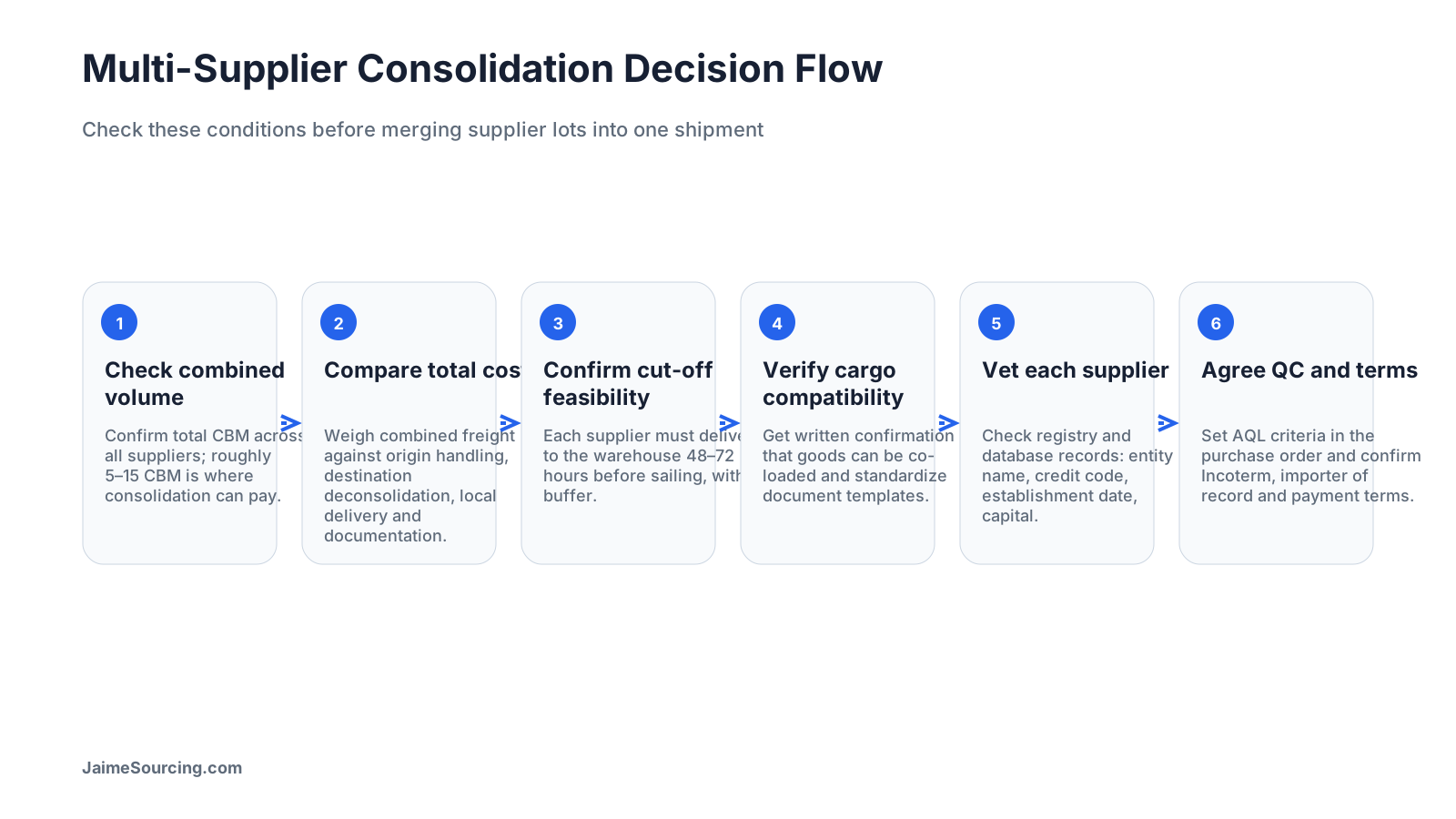
Consolidation saves money when your combined shipment is large enough to spread fixed handling costs across several suppliers, your goods are compatible, and every supplier can hit the same warehouse cut-off. In practice that usually means a combined volume of roughly 5–15 CBM, where merging several LCL lots into one shipment can cut per-CBM freight by an estimated 25–40% versus shipping each supplier separately. Below about 5 CBM, consolidation rarely beats a single LCL booking; above roughly 15 CBM, a full container (FCL) usually wins on cost anyway. Everything in between is where the real decision sits—and where hidden fees and timing risk can quietly erase the headline saving.
This article walks a Shopify reseller or small brand through the conditions that make consolidation pay, the costs people forget to model, and the verification steps that protect you before cargo leaves China.
The volume thresholds that decide the math
Consolidation is not a discount you switch on; it is a way of spreading fixed origin and destination handling across more cargo. The economics hinge on volume bands.
| Combined volume | Typical best option | Why |
|---|---|---|
| Under ~5 CBM | Single LCL shipment | Consolidation handling fees outweigh the freight saving |
| ~5–15 CBM | Multi-supplier LCL consolidation | Per-CBM freight can fall an estimated 25–40% versus separate LCL lots |
| Over ~15 CBM | FCL container | A full container is generally more economical than consolidated LCL |
These are planning bands, not guarantees—actual breakpoints depend on your lane, season and carrier rates. “Consolidate everything” is the wrong default. Model your combined volume first, then decide.
It also helps to understand why consolidation exists at all. Most importers cannot fill a container alone, so consolidators combine cargo from multiple shippers into shared containers to lower rates and improve cargo security. Multi-supplier consolidation is the same principle applied to your suppliers: their separate lots become one booking. Industry commentary suggests more than 60% of China’s export LCL already involves cargo from two or more suppliers, so the practice is mainstream—but mainstream does not mean automatic savings.
The costs consolidation adds—and the ones it hides
The freight saving is real, but it arrives with a new cost layer. Origin consolidation handling typically runs about $30–55 per CBM, covering receiving, storage and container loading. Destination deconsolidation is often in a similar range, around $30–55 per CBM. Add local delivery (billed per pallet or per CBM) and documentation fees, which can rise when supplier paperwork is incomplete or inconsistent.
Compare consolidation against separate LCL or FCL on a total-cost basis, including origin and destination handling, local delivery and documentation—not just the ocean freight line. A shipment that looks 30% cheaper per CBM can break even once handling is counted.
There is also a cash-flow angle. Cross-border supply chains tie up capital in inventory, freight and duties, and longer cycles slow repayment. Consolidation can reduce total freight spend while increasing the amount of cargo sitting in one shipment—so if that shipment is delayed, more of your capital is exposed at once. Factor that into your working-capital plan, not just your freight quote.
Timing, cut-offs and the single-supplier failure risk
The biggest operational risk in multi-supplier consolidation is a missed warehouse cut-off. Consolidators commonly require all cargo at the consolidation warehouse 48–72 hours before vessel departure, which means every supplier’s production completion, inland transport and warehouse delivery must be synchronized. If one supplier misses the deadline, the entire consolidated shipment can slip 7–14 days to the next available sailing.
For a reseller timing a product launch or restock, a two-week slip can be worse than paying more freight. Mitigations that work in practice:
- Build a written production-and-delivery plan with each supplier and confirm readiness at least a week ahead.
- Check in with all suppliers weekly in the run-up to the cut-off, and work with a forwarder that proactively chases supplier progress.
- Keep a buffer between the planned warehouse arrival and the vessel cut-off rather than planning to the last hour.
This is also where supplier verification pays off. A supplier with a shaky production record is a consolidation risk multiplier, because their delay becomes everyone’s delay.
Cargo compatibility: not everything can share a container
Consolidation only works if the goods can legally and safely travel together. Mixing dangerous goods with general cargo, or temperature-controlled goods with ambient cargo, can lead to rejection or regulatory penalties. Before booking, confirm cargo compatibility with both your forwarder and the consolidation warehouse.
Documentation is the second compatibility test. A consolidated shipment can use one master bill of lading to simplify destination clearance, but each supplier still needs accurate packing lists and commercial invoices—ideally on a standard template. Inconsistent documents can cause customs delays, fines or refused release. Standardizing invoice and packing-list templates across all suppliers is one of the cheapest risk controls available.
Verifying suppliers before you consolidate
Because consolidation amplifies any single supplier’s failure, verify each supplier’s legal and operational standing before committing cargo. Three tools are standard for overseas buyers:
- Chinese National Enterprise Credit Information Publicity System (National Enterprise Credit Information Publicity System) — the official registry. Use it to confirm the company exists, its Unified Social Credit Code, establishment date and registered capital.
- Tianyancha and Qichacha — commercial databases that aggregate registry data plus litigation, ownership and change records.
Read the numbers carefully. Registered capital (registered capital) is the amount subscribed at incorporation; paid-in capital (paid-in capital) is what shareholders have actually contributed. A high registered figure with little paid-in capital tells you less than it appears to. Check the establishment date—a company formed months ago has no track record—and confirm the Unified Social Credit Code matches the entity on your contract and invoices. Cross-check the business scope against what you are buying.
These checks do not replace a physical inspection, but they catch the obvious mismatches—wrong entity name, brand-new shell company, scope that does not cover your product—before money moves.
Quality control when several factories feed one shipment
Consolidation does not change what “good” looks like; it changes how much bad product travels together. Agree acceptance criteria with each supplier in writing and inspect against them before cargo goes to the consolidation warehouse, not after.
A common framework is AQL sampling under ISO 2859-1 / ANSI/ASQ Z1.4, using General Inspection Level II. Defects are classified as Critical (safety or legal issues), Major (functional or visible faults that would trigger a return) and Minor (cosmetic issues). A frequently used starting point is Critical 0 / Major 2.5 / Minor 4.0—but treat that as an example, not a universal rule. Tighten the limits for higher-risk or higher-value products, and document the agreed levels in your purchase order so there is no dispute at inspection.
Incoterms and payment terms that affect the real cost
Your Incoterm decides who pays origin charges and who carries risk—and therefore whether “consolidation savings” land on your side of the ledger.
- EXW (Ex Works): you pay everything from the factory door, including inland transport to the consolidation warehouse. Maximum control, maximum admin.
- FOB (Free On Board): the supplier covers costs and risk until cargo is loaded on the vessel at the named Chinese port. Origin charges up to that point sit with the supplier.
- DDP (Delivered Duty Paid): the seller handles everything including destination duty. Be cautious with “tax-inclusive” DDP arrangements that under-declare value or blur the importer of record—non-compliant structures can create customs exposure for you, the buyer. Confirm who is the importer of record and that declarations are accurate.
On payment, overseas buyers typically pay Chinese suppliers by T/T. Watch bank fees (they can be deducted from the amount received, so agree who bears them), FX exposure between order and payment, and platform fees if you use Trade Assurance. Pay the company account named on the contract and invoices, not a personal account, unless you have verified and documented why. For samples, agree up front whether the sample fee is refunded against a bulk order and who pays courier costs.
What to Verify Before You Proceed
- Combined volume: confirm total CBM across all suppliers and test it against the 5 CBM and 15 CBM bands before choosing consolidation.
- Total-cost comparison: get itemized quotes for consolidation versus separate LCL/FCL, including origin handling (
$30–55/CBM), destination deconsolidation ($30–55/CBM), local delivery and documentation. - Cut-off feasibility: confirm each supplier can deliver to the warehouse 48–72 hours before sailing, with buffer.
- Cargo compatibility: get written confirmation from forwarder and warehouse that goods can be co-loaded.
- Document templates: standardize packing lists and commercial invoices across suppliers.
- Supplier standing: check the National Enterprise Credit Information Publicity System, Tianyancha or Qichacha for entity name, Unified Social Credit Code, establishment date, registered vs. paid-in capital.
- Incoterm and importer of record: confirm who pays origin charges and who is the importer of record on any DDP arrangement.
- QC criteria: agree AQL levels and defect definitions in the purchase order before production ends.
FAQ
Does consolidating multiple Chinese suppliers always reduce freight cost?
No. Consolidation saves money mainly when combined volume is roughly 5–15 CBM, where per-CBM freight can fall an estimated 25–40% versus separate LCL lots. Below about 5 CBM, handling fees usually outweigh the saving; above about 15 CBM, FCL is generally cheaper. Always compare total cost, not just ocean freight.
How much do consolidation handling fees add?
Origin consolidation handling typically runs about $30–55 per CBM, and destination deconsolidation is often similar, around $30–55 per CBM. Local delivery and documentation fees sit on top. These charges are why a shipment that looks much cheaper per CBM can break even once everything is counted.
What happens if one supplier misses the warehouse cut-off?
The entire consolidated shipment can be delayed 7–14 days to the next sailing. Consolidators commonly require cargo at the warehouse 48–72 hours before departure, so one late supplier holds up everyone. Build buffer time and confirm supplier readiness at least a week ahead.
Can all products be consolidated together?
No. Dangerous goods mixed with general cargo, or temperature-controlled goods combined with ambient cargo, can be rejected or trigger penalties. Confirm compatibility with your forwarder and the consolidation warehouse before booking, and standardize documentation across suppliers to avoid customs delays.
Managing the distance between you and your factories
Consolidation rewards coordination and punishes drift. The risks that erode your saving are rarely dramatic—a supplier who quietly slips a week, a factory that substitutes a component after the golden sample, a packing list that does not match the carton, a time-zone gap that turns a one-day question into a five-day delay. Physical distance and time-zone friction make all of these harder to catch from the US, UK, EU, Canada or Australia.
That is the gap a ground team closes. Jaime Sourcing supports overseas buyers with supplier research and verification, inspection and quality control, consolidation, packing and shipment coordination—so quality drift, factory follow-ups and cut-off timing are checked on the ground rather than assumed from an email thread. If you are weighing multi-supplier consolidation, talk to Jaime Sourcing about a supplier check or a workflow review before your next shipment is booked.
Turn your product and order requirements into a controlled sourcing brief.
Share the product, supplier link, quantity, destination and current order stage. We will identify the practical verification, quality-control, packing and shipping steps.