Before you send CAD files, a bill of materials or your customer list to a Chinese factory, understand that a standard NDA addresses only one of your three real risks. It stops the factory from telling others about your information. It does not clearly stop the factory from using your drawings to make a competing product, and it usually says nothing about going around you to sell to your customers. An NNN agreement — non-disclosure, non-use, non-circumvention — is drafted to cover all three, under Chinese law and in a Chinese forum.
That distinction matters more for a small ecommerce brand than for a large enterprise, because you rarely have a legal department or the budget for cross-border litigation. Your protection has to come from the contract’s deterrent effect and from the verification work you do before you sign anything.
The Three Risks, and Which Document Covers Which
Your exposure sits in three layers.
Disclosure. Someone at the factory forwards your drawings to a friend at another plant, or posts a photo of your prototype. This is the classic NDA risk, and a properly drafted NDA does address it.
Use. The factory takes your tooling or your specification and runs the same product for a different buyer, or a slightly modified version under another brand. No third party is ever “told” anything confidential in a way an NDA would capture — the factory simply uses what it learned. This is the gap that catches most first-time importers.
Circumvention. The factory learns who your customers are and what they pay, then approaches those customers directly with a lower quote. Again, nothing has been “disclosed” in the NDA sense.
An NNN agreement is structured around exactly these three verbs. The non-disclosure limb mirrors an NDA; the non-use limb restricts application of your information beyond your project; the non-circumvention limb restricts bypassing you to reach your customers or market.
| Question | Standard Western NDA | China NNN Agreement |
|---|---|---|
| Stops the factory telling others? | Yes, if drafted and signed properly | Yes |
| Stops the factory using your drawings for other buyers? | Usually not addressed | Yes, via the non-use limb |
| Stops the factory selling direct to your customers? | Usually not addressed | Yes, via the non-circumvention limb |
| Governing law typically used | Your home country law | PRC law, with PRC court or CIETAC arbitration |
| Who must sign | Often a manager or sales rep | The registered legal entity, with the official company seal |
| Typical failure mode | Unenforceable in China, wrong risk covered | Downloaded template, wrong signatory, signed too late |
The table is a planning aid, not legal advice. Whether a specific clause holds up depends on drafting, signatory authority and the facts of the breach.
Why a Home-Country NDA Often Underperforms in China
China does not lack confidentiality or trade-secret law. The problem is forum and enforcement mechanics. If your NDA is governed by US, UK or EU law and specifies a foreign court, you may win at home and still face a difficult, expensive path to enforcing that judgment against a Chinese company’s assets in China.
The practical fix used in China manufacturing contracts is to designate PRC law as governing law and choose a Chinese court or CIETAC arbitration as the dispute forum, so that any award can be enforced locally against the manufacturer. That is a structural decision, not a wording tweak, and it is the single most common reason a downloaded template provides little real protection.
A second structural issue is scope. Many buyers focus entirely on confidentiality and forget ownership of what the relationship produces: CAD files, STEP files, prototypes, moulds, test data and later improvements. If the agreement is silent on ownership, you can end up arguing about who owns the tooling you paid for. A development-and-tooling clause that assigns these outputs to you — unconditionally or on payment — closes that gap.
The Signatory Problem: Verify the Entity Before You Verify the Clause
A well-drafted NNN agreement signed by the wrong party is close to worthless. Two failures recur.
First, the entity. Your contact may be a trading company while the actual production happens at a separate factory. If the trading company signs and holds no meaningful assets, there may be little to pursue. Pull the manufacturer’s official Chinese registered name from the National Enterprise Credit Information Publicity System (NECCIPS) and use that exact Chinese name in the contract — not an English trade name and not a Hong Kong entity if your real counterparty is a mainland company.
Second, the seal. In China, the company seal registered with the public security authorities functions as the corporate signature. An agreement signed only by an individual employee, without the official company seal, can later be challenged as unauthorized. Require the seal on the agreement, and check that the name on the seal matches the registered name.
When you run the entity check, read the registration data carefully rather than just confirming the company exists:
- Unified Social Credit Code — the 18-character identifier; use it to confirm you are looking at one specific legal entity, not a same-named neighbour.
- Establishment date — a company registered a few months ago may not have the production history its sales deck implies.
- Registered capital vs. paid-in capital — registered capital is a subscribed figure, not money in the bank. Paid-in capital (where disclosed) is the more meaningful signal, and even that is a snapshot, not a guarantee of financial health.
- Business scope — confirm manufacturing of your product category actually falls within the registered scope.
- Status andabnormal records — check for “abnormal operations” listings, administrative penalties and litigation history.
NECCIPS is the official channel. Tianyancha and Qichacha are commercial aggregators that often surface litigation, IP disputes and shareholder data in a more readable format; treat them as a convenience layer and reconcile anything material against NECCIPS or a qualified local adviser.
Sequencing: When to Sign, and What to Withhold Until You Do
Timing is where most small brands lose the protection they paid for. Sensitive technical drawings, specifications and pricing are frequently shared during quotation, before any agreement exists. Once information is out without a contract, proving later misuse becomes much harder.
A workable sequence for a Shopify brand launching a private-label product:
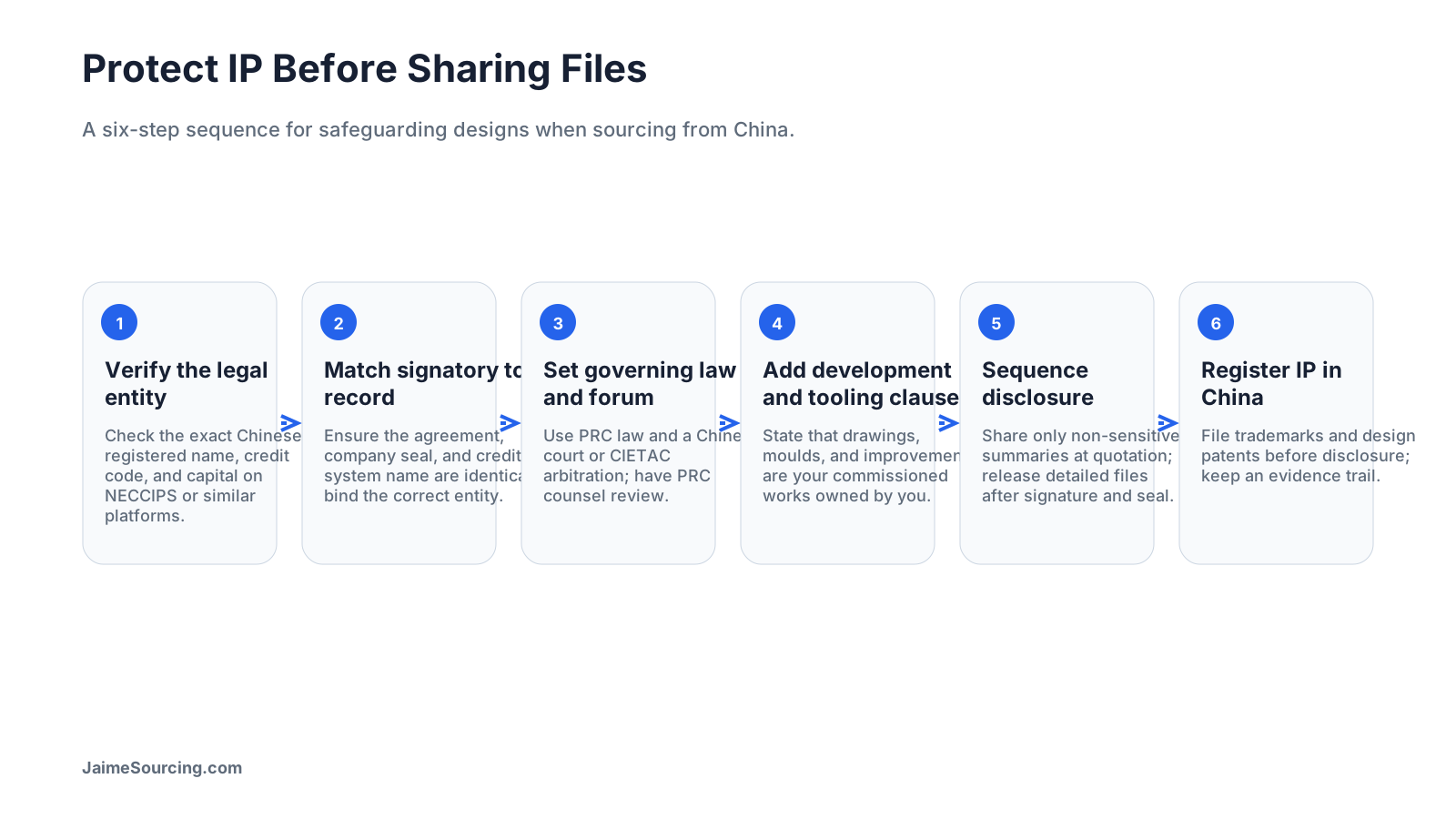
- Entity check first. Confirm the registered name, credit code, status and business scope before any substantive discussion.
- Sign the NNN agreement before technical disclosure. For the initial quote, share only non-sensitive outline information — category, target volume band, general material and finish expectations.
- Release drawings, BOM and tooling files only after the sealed agreement is returned. Keep a dated record of what was sent and to whom.
- Register your IP where it matters. An NNN agreement binds your counterparty; it does not stop unrelated third parties. Consider filing designs, trademarks or relevant rights in China before broad disclosure. Confirm current filing routes and fees with a qualified IP professional.
- Re-verify on any change of counterparty. If production moves to a sister company or a new entity, the old agreement may not follow.
An NNN agreement is a deterrent and a procedural tool, not a guarantee. Experienced China counsel note that its main value is changing the factory’s incentives at the outset, so that misuse looks costly and local rather than remote and theoretical. Buyers who treat a signed PDF as a substitute for supplier verification, tooling control and inspection are relying on the wrong control.
What to Verify Before You Proceed
Run this checklist before you release drawings or pay a tooling deposit.
- Registered identity: exact Chinese legal name, Unified Social Credit Code and business scope confirmed on NECCIPS; cross-checked on Tianyancha or Qichacha.
- Signatory authority: agreement sealed with the official company seal, name on seal matching the registered name, and the signatory’s authority confirmed in writing.
- Governing law and forum: PRC law with a Chinese court or CIETAC arbitration clause, drafted or reviewed by someone qualified in PRC law.
- Scope of confidential information: defined specifically — drawings, BOM, pricing, customer lists, test data — rather than a vague catch-all, since specificity makes breach easier to evidence.
- Ownership clause: drawings, prototypes, moulds and improvements assigned to you, with the trigger (unconditional or on payment) stated.
- Non-circumvention wording: covers your named customers and target markets, and survives termination for a defined period.
- Disclosure log: dated record of every file shared, with recipient and version.
- IP filings: design, trademark or other rights filed or scheduled, with current requirements confirmed by a qualified adviser.
- Commercial terms in parallel: Incoterm, payment structure and inspection standard agreed in writing, so the NNN agreement is not the only document in the file.
On commercial terms, keep the basics explicit. Under EXW the buyer carries origin charges and export clearance; under FOB the seller handles export clearance and loading, with risk passing at the ship’s rail; under DDP the seller nominally handles everything, but “tax-inclusive DDP” arrangements that under-declare value or route goods through informal channels can leave the importer exposed to customs and platform consequences. For payments, T/T terms, bank charges at both ends, FX exposure between quote and settlement, and whether you are paying a corporate or personal account all deserve a written record — and sample fees should be allocated explicitly rather than assumed.
Regulations, tariff treatment and platform rules can change. This guide was reviewed on November 8, 2026. Confirm the current requirements with the destination-country authority, customs broker or qualified compliance adviser before placing an order.
FAQ
Do I need an NNN agreement if the factory has already signed my NDA?
An NDA typically covers disclosure only, so it may not restrain the factory from using your drawings for other buyers or selling around you. If your NDA is governed by foreign law and lacks non-use and non-circumvention limbs, it addresses a narrower risk than most manufacturing relationships carry. Review the scope before assuming you are covered.
Can I just download an NNN template and send it to the factory?
Downloaded templates are widely sold and frequently misaligned with the buyer’s actual risk, and some buyers do not need an NNN agreement at all for their specific situation. The critical variables — governing law, forum, signatory, seal and ownership of tooling and drawings — are exactly where generic forms tend to fail. Have the document reviewed by someone qualified in PRC law.
Is an NNN agreement enforceable against a Chinese factory?
Enforceability depends on drafting, the correct legal entity signing under seal, and a forum that can act on local assets — which is why PRC law with a Chinese court or CIETAC clause is commonly used. Even then, the primary value is deterrence before breach rather than recovery after it. Treat it as one control among several, alongside verification and inspection.
What should I check on NECCIPS before signing?
Confirm the exact Chinese registered name, the Unified Social Credit Code, establishment date, business scope, operating status and any abnormal-operations or penalty records. Compare registered capital with paid-in capital where disclosed, remembering that registered capital is a subscribed figure rather than available funds. Cross-check litigation and IP history on Tianyancha or Qichacha, then reconcile anything material against the official record.
Does an NNN agreement stop a factory from copying my product entirely?
No. It binds your counterparty contractually; it does not prevent unrelated third parties from copying a design that is unprotected in China. That is why filing relevant IP in China before broad disclosure is commonly recommended alongside the agreement. Confirm current filing options and costs with a qualified IP professional for your product category.
Managing the Distance, Not Just the Document
A signed NNN agreement changes incentives, but it does not watch your tooling, catch a silent material substitution, or notice that your approved sample has quietly drifted by the third production run. Those failures happen in the gap between your time zone and the factory floor, and they are usually discovered too late — after the container is loaded.
Jaime Sourcing works as the buyer’s ground team in China, covering supplier research, verification, inspection, quality control, consolidation, packing and shipment coordination. If you are preparing to disclose drawings to a new manufacturer, or want a second pair of eyes on an existing supplier workflow, talk to Jaime Sourcing about a supplier check or a workflow review before your next deposit.
Turn your product and order requirements into a controlled sourcing brief.
Share the product, supplier link, quantity, destination and current order stage. We will identify the practical verification, quality-control, packing and shipping steps.