For duty and tariff questions, trust your destination country’s customs authority and its official tariff schedule first; for product compliance, trust the named market regulator (for example, the EU safety or chemicals regulator, the UK product-safety authority, or the US consumer-product and customs agencies); and for platform mechanics such as HS codes and DDP labels, trust the official Shopify help documentation. Treat supplier statements, freight-forwarder quotes and third-party calculators as estimates to be reconciled against those primary sources—not as the source of truth.
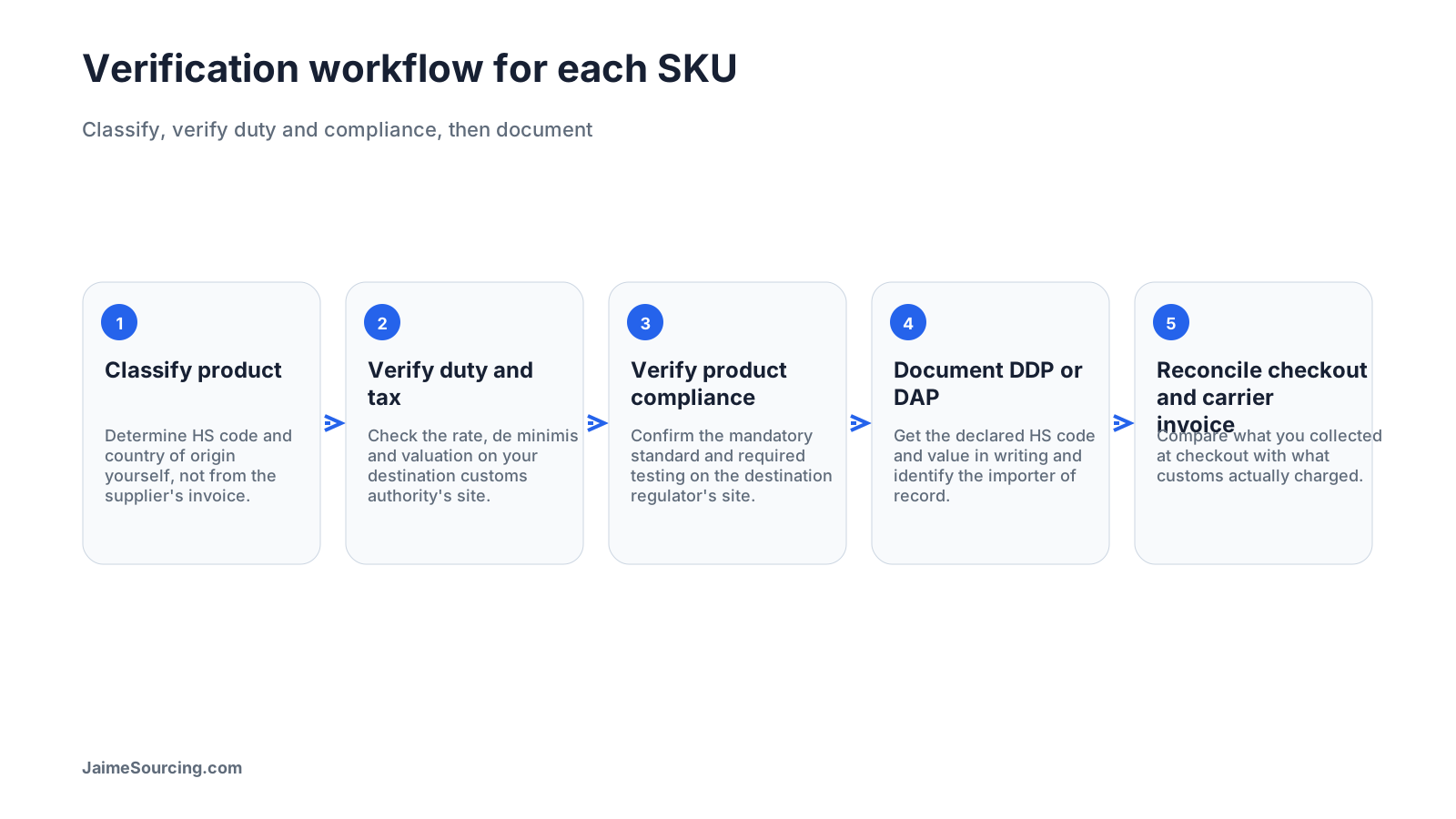
That hierarchy matters because the same product can carry different duty treatment depending on its HS code, country of origin and destination, and because platform estimates are only as good as the data you feed them. The verification workflow below is designed to run before you place a purchase order.
Regulations, tariff treatment and platform rules can change. This guide was reviewed on November 8, 2026. Confirm the current requirements with the destination-country authority, customs broker or qualified compliance adviser before placing an order.
The Source Hierarchy: What to Trust, and for What
Not every “official-looking” page carries equal authority. Sort your questions by who actually owns the answer.
| Question | Primary source to trust | What it is good for | What it cannot tell you |
|---|---|---|---|
| What duty rate applies to my product? | Destination customs authority’s tariff schedule | Duty rate by HS code and origin | Whether your specific product is correctly classified |
| Is my product legal to sell? | Named market regulator (safety, chemicals, labelling) | Mandatory standards, labelling, documentation | Commercial viability or testing cost |
| How should I set up HS codes and DDP in my store? | Official Shopify help documentation | Platform mechanics, label types, fee structure | The legally correct duty rate |
| What did customs actually charge? | Carrier invoice and customs entry | The assessed amount | Why a discrepancy occurred |
| Is my supplier a real, registered company? | Chinese corporate registries | Registration status, capital, founding date | Product quality or compliance |
Shopify’s own documentation is explicit that duty and tax amounts calculated at checkout are estimates based on the information available when the customer orders, and that inaccurate product data—such as a missing country of origin or a wrong HS code—can result in additional duties being charged to the customer on arrival. Read any platform calculator that way: a planning tool, not a legal determination.
Verify Duty and Tariff Treatment at the Destination Customs Authority
Duty is set by the importing country, not by the seller’s location. Shopify’s guidance notes that tariffs usually depend on the origin of the goods rather than where the seller is based, which means only the party that knows the product’s origin can determine whether a duty applies under current rules. Start with the destination customs authority’s published tariff and any trade-agreement rules that could change the rate.
Three variables drive the answer:
- HS classification. The Harmonized System code is the standardized numeric classification most customs authorities use to categorize products and set applicable duties. A wrong code can move you between very different rates.
- Country of origin (COO). Origin, not shipping route, determines preferential treatment. Trade-agreement eligibility depends on origin rules, and some measures apply on top of normal rates regardless of agreement status.
- Customs valuation. Duty is generally assessed on the declared value, so how you invoice matters.
Treat headline tariff figures in the press with caution. Rates change, temporary measures expire, and country-specific actions can be layered on top of base rates. Shopify’s own materials describe a fast-moving environment in which US tariff measures, de minimis treatment and refund processes have shifted repeatedly, and they direct merchants to check current government guidance rather than rely on a static summary. If a supplier or forwarder quotes you a duty percentage, ask which HS code, origin and effective date it assumes—then confirm it against the destination authority.
For cross-checking a rate from the origin side, China’s Ministry of Commerce operates an international trade tax query tool that lists duty treatments by destination and HS code. It is useful as a secondary reference, but the destination authority’s schedule governs.
Verify Product Compliance With the Named Market Regulator
Compliance is product- and market-specific, so there is no single global register. Identify the regulator that governs your category in each destination market, then confirm the mandatory standard, labelling and documentation requirements directly from that regulator’s published guidance.
A practical sequence:
- Define the product precisely. Material, intended use, age group and power source all change which rules apply.
- Identify the governing regulator and standard for that category in that market.
- Ask the supplier for the test reports and declarations that correspond to that standard—then check the issuing lab and the report’s scope, not just the logo on the cover.
- Confirm labelling and language requirements with the regulator’s guidance, since these are frequently the cause of border holds.
“Our factory is certified” is not a compliance answer. Certifications attach to specific products, tested to specific standards, by specific bodies. If a supplier cannot name the standard and the testing body, treat the claim as unverified.
Use Shopify’s Official Documentation for Platform Mechanics
Shopify’s help centre is the right source for how the platform calculates and displays duties—not for what the law requires. Key mechanics to know before you enable checkout duty collection:
- DDP versus DAP labels. If you collect duties at checkout, you need to buy and use a Delivered Duty Paid (DDP) shipping label rather than a standard one; otherwise the customer may be charged duties again on delivery. If duties were not collected, the commercial invoice should be marked DAP (Delivered At Place) to show duties are unpaid.
- Data quality drives accuracy. Missing or incorrect HS codes and country-of-origin fields are a common cause of duties not being applied or being under-collected at checkout.
- Reconcile against carrier invoices. Shopify recommends comparing the amounts collected at checkout with what the destination customs authority actually charged once you receive the carrier’s first invoice, and repeating that check periodically.
- Watch the fee structure. Shopify applies a transaction fee on orders where duties and import taxes are calculated, and the rate has been subject to temporary changes. Confirm the current fee on the official page before modelling margins.
Shopify also documents that, for US-bound shipments, de minimis treatment has been subject to change, with duties and import taxes applying to all US imports regardless of shipment value as of the date stated in its help centre. Because this is exactly the kind of rule that moves, verify the current position with US Customs and Border Protection rather than relying on any secondary summary.
Reconcile Estimates Against What Customs Actually Charges
The gap between your checkout estimate and the customs assessment is where margin leaks. Build a simple reconciliation loop:
- Record the HS code, origin and declared value used for each order.
- Compare the carrier invoice to the amount collected at checkout.
- Investigate every material variance. Common causes are a wrong HS code, a different code applied by customs, or a mismatch between the commercial invoice price and the price charged to the customer.
- Correct the product data in your store, or escalate to your customs broker if you believe your classification is right.
Currency movement between order date and shipping date is another documented source of variance, and Shopify notes that selling in multiple currencies can reduce it. Treat FX as a cost line, not a rounding error.
Check the Supplier Behind the Paperwork
Official sources tell you what the rules are. They do not tell you whether the company shipping your goods is real, stable or telling you the truth. For that, use China’s corporate registries: the National Enterprise Credit Information Publicity System, Tianyancha and Qichacha.
Read the fields carefully:
- Unified Social Credit Code — the 18-character identifier that ties a company to its official registration. Match it across documents and bank details.
- Registered capital versus paid-in (subscribed) capital — registered capital is the amount committed at incorporation; paid-in capital is what has actually been contributed. A large registered figure with little paid-in capital tells you less than it appears to.
- Establishment date — a very new entity trading under an established-sounding brand deserves extra scrutiny.
- Business scope and status — confirm the registered scope covers manufacturing or trading in your product category, and that the entity is in good standing.
Cross-check the registry name and credit code against the proforma invoice, the bank account name and the factory audit documents. Mismatches between the contracting entity and the receiving bank account are a classic red flag.
What to Verify Before You Proceed
Run this checklist before releasing a deposit or enabling international checkout:
- HS code and origin confirmed against the destination customs authority’s current schedule, not a supplier’s guess.
- Compliance standard and test reports obtained from the supplier and checked against the named regulator’s requirements for that market.
- Duty collection method decided (DDP collected at checkout versus DAP paid on delivery), with the matching label type and commercial invoice terms.
- Platform fees and calculator settings reviewed on the official Shopify page as of today’s date.
- Supplier identity verified through the National Enterprise Credit Information Publicity System, Tianyancha or Qichacha, with the credit code matched to banking details.
- Reconciliation process in place to compare checkout estimates with carrier invoices.
- Current rules re-checked with the destination authority or a customs broker, given how frequently tariff and de minimis treatment has changed.
Frequently Asked Questions
Can I rely on my freight forwarder’s duty estimate?
A forwarder’s estimate is a planning input, not an official determination—confirm the HS code, origin and rate against the destination customs authority before you price a product. Forwarders vary in how current their tariff data is, and layered measures can change the answer. Ask them to show the code and effective date behind any figure.
Is a supplier’s certificate enough to prove product compliance?
Usually not on its own—certificates attach to specific products tested to specific standards by specific bodies, so verify the scope and issuer against the market regulator’s requirements. A certificate for a different model or material proves little. Request the full test report and check the standard it references.
Why did customs charge more than my checkout estimate?
The most common causes are an incorrect or missing HS code, a code applied differently by customs, or a mismatch between invoice and charged prices. Currency movement between order and shipment can also widen the gap. Reconcile each variance and correct your product data.
Do I need a DDP label if I collect duties at checkout?
Yes—Shopify’s documentation states that if you collect duties at checkout you should buy and use a DDP label, or the customer may be charged duties again on delivery. Using a standard label after collecting duties is a documented cause of double charging. Match the label type to your collection method every time.
Managing the Distance Between You and the Factory
Paperwork verification is only half the job. The other half is physical: confirming that the goods match the approved sample, that production has not drifted, and that follow-ups happen on your timeline rather than the factory’s. Time-zone gaps and language friction make that harder from the US, UK, EU, Canada or Australia—and quality drift rarely announces itself before the container ships.
Jaime Sourcing acts as your ground team in China, supporting supplier research and verification, inspection and quality control, consolidation, packing and shipment coordination. If you want a second pair of eyes on a supplier’s registration details or a review of your sourcing and verification workflow, get in touch with Jaime Sourcing and we can walk through it with you.
Turn your product and order requirements into a controlled sourcing brief.
Share the product, supplier link, quantity, destination and current order stage. We will identify the practical verification, quality-control, packing and shipping steps.