
If your cartons can survive stacking and your receiving warehouse can break them down by hand, floor loading usually wins on container utilization. If your goods are heavy, fragile, high-value, or your warehouse runs on forklifts and dock levellers, palletizing is usually the safer operational choice. The decision is not about which method is “better” — it is about matching the loading method to your carton strength, product mix, destination handling equipment and total landed cost.
This guide covers the tradeoffs for overseas buyers shipping from China: how to calculate real capacity, what to put in writing with your supplier, and where the hidden costs sit.
What “Palletized” and “Floor-Loaded” Actually Mean
Floor-loaded (also called loose or bulk-stowed) means cartons are stacked directly inside the container without pallets. The container floor is the base. Cartons are stacked to the ceiling where product weight and crush resistance allow, and the load is typically secured with airbags, straps or dunnage.
Palletized means cartons are stacked onto pallets, wrapped and strapped, then the pallet units are loaded into the container as discrete handling units. Forklifts move each pallet in and out.
Note a terminology trap: “bulk cargo” in freight glossaries refers to unpackaged commodities like grain, coal or liquids loaded directly into a ship’s hold. That is not what an ecommerce buyer means by floor loading. Your cartons are still packaged — they are simply not palletized. Keep this distinction clear when you brief a freight forwarder, or you may get quoted for the wrong service.
The Core Tradeoff: Cubic Utilization vs Handling Speed
Floor loading exists because pallets consume space. A standard pallet has a base footprint and a height, and the gaps around and above palletized units are dead space you pay for. Floor loading lets cartons use the pallet base area and the volume a pallet would otherwise occupy.
The gain is not automatic. It depends on carton dimensions, stacking strength and how the load is arranged. Dense cargo may hit a weight limit before the container is volumetrically full, so floor loading buys you nothing. Pallets also add their own weight and can leave voids around the load.
The practical rule of thumb from container guidance: heavy cargo is limited by weight, so a 20GP is often the right call; light, bulky cargo is limited by volume, so a 40GP or 40HC makes more sense. Floor loading amplifies the volume advantage for light goods — apparel, soft furnishings, plastic storage, yoga mats — but does little for tiles, metal fittings or machinery parts.
| Factor | Floor-Loaded | Palletized |
|---|---|---|
| Container utilization | Higher, if cartons stack well | Lower — pallet base and voids consume space |
| Handling at destination | Manual, carton by carton | Forklift, pallet by pallet |
| Carton crush risk | Higher — top loads bear down | Lower — load is contained per unit |
| Receiving equipment needed | Labour, sorting space, temporary storage | Forklift or pallet truck, dock access |
| Re-palletizing cost | Possible at destination warehouse | Usually none |
| Best fit | Strong cartons, light-to-medium goods, manual receiving | Heavy, fragile, high-value or mixed SKUs |
When Floor Loading Is the Right Call
Floor loading suits you when three conditions line up: cartons are strong enough to stack, the receiving site can unload and sort by hand, and the product is not so valuable or fragile that handling damage would erase the freight saving.
It is common for ecommerce replenishment where the destination is your own warehouse and staff will break down cartons into pick locations anyway. It also suits mixed-SKU loads where palletizing each SKU separately would waste space.
The risk is cumulative handling. Floor-loaded cartons are handled repeatedly and bear the weight of everything above them. Ask the factory to demonstrate that the packaging suits the planned stacking orientation, and agree where fragile or heavy cartons sit in the load. Avoid a loading pattern where staff must disturb an unstable stack to reach another product.
Also confirm who provides unloading labour, lifting aids, sorting space and temporary storage at destination. A single person being able to lift one carton does not mean the whole unloading process is safe or fast.
When Palletizing Pays for Itself
Palletizing reduces the number of times goods are touched, which lowers breakage and collapse risk and speeds up loading and unloading. It also gives better product protection and easier inventory control. For high-value electronics, glassware, cosmetics in display packaging, or anything where a dented carton means a written-off unit, that protection often outweighs the lost cubic metres.
Pallet standards matter. Common sizes include 48“ x 40“ (122 x 102 cm), 48“ x 48“ (122 x 122 cm) and the 120 x 80 cm Euro pallet. Cargo should not overhang the pallet edge — overhang can cut individual carton strength by more than 30% and expose drums or boxes to crushing and scuffing. Confirm the pallet’s load rating with the manufacturer or test it before shipping; standard wooden pallets are commonly rated in the 1,500–3,000 kg range depending on construction.
Palletizing does not replace good product packaging. Check pallet condition, carton support, stack stability, strap and stretch-wrap tension, and protection where forklift forks contact the load. Agree in writing how palletized units are secured inside the container.
How to Compare Real Capacity, Not Generic Discounts
Do not apply a blanket “pallets cost you 15%” assumption. Ask for a loading plan based on final packed dimensions and gross weight, including pallet bases, stretch wrap, protective material, voids and stacking limits. Compare how much product each option actually fits.
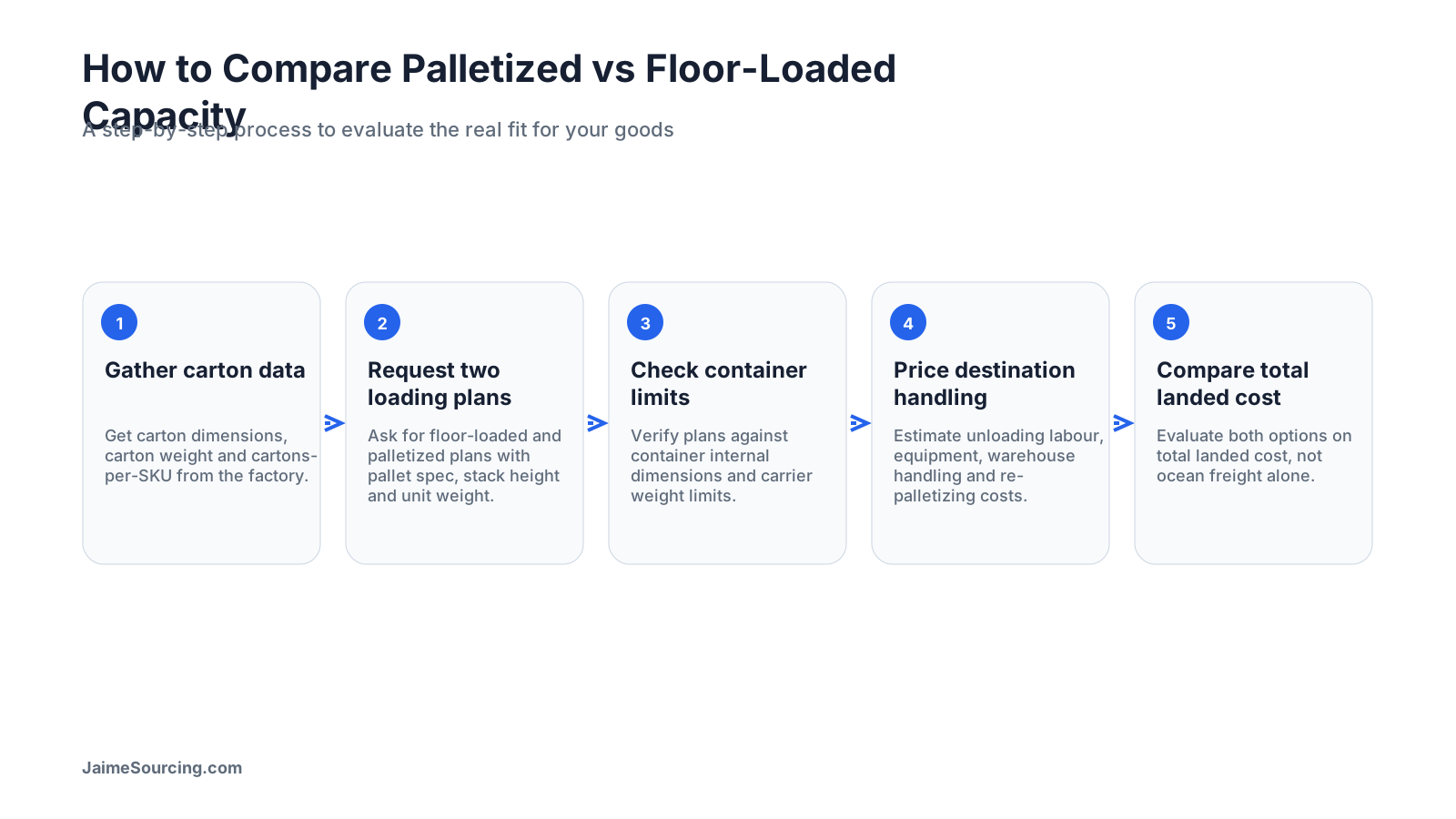
A workable process:
- Get carton dimensions, carton weight and cartons-per-SKU from the factory.
- Ask for two loading plans — floor-loaded and palletized — with the pallet spec, stack height and unit weight stated.
- Check the plans against the container’s internal dimensions and the carrier’s weight limit. A 40HC gives roughly 68 m³ of usable volume versus about 58 m³ for a 40GP, but weight limits still apply.
- Price the destination side: unloading labour, equipment hire, warehouse handling, re-palletizing and packaging waste disposal.
- Compare total landed cost, not ocean freight alone.
Shipping floor-loaded and palletizing at a UK or US warehouse can work, but it adds handling and increases the chance of damage or stock mix-ups. Ask who pays for each step and what happens if the receiving site rejects the loading format.
Incoterms, DDP and the Cost You Are Really Comparing
Your loading choice interacts with your Incoterm. Under EXW, you carry origin costs and risk from the factory gate. Under FOB, the supplier handles export clearance and delivery to the port, and your risk transfers on board. Under DDP, the seller quotes a delivered price — convenient, but you must confirm who is the importer of record and whether duties and taxes are genuinely paid.
Be cautious with “tax-inclusive” DDP arrangements that route goods through informal channels. If the declared value, HS code or importer identity does not match reality, your goods can be held, fined or seized, and your ability to claim on insurance may be compromised. For customs and tax rules, check the current official guidance in your destination jurisdiction — the US (CBP), UK (HMRC), EU member states and Australia (ABF) each apply their own rules.
For payments to Chinese suppliers, overseas buyers typically use T/T with a deposit and balance against a bill of lading copy. Budget for bank fees on both ends, watch FX exposure between quote and payment, and confirm whether you are paying a corporate account or a personal one — corporate accounts are easier to reconcile and dispute. If you use a platform escrow or Trade Assurance facility, factor in its fee and understand what it does and does not cover. For samples, agree upfront who absorbs the transfer fee.
What to Verify Before You Proceed
- Supplier identity. Run the company through the Chinese National Enterprise Credit Information Publicity System, and cross-check on Tianyancha or Qichacha. Confirm the Unified Social Credit Code matches the entity on the contract and bank account. Check establishment date (a very new entity warrants caution), registered capital, and whether subscribed capital has actually been paid in — subscribed capital is a promise, paid-in capital is money in the business.
- Business scope. Confirm the registered scope covers manufacturing or trading of your product category.
- Packing specification in writing. Get the approved loading format, pallet dimensions, stack height, weight, fork-pocket positions, labelling and overhang limits confirmed by the receiving warehouse.
- Wood packaging compliance. If solid wood is used, you, your packer or your forwarder must ensure it meets the destination’s ISPM 15 requirements. Include loose wooden bracing, not just pallets, in the review.
- Container seal discipline. Record the seal number on the bill of lading and photograph it after sealing; a broken or mismatched seal can trigger inspection or refusal.
- Quality inspection before loading. Use AQL sampling under ISO 2859-1 / ANSI/ASQ Z1.4 at General Inspection Level II. A common starting point is Critical 0 / Major 2.5 / Minor 4.0, but treat that as an example, not a universal rule — set limits by product risk. Critical defects are safety or legal failures, major defects affect function or saleability, minor defects are cosmetic.
Frequently Asked Questions
Does floor loading always fit more cargo than palletizing?
No. Floor loading only wins when cartons stack well and weight limits are not reached first. Dense goods can hit the container’s weight cap before the space is full, so palletizing may cost you little or nothing in real capacity.
Can I ship floor-loaded and palletize at my own warehouse?
Yes, provided your warehouse agrees to unload, sort and palletize, and you agree the pallet spec, stock identification and costs before the factory packs. It adds handling and raises damage and mix-up risk, so price it honestly.
What pallet size should I specify for container shipping?
Match the pallet to your cartons and your destination’s racking and truck dimensions. Common options are 48“ x 40“, 48“ x 48“ and the 120 x 80 cm Euro pallet. Confirm the load rating and forbid overhang, which can cut carton strength by over 30%.
Does palletizing protect my goods automatically?
No. Pallets reduce handling but do not guarantee protection. Check carton strength, stack stability, wrap and strap tension, and forklift contact points, and agree how units are secured inside the container.
How do I know which method my forwarder is quoting?
Ask for the loading plan and the pallet specification in writing, and confirm whether the quote assumes floor-loaded or palletized cargo. Ambiguity here is a common source of re-quotes and destination surprises.
Managing the Distance Between You and the Loading Bay
The real risk in palletized vs floor-loaded decisions is not the theory — it is quality drift, factory follow-ups and the physical distance and time-zone gap between you and the container being packed. A loading plan approved by email can quietly change on the factory floor.
Jaime Sourcing acts as your ground team in China, covering supplier research, verification, inspection, quality control, consolidation, packing and shipment coordination. If you want a second pair of eyes on a supplier or a review of your packing and loading workflow before the next container is sealed, talk to Jaime Sourcing and we will help you check the details that matter.
Turn your product and order requirements into a controlled sourcing brief.
Share the product, supplier link, quantity, destination and current order stage. We will identify the practical verification, quality-control, packing and shipping steps.