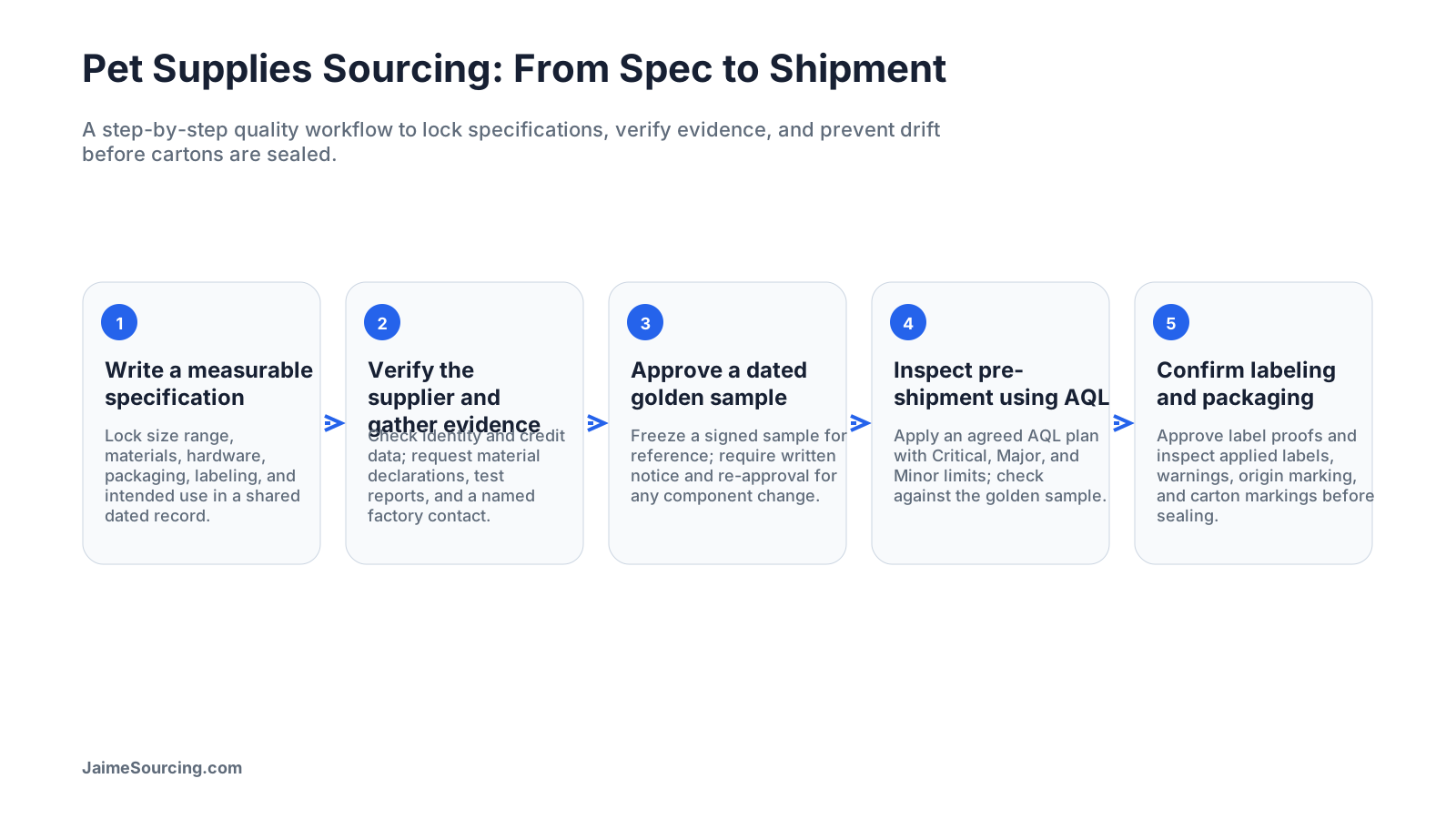
Pet supplies are performance products. A toy is chewed, a leash is pulled, a bed is licked and washed, and a bowl holds food or water. Before you pay a deposit, convert every vague promise (“pet-safe material,” “strong enough for medium dogs”) into a written specification plus evidence you can re-check at the sample, production and pre-shipment stages. For a Shopify reseller, the sequence is: lock the spec, request material and test evidence, approve a golden sample, inspect against that sample with a defined AQL plan, and confirm labeling before the cartons are sealed.
Start with a specification that can be inspected
Most pet-product disputes trace back to a spec that could not be measured. “Suitable for medium dogs” is not a specification. A workable one states the size range, the target pet weight range, material and construction, color, hardware (buckles, D-rings, clips), packaging, labeling, intended use, and destination market. For toys, add whether the product is for puppies, adult dogs or cats, since chew intensity and risk profile differ.
Build the spec as a table you can hand to the factory, the inspector and your freight contact. Everyone should confirm their own responsibilities, committed dates and the evidence they will provide, and all of it should sit in one dated record so inconsistencies surface early.
| Product type | Spec fields to lock | Primary failure risks to inspect |
|---|---|---|
| Chew toys, ropes, plush | Material and hardness, scent, small-part attachment, size vs. pet weight | Detached pieces, tearing, odor, sharp edges |
| Beds, apparel, textiles | Fabric composition, filling, stitching, sizing, wash instructions | Seam failure, filling migration, shrinkage, color bleed |
| Leashes, collars, harnesses | Webbing, hardware, stitching pattern, load rating basis | Buckle/clip failure, stitch pull-out, hardware corrosion |
| Bowls, feeders | Food-contact material, finish, capacity, base stability | Cracking, coating defects, unstable base |
| Grooming and cleaning tools | Blade/comb material, handle grip, moving parts | Loose parts, pinch points, poor finish |
Verify the supplier before you verify the product
Supplier identity checks come first, because a convincing quotation from an unverified trading company tells you little about who actually makes the goods. Ask for the factory’s business license and check the company name against the Chinese National Enterprise Credit Information Publicity System, and cross-reference on Tianyancha or Qichacha. Read four fields carefully:
- Unified Social Credit Code — the identifier that ties the license to the registered entity; confirm it matches the name on your quotation and proforma invoice.
- Establishment date — a company registered months ago may be a trading intermediary rather than the manufacturer you think you are buying from.
- Registered capital vs. subscribed vs. paid-in capital — registered capital is a declared figure; subscribed capital is what shareholders committed; paid-in capital is what has actually been contributed. A high registered figure with minimal paid-in capital is a signal to ask more questions, not proof of weakness.
- Business scope — check that the scope plausibly covers the product category.
Then request evidence rather than assurances: a cost breakdown, a confirmed sample, production records, inspection evidence, and a named factory contact. If a supplier’s answers and its documents disagree, pause the order instead of filling the gap with assumptions.
Materials and safety: what evidence to ask for
Whether you need third-party test reports depends on the product type and the market where you sell. Toys and food-contact items, and products sold on major marketplaces, generally warrant closer confirmation. A verbal “the material is safe” is not evidence; at minimum, ask for material declarations, review how the sample performs, and confirm what your destination market requires.
Be explicit about jurisdiction. In the US, the Consumer Product Safety Commission administers rules that can apply to pet products depending on how they are marketed and used; in the EU, the General Product Safety Regulation framework and food-contact rules may apply to bowls and feeders; the UK, Canada and Australia each have their own regimes. This article does not interpret those rules — check the current official text for your market and product, and use a qualified testing lab where the risk justifies it. A practical middle path for a small brand is to ask the factory which tests it has already run, request the report and verify the lab and report date, then decide whether to commission your own.
For textiles and plush, ask about filling composition and whether recycled or reclaimed fill is used, since this affects both marketing claims and inspection criteria. For anything a pet mouths, ask about odor, dye fastness and small attached parts.
Durability: test the way the pet will use it
Durability checks should mirror real use. For leashes, collars and harnesses, a load test is used to judge whether the product withstands the pull of the target pet size, with the specific standard confirmed against the product and market. For toys, focus on attachment strength of squeakers, ropes and appendages, plus tear resistance at seams. For beds and apparel, inspect stitching density, seam integrity and filling distribution.
Do not rely on a single pretty sample. A sample can look fine while bulk production drifts because of material batch or process changes. Freeze an approved “golden sample,” dated and signed, and inspect bulk against it. Where a factory changes a component — a buckle supplier, a fabric mill, a filling grade — require written notice and re-approval before production continues.
Pre-shipment inspection: use AQL properly
For pre-shipment inspection, the common framework is ISO 2859-1 / ANSI/ASQ Z1.4, typically at General Inspection Level II, with defects classified as Critical, Major and Minor. A frequently used starting point is Critical 0 / Major 2.5 / Minor 4.0, but treat that as an example, not a universal rule — tighten or loosen it based on product risk and your tolerance.
- Critical — a defect that creates a safety hazard or makes the product unusable (for example, a buckle that releases under normal load, or a chew toy with a detachable small part). Accept zero.
- Major — a defect a customer would likely return or complain about: failed stitching, wrong hardware, strong odor, incorrect size.
- Minor — cosmetic issues that do not affect function or safety.
Write the inspection plan into the purchase order: sample size, AQL levels, the checklist, and who bears rework or rejection costs. At pre-shipment, the highest-value checks are safety risks, dimensions, stitching, hardware, packaging, labeling and bulk-to-sample consistency.
Labeling, packaging and the compliance paper trail
Labeling is where small brands get caught. Confirm before production: fiber and material content where applicable, country of origin marking, importer or responsible-person details required by your market, care and washing instructions, suffocation or supervision warnings for toys and beds, and barcode and carton markings. Ask for a production label proof and inspect the actual applied label, not a PDF.
Packaging also affects cost and damage rates. Confirm retail packaging, polybag and suffocation warnings, master carton strength, and whether the packaging is designed for your sales channel. Keep your product page claims aligned with the evidence you hold — avoid “non-toxic,” “indestructible” or “vet-approved” unless you can substantiate them.
Incoterms, payment and total landed cost
Agree the Incoterm early, because it determines who pays origin charges and who carries customs responsibility. Under EXW, the buyer handles essentially everything from the factory door. Under FOB, the supplier covers costs to the named port and export clearance, and the buyer handles main freight, import duty and destination charges. Under DDP, the seller delivers duty-paid — convenient, but risky if the arrangement is a non-compliant “tax-inclusive” structure that under-declares value or misroutes customs. Confirm in writing who is the importer of record and that the declared value is accurate.
For payments, overseas buyers typically pay Chinese suppliers by T/T, often a deposit and balance before shipment. Budget for bank fees on both ends, note FX exposure between quotation and payment, and understand any platform Trade Assurance fee before you rely on it. Pay the company account named on the contract and license, not a personal account, unless you have documented why. For samples, agree in advance whether the sample fee and courier cost are refunded against the bulk order.
What to Verify Before You Proceed
- Supplier legal name, Unified Social Credit Code, establishment date and paid-in capital cross-checked on the credit systems.
- A written, measurable specification signed off by you and the factory.
- Material declarations and any test reports, with lab name and report date verified.
- A dated golden sample approved before bulk production.
- AQL plan (levels and Critical/Major/Minor definitions) written into the PO.
- Label and packaging proofs approved, including origin and warning text for your market.
- Incoterm, importer of record, payment account and sample-fee terms confirmed in writing.
FAQ
Do pet supplies from China always need third-party test reports?
No — the need depends on product type and destination market, with toys and food-contact items generally warranting closer confirmation. Ask what the factory has already tested, verify the report and lab, then decide whether your market and risk profile justify commissioning your own testing.
Is a factory’s verbal “material is safe” statement enough?
No. A verbal assurance is not evidence you can re-check. Request material declarations, review sample performance, and confirm your destination market’s requirements, then document all of it in your order file.
Can I order pet supplies in small batches from China?
Sometimes. Stock items and light customization are more feasible, but colors, packaging and labeling may carry minimum order quantities. Confirm MOQ, tooling and lead time before assuming a small run is viable.
What should a pre-shipment inspection focus on for pet products?
Prioritize safety risks, dimensions, stitching, hardware, packaging, labeling and bulk-to-sample consistency. Use a defined AQL plan so Critical, Major and Minor defects are judged against agreed limits rather than opinion.
How do I stop quality drifting between the sample and bulk production?
Freeze a dated golden sample, require written notice of any component or material change, and inspect bulk against the approved sample. Keep every spec change and quality finding in one dated record so drift is visible early.
Manage quality drift before it reaches your customers
Pet products fail in ways customers notice fast — a clip that lets go, a seam that opens, a smell that will not wash out. The real risk is not one bad sample; it is drift between the approved sample and the cartons on the water, compounded by factory follow-ups across time zones and the physical distance between you and the line. That is where a ground team earns its keep. Jaime Sourcing supports overseas buyers with supplier research and verification, inspection and quality control, consolidation, packing and shipment coordination, so problems are caught while they are still fixable in China. If you are planning a pet-supplies order, talk to Jaime Sourcing about a supplier check or a review of your inspection workflow before you commit the deposit.
Turn your product and order requirements into a controlled sourcing brief.
Share the product, supplier link, quantity, destination and current order stage. We will identify the practical verification, quality-control, packing and shipping steps.