If you are a Shopify reseller buying electronics accessories from Shenzhen, treat three risks as deal-breakers before you pay a deposit: whether the product contains a lithium battery that can legally and economically ship, whether the FCC/CE paperwork is genuine and matches your exact SKU, and whether functional testing is defined tightly enough to catch failures before goods leave China. Most sourcing failures in this category come from buyers accepting vague compliance claims, generic test reports and loose inspection criteria, not from bad factories alone. This article explains how to verify each one, what tradeoffs you face, and what to check before you commit.
Why Shenzhen electronics accessories carry concentrated risk
Shenzhen’s electronics ecosystem is deep and fast, which is exactly why risk concentrates there. A single accessory — a wireless charger, a power bank, a Bluetooth earbud, a USB-C hub — can combine a lithium cell, a radio transmitter, a power supply and a plastic housing, each with its own compliance and testing requirements. Suppliers often quote “CE and FCC available” as a line item, but the underlying evidence may be a report for a different model, a report issued years ago, or a self-declaration with no test data behind it.
The local testing market reflects this demand. Shenzhen labs advertise CE, FCC, SRRC, PSE, RoHS, REACH, MSDS and battery-related testing, along with authorizations such as CNAS, CMA and A2LA, and some publish battery reports positioned for global use. That breadth is useful, but it also means the burden is on you to confirm that a specific report covers your specific product, standard and destination market — not just that a lab exists and issues certificates.
Battery shipping: the constraint that reshapes your whole supply chain
Lithium batteries are the most common reason an otherwise good electronics accessory order stalls at the freight stage. Batteries are regulated as dangerous goods for transport, and the requirements differ by mode (air, sea, road, rail) and by whether the battery is standalone, packed with equipment, or contained in equipment. Some labs and service providers specifically offer transport-condition appraisal documents covering sea, air, road and rail scenarios, which tells you the documentation is a distinct deliverable — not something you can assume the factory has handled.
For a reseller, the practical consequences are:
- Product design choices change shipping options. A power bank with a large standalone cell is harder and more expensive to ship than a small built-in battery in a low-power device. Ask the supplier early whether the battery is “contained in equipment” or shipped separately, because that classification drives the paperwork.
- Air freight is not automatic. Many couriers and airlines restrict or refuse lithium battery shipments without correct documentation and packaging. Confirm with your forwarder, in writing, before you approve production.
- Documentation must match the shipment. A battery test report or transport document that does not match the cell, the pack configuration or the model can be rejected at origin or destination.
- Cost is not just freight. Battery-compliant packaging, labeling and documentation add cost and lead time. Build this into your landed-cost model rather than discovering it at booking.
Do not accept a supplier’s verbal assurance that “battery shipping is fine.” Ask for the specific documents they will provide, confirm with your own freight forwarder that those documents are accepted for your route, and check the current rules with the relevant aviation, maritime and customs authorities in your destination country, because these rules change.
FCC and CE: what the paperwork actually has to prove
FCC (US) and CE (EU) are different regimes with different logic, and conflating them is a common buyer error.
FCC applies to radio-frequency devices sold in the US. For intentional radiators such as Bluetooth or Wi-Fi accessories, the relevant evidence is typically an FCC ID and the associated test report. Shenzhen labs advertise FCC testing and FCC ID lookup services, which is helpful — but you should verify the FCC ID against the official FCC database yourself and confirm the grantee, model and frequency bands match your product.
CE is a marking regime under EU law, supported by directives such as the Radio Equipment Directive 2014/53/EU for wireless products. CE is not a single certificate issued by a lab; it is a declaration of conformity backed by appropriate testing and technical documentation. A lab report supports your CE file, but the manufacturer’s declaration and the technical file are what legally underpin the mark. Confirm which directives apply to your product, who signs the declaration, and whether the report covers the right standards.
Practical checks that catch most problems:
- Match the model number exactly. Reports for a “similar” model are not evidence for your SKU. Ask for the report’s product description, model and photos, and compare them to your sample.
- Check the date and standard version. An old report may reference superseded standards. Ask the supplier or lab to confirm the current version applies.
- Verify the issuing body. Labs advertise authorizations such as CNAS, CMA, A2LA and TCB status; ask which accreditation applies to your specific test and confirm it is relevant to the destination market.
- Separate testing from declaration. The lab tests; the manufacturer declares. Make sure you know who is legally responsible for the CE declaration and that they will provide it.
- Check destination-specific rules. UKCA considerations in Great Britain, Canadian ISED requirements and Australian RCM requirements are separate from FCC and CE. Confirm the current official rule for each market you sell into.
Functional testing: turn “it works” into a measurable specification
Compliance paperwork proves a sample met a standard on test day. It does not prove that the 5,000 units in your container will work when your customers open the box. That gap is closed by a written functional test specification and a structured inspection.
Start by defining, in writing, what “working” means for your product: charging speed and cut-off behavior, Bluetooth pairing and range, button and port durability, LED behavior, app connectivity, standby drain, and cosmetic criteria. Then apply AQL sampling under ISO 2859-1 / ANSI/ASQ Z1.4, typically at General Inspection Level II, with defect classes defined as:
- Critical: safety or legal failures — for example, a battery that overheats, a charger that fails hipot/insulation checks, or a product missing required labeling. Critical defects are usually accepted at zero.
- Major: functional failures a customer would return the product for — a port that does not charge, a device that will not pair, a battery that does not hold rated capacity.
- Minor: cosmetic or non-functional deviations — scuffs, minor molding marks, label alignment.
A common starting point is Critical 0 / Major 2.5 / Minor 4.0, but this is an example, not a universal rule. Tighten the major limit for high-return categories, and write the sampling plan and defect definitions into the inspection brief so the inspector applies your standard, not a generic one.
For battery products, add specific functional checks: capacity verification against the claimed rating, charge/discharge cycle behavior, temperature behavior under load, and protection-circuit function (overcharge, over-discharge, short circuit). For wireless products, add pairing stability, range and interference checks. Where a lab test is needed, use an accredited third-party lab rather than relying on the factory’s internal report.
Supplier verification: read the company record, not the sales deck
Before you trust a Shenzhen supplier with a deposit, verify the legal entity. Use the Chinese National Enterprise Credit Information Publicity System for the official record, and Tianyancha or Qichacha for a faster commercial view. Check:
- Unified Social Credit Code — the 18-character identifier that uniquely ties the company to its registration. Confirm it matches the name on your contract and proforma invoice.
- Registered capital vs. paid-in capital — registered capital is a subscribed figure, not money in the bank. Paid-in capital tells you more about actual funding. A high registered figure with low paid-in capital is a warning to look closer.
- Establishment date — a company registered a few months ago may be a trading shell. That is not automatically disqualifying, but it changes how much you rely on factory audits versus paperwork.
- Business scope — confirm manufacturing or trading scope covers your product category.
- Legal representative and address — compare with the address on the contract and the factory address used for inspection.
Also separate the trading company from the factory. Many Shenzhen “manufacturers” are traders who outsource production. Ask directly, then verify by visiting or commissioning a factory audit. If the supplier cannot or will not disclose the production site, treat that as a risk signal.
Incoterms, payment and the “tax-inclusive DDP” trap
Your commercial terms determine who carries which risk, and electronics accessories are a category where vague terms cause expensive disputes.
| Term | Who arranges main freight | Who clears export/import | Who pays duty/tax | Key risk for buyers |
|---|---|---|---|---|
| EXW | Buyer | Buyer | Buyer | Buyer has little control at origin; pickup and export handling fall on you |
| FOB | Seller to port | Seller exports; buyer imports | Buyer | Clear split, but you must manage freight and destination clearance |
| DDP | Seller | Seller | Seller (claimed) | “Tax-inclusive” quotes may under-declare value or use non-compliant routes |
DDP is popular because it looks simple, but a suspiciously cheap “tax-inclusive DDP” quote can mean the goods are declared at an unrealistic value or routed through arrangements that create customs and compliance exposure for you as the importer of record. Ask for the declared value, the duty and tax calculation, and the importer-of-record details. If the seller cannot explain them clearly, the saving is probably a risk transfer, not a discount.
On payment: overseas buyers typically pay Chinese suppliers by T/T. Confirm who bears bank charges (agree “OUR” or split explicitly), understand FX exposure if you are quoted in RMB but sell in USD/GBP/EUR, and check whether platform fees such as Trade Assurance apply and who absorbs them. Pay the legal entity named on the contract — a corporate account, not a personal one — and agree in writing how sample and test fees are allocated and whether they are credited against the bulk order.
What to Verify Before You Proceed
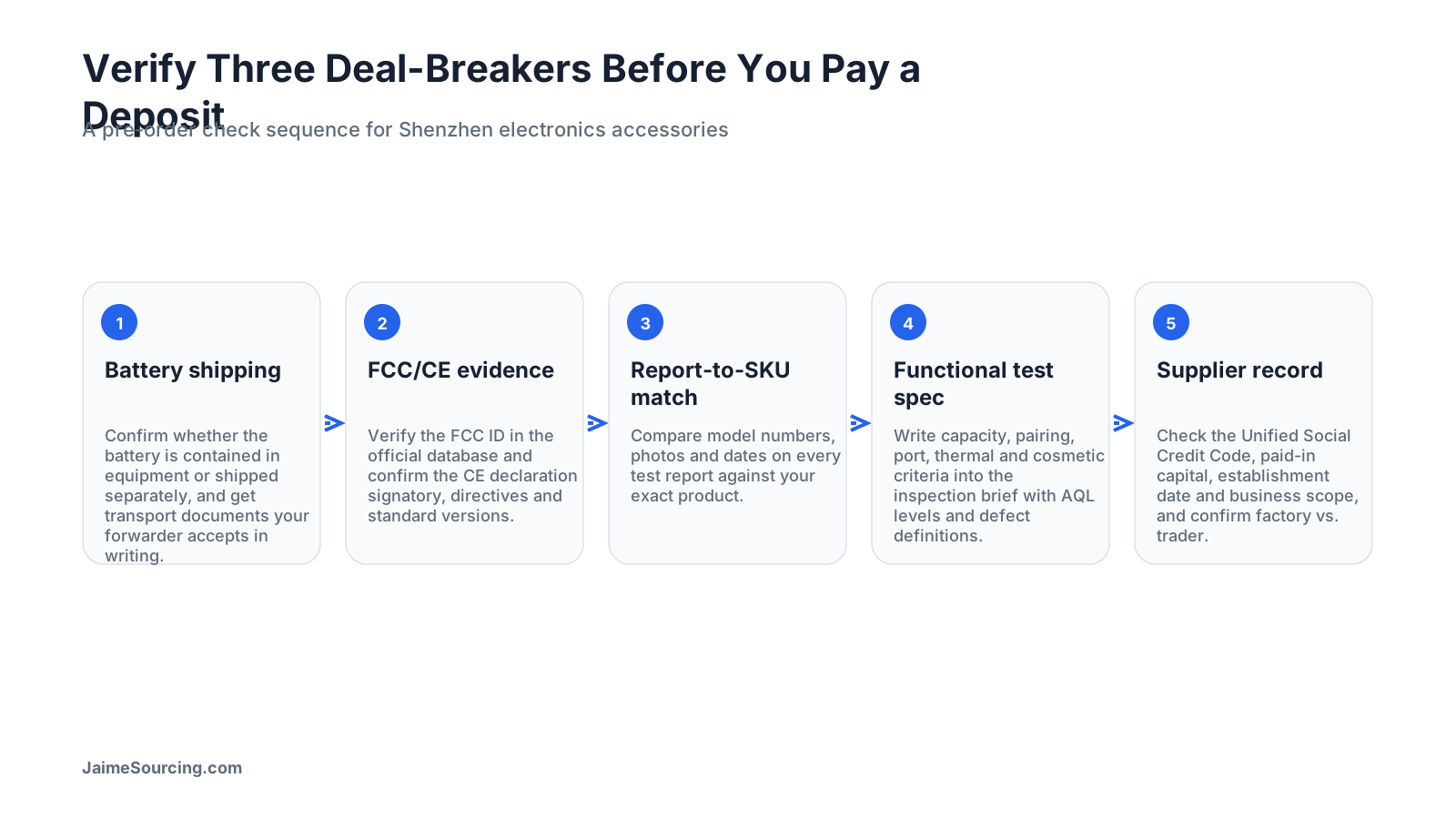
- Battery classification and documents: confirm whether the battery is contained in equipment or shipped separately, and get the specific transport documents your forwarder will accept.
- FCC ID and CE file: verify the FCC ID in the official database; confirm the CE declaration signatory, applicable directives and current standard versions.
- Report-to-SKU match: compare model numbers, photos and dates on every test report against your exact product.
- Functional test spec: write capacity, pairing, port, thermal and cosmetic criteria into the inspection brief, with AQL levels and defect definitions.
- Legal entity: check the Unified Social Credit Code, paid-in capital, establishment date and business scope on the official system and Tianyancha/Qichacha.
- Factory vs. trader: confirm the production site and commission an audit if the answer is unclear.
- Incoterm and DDP math: get the declared value, duty/tax calculation and importer-of-record details in writing.
- Payment terms: agree bank charges, FX basis, platform fees and sample-fee allocation before paying.
FAQ
How do I know if my Shenzhen supplier’s FCC or CE report is genuine?
Verify the FCC ID in the official FCC database and confirm the grantee, model and bands match your product; for CE, confirm the declaration signatory and that the report covers current standards for your exact SKU. A report is only evidence if the model, date and standard match what you are buying.
Can electronics accessories with lithium batteries ship by air from China?
Sometimes, but only with correct dangerous-goods documentation, packaging and carrier acceptance, and many routes restrict or refuse such shipments. Confirm with your own forwarder in writing before production, and check current aviation and customs rules for your destination.
What AQL should I use for electronics accessory inspections?
A common starting point is General Inspection Level II under ISO 2859-1 / ANSI/ASQ Z1.4 with Critical 0 / Major 2.5 / Minor 4.0, but this is an example, not a rule. Tighten major limits for high-return categories and define functional and battery tests explicitly in the brief.
Is a cheap “tax-inclusive DDP” quote from a Shenzhen supplier safe?
Not automatically. Ask for the declared value, duty and tax calculation, and importer-of-record details; if the seller cannot explain them, the low price may reflect under-declaration or a non-compliant route that creates customs exposure for you.
How do I check a Shenzhen supplier’s company registration?
Use the Chinese National Enterprise Credit Information Publicity System for the official record, and Tianyancha or Qichacha for a commercial view. Confirm the Unified Social Credit Code, paid-in capital, establishment date and business scope, and compare them with your contract.
Manage the risk with a ground team in China
Quality drift, unanswered factory follow-ups and the friction of distance and time zones are what turn a good sample into a bad container. You cannot inspect what you cannot see, and you cannot chase a factory effectively from eight time zones away. Jaime Sourcing acts as your ground team in China, supporting supplier research and verification, inspection and quality control, consolidation, packing and shipment coordination — so battery documentation, FCC/CE evidence and functional test results are checked against your specification before goods move. If you are planning a Shenzhen electronics accessory order, talk to Jaime Sourcing about a supplier check or a workflow review before you pay your next deposit.
Turn your product and order requirements into a controlled sourcing brief.
Share the product, supplier link, quantity, destination and current order stage. We will identify the practical verification, quality-control, packing and shipping steps.