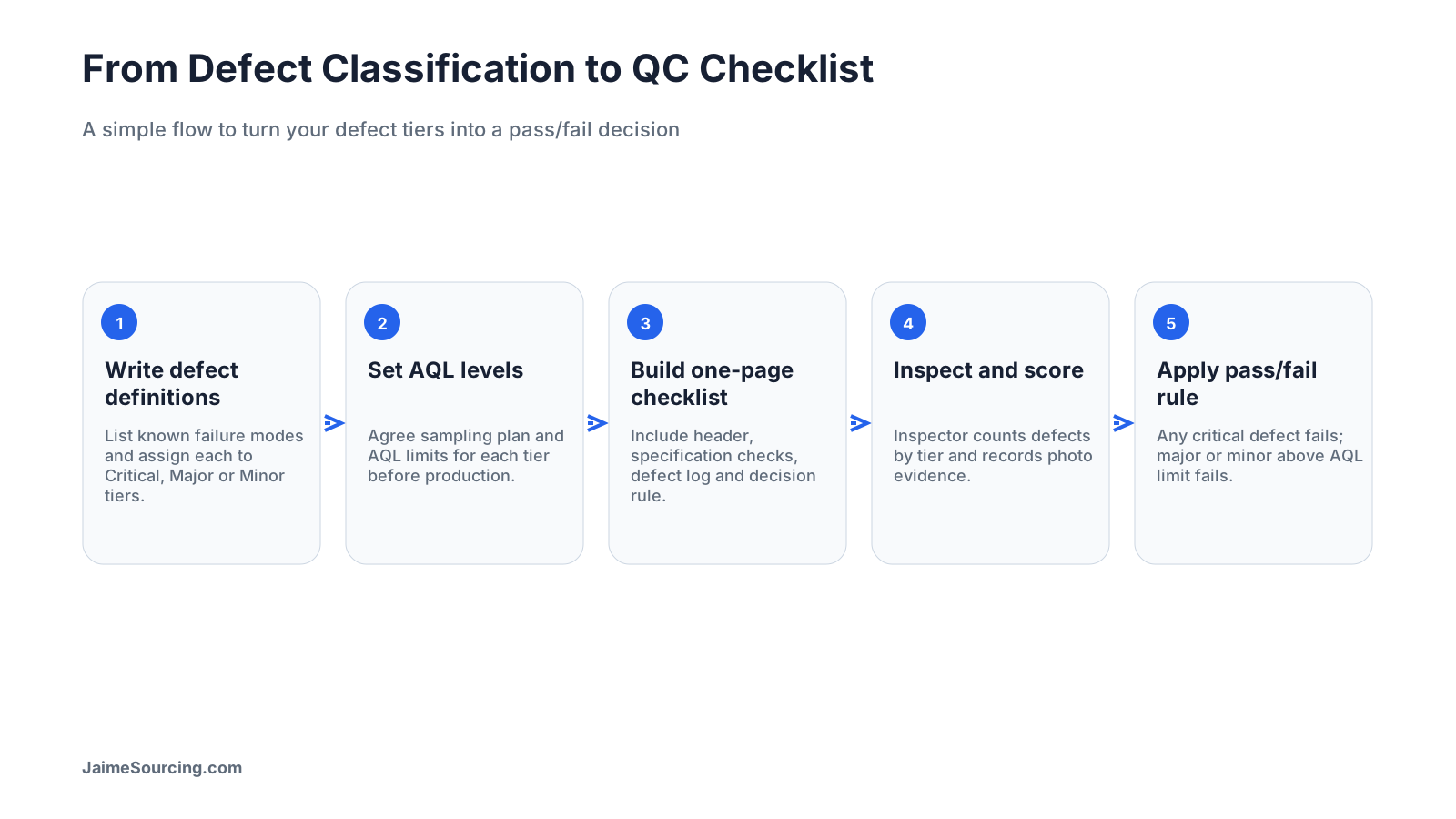
Build a written defect classification first, then turn it into a one-page QC checklist your inspector can score line by line. For most Shopify sellers sourcing from China, that means three defect tiers (Critical, Major, Minor), a sampling plan based on ISO 2859-1 / ANSI/ASQ Z1.4 General Inspection Level II, and a pass/fail rule agreed with the supplier before production starts. The checklist turns a vague “please check quality” instruction into a decision you can defend when a shipment is on the line.
This guide is written for overseas buyers and resellers, not for mainland exporters. It covers what to classify, how to sample, what to verify about the factory, and where quality drift usually appears.
Why a Defect Classification Comes Before the Checklist
Defect classification decides whether a shipment passes or fails, and it shapes how many units an inspector samples. Skip it and every inspection becomes a negotiation, with the inspector applying a default standard that may not match your brand.
Quality-control specialists typically sort defects into three tiers by severity and consequence:
- Minor defects are usually cosmetic and do not affect function or form. Customers may not notice them and are unlikely to return the product over them. Importers often set a higher tolerance for minor defects, but a batch can still fail if the count exceeds the limit.
- Major defects deviate more from your specification and may affect function, performance or appearance. Customers notice them, and they can trigger returns, complaints or refunds. Tolerance is lower, and too many usually mean rework or rejection.
- Critical defects can make the product unusable or unsafe, creating product-liability, recall or legal risk. Most importers apply a zero-tolerance policy, and a single critical defect fails the batch.
The same physical flaw can move tiers depending on your market. Untrimmed threads on a blouse might be minor for a discount channel but major for a premium retailer with low tolerance. The buyer, not the inspection company, must make the final call and record it in the QC checklist.
How to Classify Defects for Your Product Category
Start from the material and process, then list the known failure modes. The examples below are starting points, not a substitute for your own product spec.
Soft goods (textiles, apparel, footwear). Apparel relies on manual sewing, so defects cluster around stitching and finishing. Minor: untrimmed threads that can be fixed with simple rework. Major: skipped stitches from machine fault or operator error, affecting appearance and seam strength. Critical: a broken sewing needle left in the finished garment, a safety hazard that fails the batch on sight.
Hard goods (furniture, cookware, hardware, plastics). Minor: light surface scratches that do not affect sellability. Major: deep scratches on a brand logo that are hard to repair and damage brand image. Critical: sharp burrs that could cut a user and trigger a recall.
Electrical and powered products. Major: functional failure such as not powering on or a display fault. Critical: damaged wiring with exposed copper, a shock or fire risk.
Industrial or component parts. Major: out-of-tolerance non-critical dimensions that may affect downstream assembly. Critical: corrosion that signals premature failure, such as rust in water or gas pipe.
A practical method: pull your last 20 customer complaints and returns, write each one as a defect line, and assign a tier. That gives you a checklist grounded in real cost rather than guesswork.
Setting AQL Limits: Critical 0, Major 2.5, Minor 4.0 as a Starting Point
Acceptable Quality Limit (AQL) sampling is the standard tool importers use to set tolerance per defect class, and it determines the sample size at inspection. The widely used framework is ISO 2859-1 / ANSI/ASQ Z1.4, commonly applied at General Inspection Level II.
A frequent starting configuration is Critical 0, Major 2.5, Minor 4.0. Treat this as a common example, not a universal rule. Critical defects are normally set to zero tolerance, while major and minor limits should reflect your price point, channel and return cost.
| Defect class | Typical AQL starting point | Common buyer stance | Example (apparel) |
|---|---|---|---|
| Critical | 0 | Zero tolerance; one defect fails the batch | Needle fragment in garment |
| Major | 2.5 | Low tolerance; rework or reject if exceeded | Skipped stitches, seam failure |
| Minor | 4.0 | Higher tolerance; fail only if count exceeds limit | Untrimmed threads |
Two operational notes. First, the inspection company can suggest tolerances, but the buyer must confirm them in the QC checklist. Second, if the inspector’s classification differs from your standard, give feedback so future reports match your definitions. Keep the checklist version-controlled and update it as new orders reveal new failure modes.
Building the One-Page QC Checklist
A usable checklist is short enough to score on the floor and specific enough to be unambiguous. Structure it in four blocks:
- Header and references. PO number, SKU, quantity, factory name, inspection date, inspector, sampling plan and AQL levels.
- Specification checks. Dimensions, weight, color against an approved sample, labeling, packaging and barcode/GTIN accuracy. These are pass/fail, not scored.
- Defect log by tier. List every known defect under Critical, Major or Minor, with a column for count found and a photo reference. This is where the classification work pays off.
- Decision rule. State the pass/fail logic explicitly: any critical defect = fail; major or minor counts above the AQL limit = fail; otherwise pass.
Add a photo protocol: one wide shot of the carton, one of the defect, one of the measurement. Photos are what let you challenge a report or a supplier’s claim later.
For pre-shipment inspection, once defects are found you have options: rework, reject, or destroy unsellable goods to keep them out of the grey market. If you need every unit checked rather than sampled, a 100% inspection removes defective pieces before shipment — confirm scope and cost with your provider rather than assuming it is included.
Verifying the Supplier Behind the Checklist
A checklist is only as good as the factory it is applied to. Before you invest in tooling or a first bulk order, verify the legal entity. In China, use the National Enterprise Credit Information Publicity System, Tianyancha or Qichacha to cross-check:
- Unified Social Credit Code — the 18-character identifier; confirm it matches the name on your contract and invoice.
- Registered capital vs. paid-in (subscribed) capital — registered capital is a pledged figure, not cash in the bank; paid-in capital shows what has actually been contributed.
- Establishment date — a very recent entity may be a trading company rather than the factory it claims to be.
- Business scope and status — check the entity is active and its scope covers your product.
These tools show registration data, not production capability. Pair them with a factory audit or a trial order. Third-party test reports can be purchased without genuine sample testing in some cases, so verify that any report names your product, your supplier and a credible lab, and check the report’s authenticity with the issuing lab.
What to Verify Before You Proceed
- Defect definitions are written and signed off by you and the supplier before mass production, with photo examples for each tier.
- AQL levels and sampling plan are stated in the inspection booking, using ISO 2859-1 / ANSI/ASQ Z1.4 General Inspection Level II unless you have a reason to change.
- The legal entity matches across contract, invoice and Unified Social Credit Code, checked on the National Enterprise Credit Information Publicity System, Tianyancha or Qichacha.
- Incoterms are explicit. Under EXW the buyer carries origin charges and export clearance; under FOB the seller handles export and origin port costs; under DDP the seller handles delivery and duty. Be cautious with “tax-inclusive” DDP quotes that may under-declare value — the importer of record can carry the compliance risk. Confirm who is importer of record and check current customs rules for your destination jurisdiction.
- Payment terms are clear. For overseas buyers paying Chinese suppliers, confirm T/T terms, who pays bank fees, FX exposure, any Trade Assurance fee, and whether payment goes to a corporate or personal account. Allocate sample-payment fees in writing.
- Compliance scope is checked against the destination market. For example, Shopify’s Managed Markets reviews product listings against country restrictions and can mark items unsupported in specific regions; check current official rules for your category and market.
FAQ
What is the difference between critical, major and minor defects?
Critical defects can make a product unsafe or unusable and usually carry zero tolerance; major defects affect function or appearance and risk returns; minor defects are cosmetic and tolerated at higher limits. Assign tiers based on your market’s tolerance, not a generic template.
What AQL should a Shopify seller use for a first order?
Critical 0, Major 2.5, Minor 4.0 is a common starting point under ISO 2859-1 / ANSI/ASQ Z1.4 General Inspection Level II, but it is an example, not a rule. Adjust based on price point, return cost and channel expectations, and record the final levels in the checklist.
Can I rely on a supplier’s test report as proof of quality?
Not on its own. Reports can sometimes be obtained without genuine sample testing, so confirm the report names your product and supplier, and verify authenticity with the issuing lab. Pair reports with your own inspection and a factory check.
How often should I update the QC checklist?
Update it whenever a new order, return or complaint reveals a failure mode not yet listed. Version-control each checklist so inspection reports can be tied to the exact standard used.
Managing Quality Drift From a Distance
Quality drifts quietly. A factory that passed your first order can slip on the third as operators change, materials shift or deadlines compress — and from the US, UK, EU, Canada or Australia, you cannot walk the floor or catch it in a time zone that is asleep during your working day. That distance is where rework costs, chargebacks and late shipments accumulate.
Jaime Sourcing acts as your ground team in China, covering supplier research and verification, inspection and quality control, consolidation, packing and shipment coordination. If you want a second pair of eyes on a supplier or a review of your defect classification and QC checklist workflow, get in touch with Jaime Sourcing and we can pressure-test the process before your next production run.
Turn your product and order requirements into a controlled sourcing brief.
Share the product, supplier link, quantity, destination and current order stage. We will identify the practical verification, quality-control, packing and shipping steps.