Your ecommerce model decides who carries inventory risk, who owns the customer promise, and therefore how much supplier verification you actually need. A dropshipper can start with a supplier questionnaire and a sample order; a private-label brand selling into the EU needs paid-in-capital checks, IP searches, packaging artwork control and a documented inspection plan before the first bulk run. The product can be identical — the sourcing job is not.
The four models most Shopify resellers operate — dropshipping, wholesale resale, private label and generic multi-SKU resale — call for different supplier types, MOQs, quality controls and logistics terms. The requirements below are written for overseas buyers purchasing from China.
Dropshipping: You Outsource Fulfilment, Not Accountability
In dropshipping, the seller holds no stock: the customer orders, the seller forwards the order to a third-party supplier, and that supplier picks, packs and ships directly to the customer. Your capital outlay is low and your cash cycle can stay positive because you collect payment before paying the supplier. The trade-off is that you surrender control over stock accuracy, packing quality and delivery speed.
That changes your sourcing requirements in three concrete ways:
- Supplier type. You need a supplier built for single-unit fulfilment — one that does not sell the same SKU to the public at your retail price, and that publishes realistic handling times. Factories are usually the wrong fit here; trading companies and fulfilment-oriented wholesalers are the right one.
- What you verify. Stock-sync reliability, order cut-off times, packaging neutrality (no supplier invoices or competitor branding inside the parcel) and the courier channels used. Ask for a test order shipped to your own address before you list the product.
- What you accept. Thinner margins, because the supplier captures much of the spread, and quality variance you cannot inspect directly.
Practical control: keep at least two suppliers per hero SKU so a stock-out does not become a refund wave, and treat the first 20 orders as a live audit — photograph every parcel that comes back as a complaint.
Wholesale Resale: MOQ, Margin and Inventory Turnover Drive the Deal
Wholesale resale means you buy in bulk at a discount and resell at retail, carrying the inventory yourself. The sourcing question shifts from “can they ship one?” to “can I turn this stock before it eats my cash?”
Three numbers govern the decision:
- MOQ versus sell-through. A low MOQ protects cash but raises unit cost; a high MOQ lowers unit cost but locks capital. Model both against your realistic 90-day sell-through, not your best-case one.
- Margin structure. Wholesale gross margins commonly sit in the 10–30% range, while retailers typically mark up 30–50% over wholesale cost. If your landed cost plus fees leaves less than that, the model does not work at your price point.
- Replenishment lead time. Because you own the stock, a slow restock is a lost sale, not a delayed parcel. Confirm the supplier’s production or picking lead time in writing and add buffer for Chinese New Year and peak-season congestion.
Supplier type: manufacturers for single-category depth, trading companies for breadth. Verification should include a factory or warehouse video walkthrough, a pre-shipment inspection on the first order, and a written restock lead time.
Private Label: Packaging, Compliance, IP and QC Become the Job
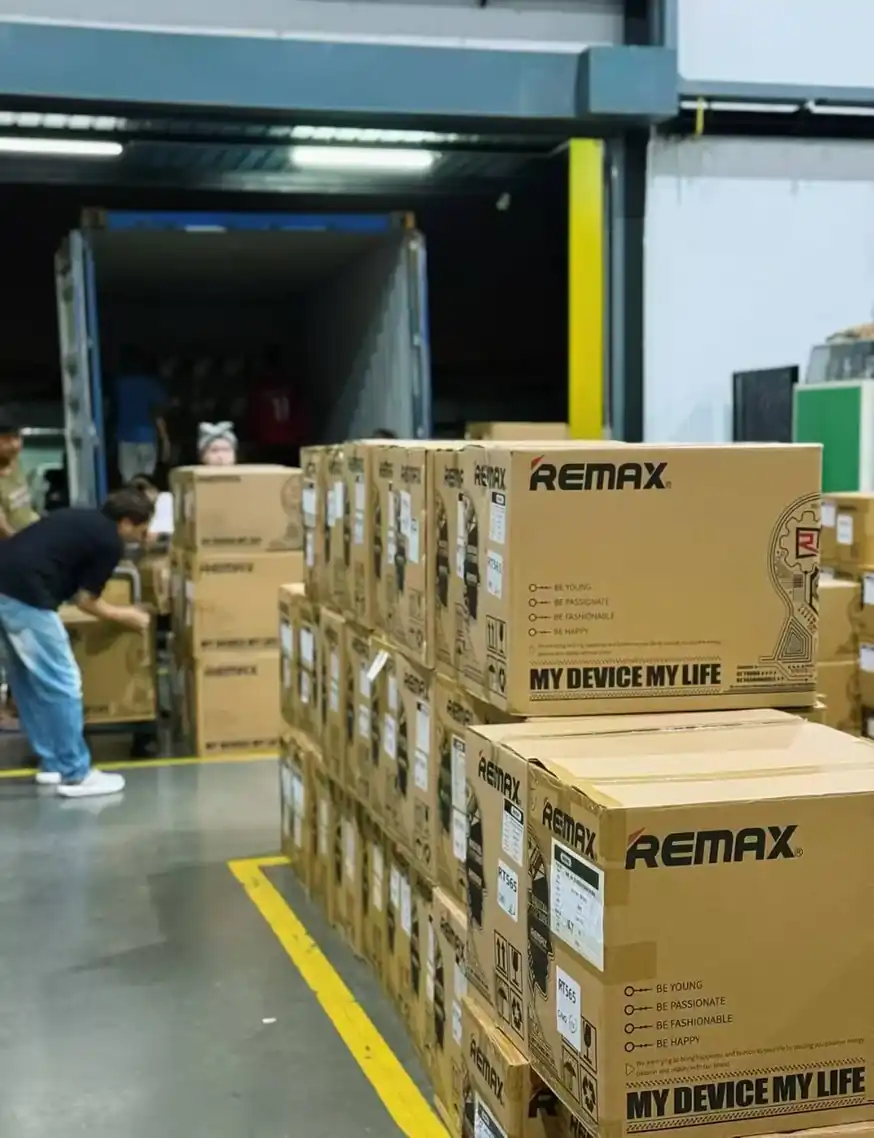
Private label is where sourcing requirements multiply fastest. You are no longer buying a product; you are buying a product plus your brand, your artwork, your claims and your legal exposure.
Packaging and artwork control. Specify dielines, colour references, barcode placement and country-of-origin marking in a signed artwork approval. Approve a physical pre-production sample of the printed packaging — screen colours and substrate behave differently from a PDF.
Compliance by destination. Rules differ by jurisdiction and product category: EU labelling and safety obligations, UKCA/CE marking where applicable, US FTC and state-level rules, Canadian bilingual labelling, Australian consumer-law claims. Confirm the current official rule for your category and destination before production, not after. If you sell into the EU from a supplier outside it, import VAT and IOSS registration may apply to your sales — that is a tax question for your accountant, not a supplier promise.
IP clearance. Run a trademark search in your selling jurisdictions before you print a brand name, and ask the factory whether the mould or tooling is exclusive to you. Get exclusivity in writing.
QC. For private label, a written inspection plan is standard practice. AQL sampling under ISO 2859-1 / ANSI/ASQ Z1.4 at General Inspection Level II is the common framework; Critical 0 / Major 2.5 / Minor 4.0 is a frequent starting point, not a universal rule. Define what counts as Critical (safety, function failure), Major (visible defect that triggers a return) and Minor (cosmetic tolerance) for your specific product, and put those definitions in the PO.
Generic Resale: Multi-SKU Replenishment and Price Stability
Generic resale — selling many non-branded SKUs across categories — is a replenishment and price-stability problem more than a quality problem. You need a supplier base that can hold consistent specs across dozens of small orders, and pricing that does not drift between restocks.
Requirements that matter here:
- Spec sheets per SKU, with dimensions, material and packaging, so a substitute batch is comparable.
- Price validity windows in writing, and a clear Incoterm so you know when cost changes are freight and when they are product.
- Consolidation, because ten small suppliers shipping ten small parcels is a landed-cost disaster. Consolidating multiple suppliers’ goods into one shipment is usually the single biggest saving at this scale.
Supplier type: trading companies with broad catalogues and stable upstream factories, rather than single-line factories.
Matching Supplier Type, Inspection and Logistics to the Model
| Model | Inventory owner | Typical supplier type | MOQ reality | Core QC approach | Logistics term to aim for |
|---|---|---|---|---|---|
| Dropshipping | Supplier | Fulfilment wholesaler / trading company | None to very low | Test orders, parcel audits, stock-sync checks | Supplier-arranged delivery to end customer |
| Wholesale resale | You | Manufacturer or trading company | Moderate to high | Pre-shipment inspection on first and repeat orders | FOB with your own forwarder, or DDP if compliant |
| Private label | You | Manufacturer with tooling and packaging capability | Moderate to high, plus tooling cost | AQL plan, artwork approval, pre-production sample | FOB, with DDP only via a compliant broker |
| Generic resale | You | Trading company with broad catalogue | Low to moderate per SKU | Spec-sheet matching, spot checks, consolidated inspection | Consolidated shipment, FOB or DDP |
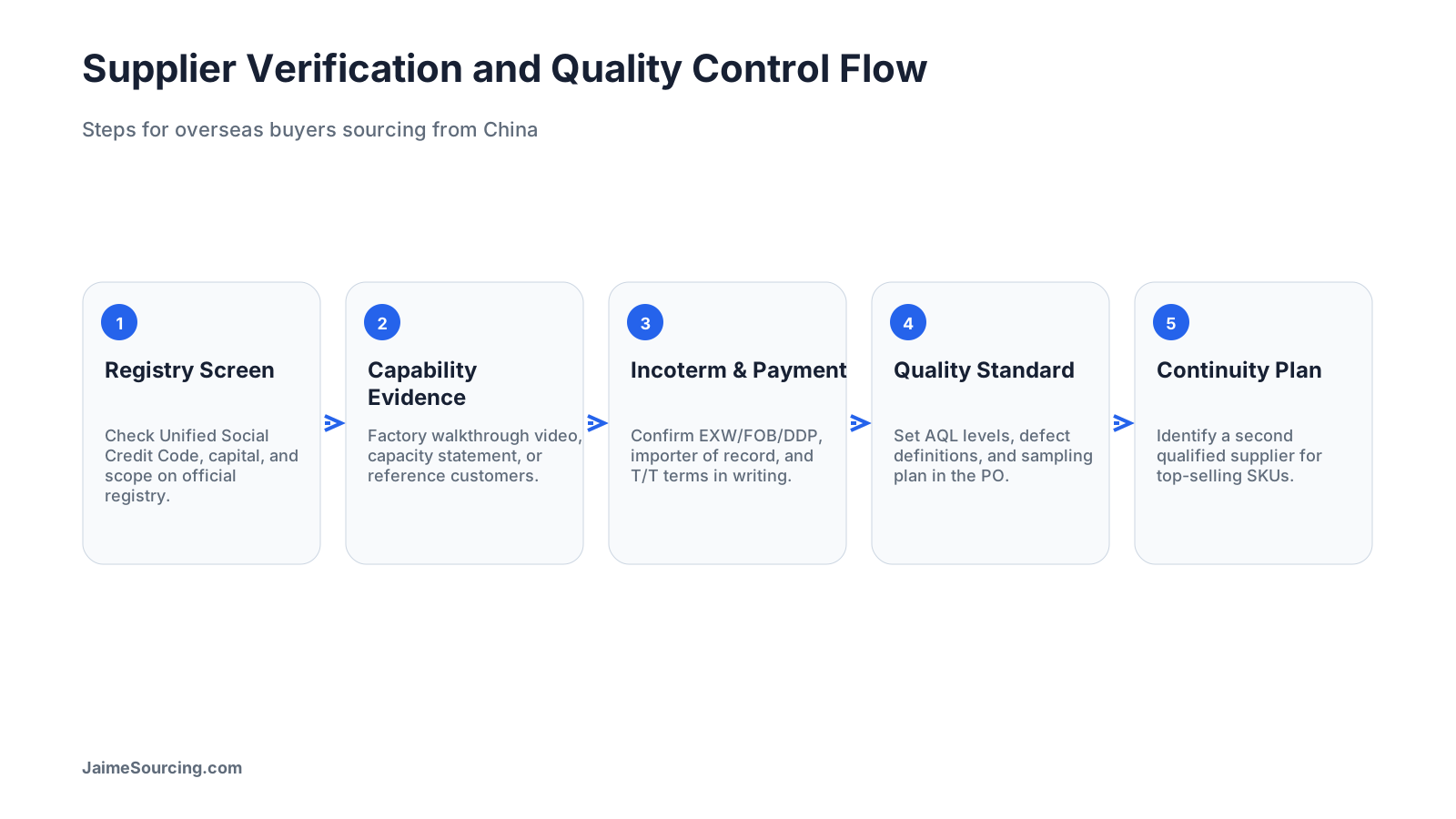
On Incoterms: EXW leaves origin charges, export clearance and main freight with you; FOB puts origin charges and export clearance on the supplier and main freight on you; DDP puts delivery and import duty on the supplier. Be cautious with “tax-inclusive DDP” quotes that do not name the importer of record or the duty rate — non-compliant arrangements can leave you as the liable importer without knowing it. Ask for the customs declaration and the importer name in writing.
On payment: overseas buyers paying Chinese suppliers typically use T/T, often 30% deposit and 70% before shipment, though terms vary by supplier and order size. Budget for bank fees at both ends, note that FX exposure sits with whoever holds the currency, and check whether any platform Trade Assurance fee is passed to you. Pay the company account named on the business licence, not a personal account, and agree in writing who absorbs sample and courier fees.
What to Verify Before You Proceed
Before committing to any model, run these checks on the supplier itself:
- Business identity. Look up the supplier on the Chinese National Enterprise Credit Information Publicity System using its full legal name or Unified Social Credit Code. Cross-check on Tianyancha or Qichacha for shareholder structure and any litigation records.
- Registered versus paid-in capital. Registered capital is a subscribed figure, not money in the bank. Paid-in capital tells you what has actually been contributed; a large registered figure with zero paid-in is a warning, not a disqualifier.
- Establishment date and scope. A company registered last year with a broad business scope may be a trading intermediary rather than a factory. That can be fine — but price and QC expectations should match reality.
- Unified Social Credit Code. Confirm it matches the code on the proforma invoice and the bank account name. Mismatches are a common fraud signal.
- Factory evidence. Ask for a live video walkthrough with the production line and warehouse visible, not a photo pack.
Frequently Asked Questions
Can I use the same supplier for dropshipping and later private label?
Often yes, but only after re-verification, because a supplier that fulfils single units reliably may lack packaging capability, tooling or compliance documentation for private label. Ask directly whether they manufacture or trade, request a pre-production sample with your artwork, and run a fresh inspection before the first bulk order.
How much should I budget for inspection on a first wholesale order?
Treat inspection as a fixed cost per order rather than a percentage, and compare it against the cost of one recall or one star-rating collapse. For most small resellers, a single pre-shipment inspection on the first and second orders, then periodic checks once quality stabilises, is a reasonable starting rhythm.
Is DDP always simpler for a small buyer?
Simpler on paper, riskier if the arrangement is opaque, because a compliant DDP quote names the importer of record, the duty rate and the customs declaration. If a supplier cannot explain how duty is being handled, the saving may be a compliance gap you inherit. FOB with your own forwarder is often cleaner for repeat orders.
What changes if I sell into the EU versus the US?
Labelling, safety marking and tax obligations differ by jurisdiction and category, and EU cross-border sales can trigger import VAT and IOSS obligations. Confirm the current official rule for your product and destination, and build compliance documents into the supplier’s pre-production checklist rather than retrofitting them later.
Where the Risk Actually Sits
Every model above shares the same three failure points: quality drift between the approved sample and the shipped batch, follow-up that stalls because nobody is physically at the factory, and the distance and time-zone gap that turns a two-day question into a two-week delay. Dropshipping hides these risks behind a supplier’s promise; wholesale and private label expose you to them directly.
Jaime Sourcing acts as your ground team in China — supplier research and verification, inspection and quality control, consolidation, packing and shipment coordination — so the checks described above happen on the ground rather than in an email thread. If you are choosing between models, or want a supplier check or workflow review before your next order, talk to Jaime Sourcing.
Turn your product and order requirements into a controlled sourcing brief.
Share the product, supplier link, quantity, destination and current order stage. We will identify the practical verification, quality-control, packing and shipping steps.