If you are a Shopify reseller sourcing toys or baby products from China, the short answer is this: your product must be tested by an accredited third-party lab against the standard of every market you sell into, and you—not the factory—own the compliance file. For the US that means ASTM F963 plus CPSIA rules and a Children’s Product Certificate (CPC); for the EU it means the Toy Safety Directive, EN71 testing, a Declaration of Conformity (DoC) and the CE mark. A supplier’s existing certificate almost never covers your SKU, your materials or your production batch, so budget for testing as a line item in your landed cost before you place a purchase order.
This guide covers the standards, the testing workflow, the labeling traps that cause customs holds, and the supplier checks that separate a real factory from a trading company reselling someone else’s paperwork.
Which Standards Apply to Your Market?
Toy safety is regulated market by market, and the standards are similar in intent but not interchangeable. A product tested only to EN71 cannot be sold in the US without ASTM F963 testing, and vice versa. The table below maps the main requirements by destination.
| Market | Core toy standard | Additional requirements | Importer document |
|---|---|---|---|
| United States | ASTM F963 (mandatory under CPSIA) | CPSIA total lead, phthalates, small parts, tracking label | Children’s Product Certificate (CPC) |
| European Union | EN71 (parts 1–3 core; up to 13 parts) | Toy Safety Directive 2009/48/EC, REACH, CE marking | Declaration of Conformity (DoC) |
| United Kingdom | EN71 as retained in UK law | UKCA marking regime | UK DoC |
| Canada | Canada Toy Regulations (SOR/2011-17) | Surface coating, phthalates, lead rules | As required by importer |
| Australia / NZ | AS/NZS ISO 8124 | Electrical toys AS/NZS 62115 | Supplier declaration |
| International benchmark | ISO 8124 | — | — |
Sources:. The UK and Canada rows are summarized from lab service scopes; confirm the current official rule with the relevant regulator before you ship, because standards are revised (for example, ASTM F963 has moved through multiple editions, and Amazon’s toy policy references ASTM F963-23).
For baby products specifically—feeding items, pacifiers, strollers, carriers—the toy standards are only part of the picture. Pacifiers, bottle nipples and similar items fall under separate infant-care standards (for example EN 1400 for soothers), and durable infant products in the US have their own CPSC rules. Treat “baby product” as a category that needs a product-specific standard review, not a generic toy test.
What the Tests Actually Cover
EN71 and ASTM F963 overlap heavily on mechanical, physical, flammability and heavy-metal migration requirements, which is why labs often quote them together. The practical breakdown:
- Mechanical and physical safety (EN71-1 / ASTM F963 mechanical clauses): sharp edges, small parts and choking hazards, pull and torque tests on attached components, drop and impact testing. Labs run pull/pressure tests up to 10 kN and beyond depending on the product.
- Flammability (EN71-2 / ASTM F963 flammability): how fast materials burn, especially plush, textiles and costumes.
- Heavy metal migration (EN71-3 / ASTM F963 soluble heavy metals): migration of elements from toy materials—19 elements under EN71-3 versus 8 under the ASTM F963 scope quoted by SGS.
- Chemical restrictions: CPSIA total lead and phthalates in the US; REACH, plus specific limits such as bisphenol A, phenol, formamide and flame retardants in the EU.
- Electrical safety: EN62115 for electric toys in the EU, AS/NZS 62115 in Australia, GB 19865 in China.
- Slime, putty and compound toys: these need their own chemical and microbiological testing packages; they are a frequent recall category and should never be tested as “general plastic toys”.
Not every clause of ASTM F963 applies to every toy. A silent wooden stacking toy does not need sound-level testing, but it still needs mechanical, heavy-metal and flammability review. Ask your lab for a clause-by-clause test plan rather than a flat “toy test” quote.
The Testing Workflow: From Sample to Shipment
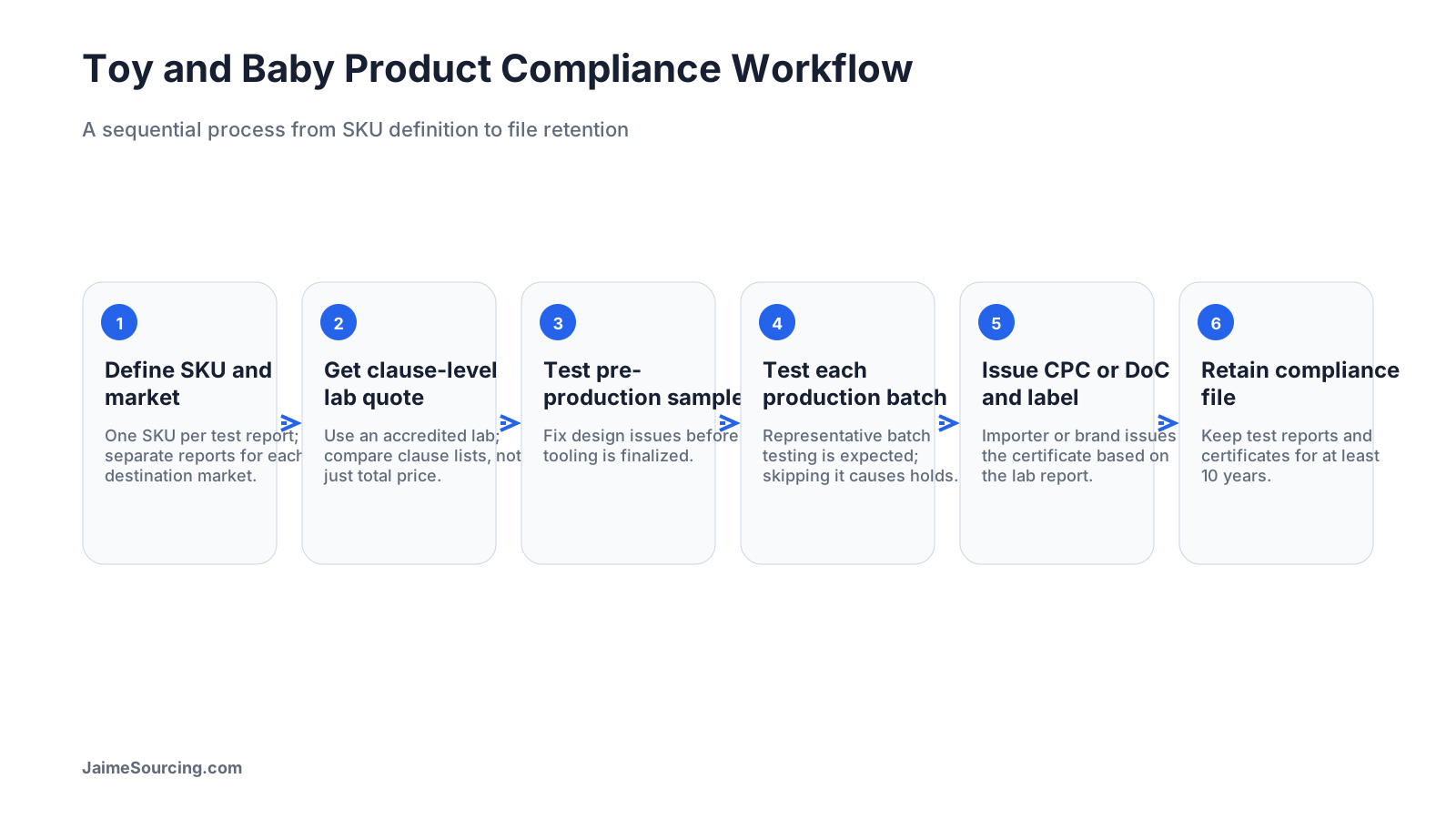
Compliance is a process, not a certificate you buy once. A workable sequence for a small brand:
- Define the SKU and the market. One SKU per test report. If you sell the same toy in the US and EU, you need two reports and two document sets.
- Get a clause-level quote from an accredited lab. CPSC-recognized labs for the US; EN71-accredited labs for the EU. Get quotes from at least two labs and compare the clause list, not just the total price.
- Test the pre-production or golden sample. Fix design issues before tooling is finalized. A failed mechanical test after mass production is expensive.
- Test each production batch. Both the EU and US regimes expect representative batch testing; skipping it is a common cause of customs holds and recalls.
- Issue the CPC or DoC and apply labels. The CPC is issued by the importer or brand, based on the lab report—not by the factory.
- Keep the file for at least 10 years. Importers have a legal obligation to retain test reports and certificates and produce them on request.
Budget reality: third-party testing typically runs about US$400–$1,200 per SKU per market, depending on product complexity and the number of clauses. That is per SKU, per market, per batch—so a five-SKU US launch can easily carry US$2,000–$6,000 in testing before freight. Build this into your unit economics rather than treating it as a surprise.
Labeling, Packaging and the Traps That Cause Customs Holds
Missing or incorrect labels are one of the most common reasons toy shipments get held, and they are entirely preventable.
- EU: CE mark on the packaging and, where possible, on the toy itself; importer name and address on the packaging; age warnings (for example “not suitable for children under 3”) clearly displayed; safety information in the official language of each destination country.
- US: a tracking label per ASTM F963/CPSIA covering manufacturer or importer, batch or lot number and production date; age grading and warnings on the packaging per CPSC rules.
- Packaging materials: phthalates and heavy metals in packaging are also checked during EN71 or ASTM F963 testing, so do not assume the polybag is exempt.
A practical control: request photos of the printed packaging and label artwork before mass printing, and have the lab review the artwork against the destination requirements. A label review is far cheaper than a reprint or a held container.
Supplier Verification Before You Pay for Testing
Testing a sample from a supplier you have not verified is testing the wrong thing. Before you commit to a lab spend, confirm who you are actually buying from.
Use the Chinese National Enterprise Credit Information Publicity System (National Enterprise Credit Information Publicity System) as the primary public record. Search the company’s Chinese legal name and check:
- Unified Social Credit Code (Unified Social Credit Code): the 18-character identifier that ties the company to its registration. It should match the name on your contract and proforma invoice.
- Establishment date: a company registered a few months ago is not automatically a problem, but it changes how much you rely on documents versus site verification.
- Registered capital vs. paid-in (subscribed) capital: registered capital is a declared figure, not cash in the bank. Paid-in capital tells you how much has actually been contributed. A high registered capital with minimal paid-in capital is common and not illegal—but it should temper how much you treat the number as a proxy for capability.
- Business scope (business scope): confirm toy manufacturing or wholesale is actually listed.
- Abnormal operations list (abnormal operations list) and administrative penalties: check for missed annual reports or enforcement actions.
Tianyancha and Qichacha aggregate the same public records plus shareholder structures, branch offices and litigation history. They are useful for cross-checking ownership and spotting related entities, but treat their summaries as a starting point and verify key facts against the official system.
Then layer on operational checks: ask for the factory’s business license, a recent utility bill or lease in the factory’s name, and a short video walk-through of the production line. If the supplier cannot show a production floor, assume you are dealing with a trading company and price the added margin and communication risk accordingly.
Quality Control in Production: AQL and Inspection
Lab testing proves the design is safe; inspection proves the batch matches the approved sample. For toys and baby products, use AQL sampling under ISO 2859-1 / ANSI/ASQ Z1.4, General Inspection Level II, and define defect classes before the inspection, not after.
- Critical defects: safety hazards—sharp points, detachable small parts on items for under-3s, banned chemicals, missing required labels. A common starting point is zero tolerance (Critical 0).
- Major defects: functional failures or visible flaws a customer would return the product for—broken mechanisms, wrong color, weak seams.
- Minor defects: cosmetic issues that do not affect function or safety.
A widely used starting point is Critical 0 / Major 2.5 / Minor 4.0, but this is an example, not a universal rule. Tighten the major limit for baby products and anything a child puts in their mouth, and agree the defect definitions in writing with the factory and the inspection provider before the visit. Pair the pre-shipment inspection with an in-line check during production so defects are caught before packing, not after.
Landed Cost, Incoterms and Payment Practicalities
Compliance cost sits alongside freight and payment risk in your landed cost. Three Incoterms matter most for small importers:
- EXW (Ex Works): you take over at the factory gate. Cheapest on paper, but you carry origin handling, export clearance and the risk of a factory that is not set up to export.
- FOB (Free On Board): the supplier handles export clearance and delivery to the port; you pay main freight, insurance and destination charges. The most common and transparent choice for small brands.
- DDP (Delivered Duty Paid): the supplier quotes a single delivered price including duty and tax. Convenient, but “tax-inclusive DDP” arrangements can involve under-declared values or non-compliant customs entries—and as the importer of record you carry the legal exposure, not the supplier. Ask for the customs entry and duty receipt, and be cautious of DDP quotes that are dramatically below the duty you can calculate yourself.
On payments to Chinese suppliers: T/T is standard, typically a deposit with the balance before shipment. Bank fees and FX spreads are usually borne by the sender—confirm who pays the intermediary bank charges. Trade Assurance–style platform protection adds a fee and only covers transactions routed through that platform, so it does not protect off-platform payments. Pay the company’s corporate account matching the contract name, not a personal account, and agree in writing who absorbs sample and courier fees before the first sample ships.
What to Verify Before You Proceed
Before you release a deposit or book a lab, confirm each of the following in writing:
- The supplier’s Chinese legal name, Unified Social Credit Code and business scope match the contract, proforma invoice and bank account.
- The exact standard and edition for each destination market, confirmed against the current official regulator guidance.
- A clause-level lab quote from an accredited lab, with the sample quantity the lab requires.
- Who issues the CPC or DoC, and who retains the compliance file (you should).
- Label and packaging artwork reviewed against destination requirements, including language.
- AQL levels and defect definitions agreed before the inspection is booked.
- Incoterm, duty responsibility and payment account confirmed in the contract.
Frequently Asked Questions
Can I use the supplier’s existing EN71 or ASTM F963 certificate?
No—a supplier certificate almost never covers your SKU, materials or batch. Each new product and each production batch needs its own testing, and the CPC or DoC must be issued by the importer or brand based on that report.
How much does toy testing cost per SKU?
Expect roughly US$400–$1,200 per SKU per market, depending on complexity and the number of clauses tested. Budget separately for the US and EU, and remember batch testing adds recurring cost across repeat orders.
Do baby products need toy testing?
Only partly. Feeding items, pacifiers and similar infant-care products fall under separate standards such as EN 1400, and US durable infant products have their own CPSC rules. Review the product-specific standard rather than defaulting to a generic toy test.
Is a CE mark enough to sell in the US?
No. CE and EN71 are EU requirements; the US requires ASTM F963 testing under CPSIA and a CPC. The standards are similar in intent but not interchangeable, so a CE-marked product still needs US testing before import.
What happens if my shipment arrives without the right documents?
Customs can hold, fine or destroy the goods, and recalls are costly. EU penalties can reach €500,000 and US penalties up to US$100,000 in the figures cited by compliance guides, before recall costs. Keep reports on file for at least 10 years.
Managing Quality Drift When You Are 8,000 Miles Away
The hardest part of sourcing toys and baby products from China is not finding a supplier—it is keeping the tenth batch identical to the first approved sample, chasing factory answers across time zones, and catching a labeling or material substitution before it reaches a container. That is a ground-game problem: someone needs to walk the line, pull the samples, check the artwork and follow up on the lab report while the factory is still open for business.
Jaime Sourcing supports overseas buyers with supplier research and verification, inspection and quality control, consolidation, packing and shipment coordination—acting as your ground team in China so quality drift, factory follow-ups and time-zone friction do not become your problem. If you are planning a toy or baby product order, talk to Jaime Sourcing about a supplier check or a workflow review before you place your next deposit.
Turn your product and order requirements into a controlled sourcing brief.
Share the product, supplier link, quantity, destination and current order stage. We will identify the practical verification, quality-control, packing and shipping steps.