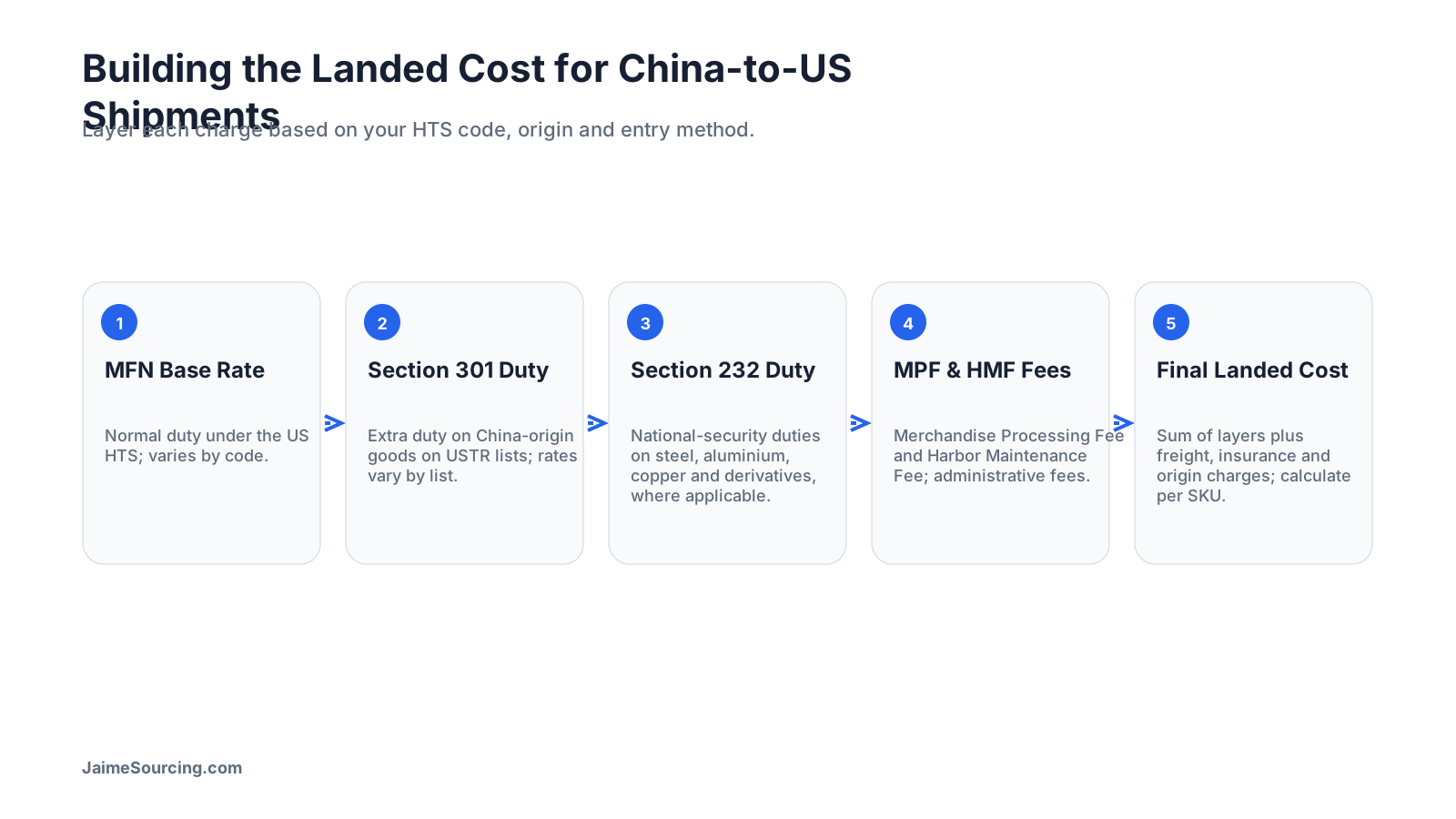
If you sell China-made goods to US customers, your landed cost is no longer just the factory price plus freight. For most product categories it is a stack: the normal (MFN) duty rate, a Section 301 tariff that can run from 7.5% to 100% depending on the HTS code, and — for shipments entered on or after July 24, 2026 — an additional 12.5% Section 301 charge tied to forced-labor enforcement, plus merchandise processing fees (MPF) and, for ocean freight, the harbor maintenance fee (HMF). The old assumption that small parcels under US$800 arrive duty-free is also no longer safe to build a business model on: the de minimis exemption has been progressively restricted, and proposed rules would exclude any goods subject to Section 201, 232 or 301 duties from it entirely.
The practical answer for a Shopify reseller: assume duty applies, price it into your margin, and verify your HTS classification and origin before you place a purchase order — not after the container lands.
Regulations, tariff treatment and platform rules can change. This guide was reviewed on November 8, 2026. Confirm the current requirements with the destination-country authority, customs broker or qualified compliance adviser before placing an order.
The Four Layers of Cost on a China-to-US Shipment
Duty is rarely one number. US importers of Chinese-origin goods can face several layers that stack on top of each other:
| Cost layer | What it is | Who it applies to |
|---|---|---|
| MFN base duty | The standard HTSUS rate for that product | All imports |
| Section 301 (China lists) | Additional duty of 7.5%–100% by list and HTS code | Chinese-origin goods on Lists 1–4A |
| Section 301 forced-labor action | 12.5% additional duty (HTS 9903.05.31) for entries from July 24, 2026, subject to exclusions | Chinese-origin goods not covered by the note 52 exemption list |
| MPF and HMF | Customs processing fee and ocean-freight harbor fee | Most formal entries; ocean shipments |
Two nuances matter for consumer brands. First, List 4B products — including laptops (HTS 8471.30), smartphones (HTS 8517.13), games consoles, toys and some consumer electronics — remain suspended from the List 1–4A tariffs, but toys and games consoles are not on the forced-labor exemption list and therefore attract the 12.5% charge, while laptops and smartphones are exempt from Section 301 entirely under the note 52 list. Second, a small number of product-specific exclusions remain in force — 178 exclusions extended after the November 2025 US–China arrangement run until November 9, 2026 under HTS 9903.88.69 and 9903.88.70 — so an exclusion check is worth doing before you assume a rate.
The same “China product” can carry very different total duty depending on its 10-digit HTS code. Classification is the single highest-leverage cost decision you control.
Section 301 in Plain Terms — and Why “Made in Vietnam” Isn’t a Shortcut
Section 301 of the Trade Act of 1974 authorises the US Trade Representative to respond to unfair foreign trade practices. The China tariffs began under the first Trump administration, with four lists covering roughly US$550 billion of Chinese-origin goods: List 1 (US$34 billion at 25%, July 2018), List 2 (US$16 billion at 25%, August 2018), List 3 (US$200 billion, initially 10% then raised to 25% in May 2019) and List 4A (US$300 billion at 15%, cut to 7.5% under the Phase One agreement, with List 4B suspended). The Biden administration kept those tariffs and, in its September 2024 four-year review, finalised increases on strategic goods — EVs to 100%, solar cells to 50%, and 25% on critical minerals, steel, aluminium, masks and cranes from September 27, 2024, with semiconductor increases from January 1, 2025 and medical gloves and masks rising further in 2025–2026.
Shipping from a third country does not remove the tariff. US Customs and Border Protection applies Section 301 based on country of origin, not country of export. Origin is determined either by the “wholly obtained” test or by “substantial transformation” — whether the last processing step creates a new and different article in name, character and use. Simple re-export or light assembly in Southeast Asia or Mexico does not automatically change origin, and CBP has challenged such structures. If a supplier proposes a “transshipment” solution, treat it as a compliance risk, not a cost saving.
De Minimis: What Changed and What It Means for Parcel Sellers
The US de minimis rule historically let shipments valued at US$800 or less enter duty-free with minimal scrutiny. By 2023, more than one billion parcels entered the US under the exemption — nearly four million a day — with most coming from Chinese ecommerce platforms. In September 2024 the White House proposed rules to exclude any goods subject to Section 201, 232 or 301 duties from de minimis eligibility and to tighten declaration requirements, a change aimed squarely at direct-to-consumer parcel flows.
The policy has since moved from proposal to implementation. Reporting in early 2025 described the de minimis exemption being cancelled for Chinese imports alongside an additional 10% China tariff, and a subsequent US policy update described termination of low-value treatment for goods from China, Mexico and Canada, with the exemption remaining for other countries. Shopify’s own guidance to merchants noted the removal of de minimis treatment for sub-US$800 Chinese goods from May 2, with postal shipments facing either an ad valorem rate or a per-item charge that stepped up in June.
Because the exact mechanics and rates have shifted repeatedly, do not rely on any single figure in this article. The durable planning assumption is: low-value parcels from China should be modelled as dutiable, and your checkout, shipping labels and customer communications need to reflect that.
What This Does to Your Landed Cost — and Your Shopify Checkout
Landed cost is the number that decides whether a product is viable. Build it as: ex-works price + origin charges + freight + insurance + duty stack + MPF/HMF + destination delivery + payment and FX costs. Duty is calculated on the customs value declared to CBP, which is generally the transaction value of the goods — so freight and duty are not interchangeable line items.
On the commercial side, the Incoterm you accept determines who carries that risk:
- EXW leaves export clearance, origin charges and all customs responsibility with you, the buyer. It looks cheapest on a quote and is usually the most expensive in practice.
- FOB puts the supplier in charge of export clearance and loading at the Chinese port; you own the main carriage and US import.
- DDP means the seller delivers duty-paid. This is convenient but is where non-compliant “tax-inclusive” arrangements appear — a forwarder or supplier under-declaring value, misclassifying the HTS code, or routing through a third country to avoid Section 301. If the DDP price looks too good, ask for the entry summary (CBP Form 7501) and the declared HTS code. You, as importer of record, carry the liability for an incorrect declaration, not the seller.
For payments to Chinese suppliers, standard practice is a T/T deposit (commonly 30%) with the balance against a pre-shipment inspection, though terms vary by supplier and should be negotiated. Watch bank charges on both ends, FX exposure between quote and payment, platform fees if you use Trade Assurance, and whether you are paying a corporate account or a personal one — the latter is a red flag in supplier due diligence. Agree in writing who absorbs sample-payment fees.
Shopify merchants can collect duties and import taxes at checkout and buy DDP shipping labels through supported carriers, which avoids the “surprise fee at the door” problem that drives chargebacks and refused deliveries. If you ship DAP instead, your shipping policy and order confirmation must state clearly that the customer pays duties on delivery.
Supplier and Origin Verification Before You Commit
Tariff exposure is set by facts you can check. Before placing an order:
- Confirm the HTS code with your broker, not the supplier alone. Ask for the 10-digit code and the reasoning; cross-check against the USTR HTS tool and the Section 301 list for that code.
- Verify the manufacturer, not just the trading company. Use the Chinese National Enterprise Credit Information Publicity System (National Enterprise Credit Information Publicity System) to confirm the legal entity, Unified Social Credit Code, establishment date, registered capital and whether subscribed capital has actually been paid in. Tianyancha and Qichacha offer similar corporate records and can surface related entities, litigation and abnormal-operation listings. Registered capital is a statement of subscribed liability, not proof of factory capacity — treat it as one data point.
- Check origin claims against the production process. If a supplier says goods are “made in Vietnam” or “assembled in Malaysia,” ask for the bill of materials, factory address and production records. Substantial transformation is a legal test, not a marketing label.
- Inspect before shipment. For QC, agree an AQL plan under ISO 2859-1 / ANSI/ASQ Z1.4 at General Inspection Level II, with Critical, Major and Minor defect classes defined in writing. Critical 0 / Major 2.5 / Minor 4.0 is a common starting point, not a universal rule — set limits by product risk.
- Reconcile the entry. After clearance, compare the CBP Form 7501 against your commercial invoice and purchase order. Discrepancies in value or classification are cheaper to fix early; post-summary correction and protest windows are time-limited.
What to Verify Before You Proceed
- The 10-digit HTS code for every SKU, confirmed by a licensed customs broker.
- Whether that code sits on a Section 301 list, and whether any product exclusion (e.g., HTS 9903.88.69/9903.88.70, valid to November 9, 2026) applies.
- Whether the 12.5% forced-labor Section 301 charge applies, or the goods fall under the note 52 exemption list.
- The declared customs value and Incoterm on your supplier’s quote — and who is importer of record.
- Supplier legal identity, Unified Social Credit Code and paid-in capital via the National Enterprise Credit Information Publicity System, Tianyancha or Qichacha.
- Origin evidence if any non-China manufacturing is claimed.
- Your checkout duty settings, DDP/DAP label choice and shipping-policy wording.
- A written AQL inspection plan before balance payment.
Frequently Asked Questions
Do Section 301 tariffs apply to all products from China?
No — Section 301 applies only to Chinese-origin goods listed under specific HTS codes on Lists 1–4A, at rates from 7.5% to 100%, while List 4B items such as laptops and smartphones remain suspended. The forced-labor 12.5% charge from July 24, 2026 applies more broadly but has its own exemption list. Always check your exact HTS code rather than assuming by product category.
Can I avoid Section 301 by shipping through another country?
Generally not, because CBP applies Section 301 based on country of origin, not country of export, and light assembly abroad often fails the substantial-transformation test. Genuine origin change requires real manufacturing that creates a new article in name, character and use. Document any such claim with production records before relying on it.
Is the US$800 de minimis exemption still available for China parcels?
The de minimis exemption for Chinese-origin goods has been progressively restricted and, per 2025 reporting and policy updates, terminated for China-origin shipments, with postal flows facing ad valorem or per-item charges. Because the rules have changed repeatedly, confirm current treatment with CBP or your broker before pricing parcels.
Who pays the duty if my supplier quotes DDP?
Legally, the importer of record is liable for the declared value and classification, even when a supplier or forwarder quotes DDP. Ask for the entry summary and HTS code; if the DDP price implies under-declaration or misclassification, the risk sits with you. Compliant DDP is possible — non-compliant “tax-inclusive” pricing is not worth the exposure.
How do I estimate total landed cost before ordering?
Build it from ex-works price plus freight, insurance, the full duty stack (MFN + Section 301 + any forced-labor charge), MPF/HMF and destination delivery. Confirm the HTS code and origin first, then model duty at the applicable rate. Shopify’s duty calculator and DDP label options can help you pass the cost through transparently at checkout.
Manage the Risk, Not Just the Rate
Tariff rates get the headlines, but most losses for small ecommerce brands come from quality drift, missed factory follow-ups and the physical and time-zone distance between a buyer and a Chinese production line. A misclassified HTS code, an unverified trading company or a shipment that fails inspection after balance payment costs more than a few points of duty.
Jaime Sourcing works as your ground team in China — supplier research and verification, inspection and quality control, consolidation, packing and shipment coordination — so the facts behind your landed-cost model are checked before money moves. If you are reviewing a supplier, an HTS classification or a China-to-US workflow, talk to Jaime Sourcing for a supplier check or workflow review.
Turn your product and order requirements into a controlled sourcing brief.
Share the product, supplier link, quantity, destination and current order stage. We will identify the practical verification, quality-control, packing and shipping steps.