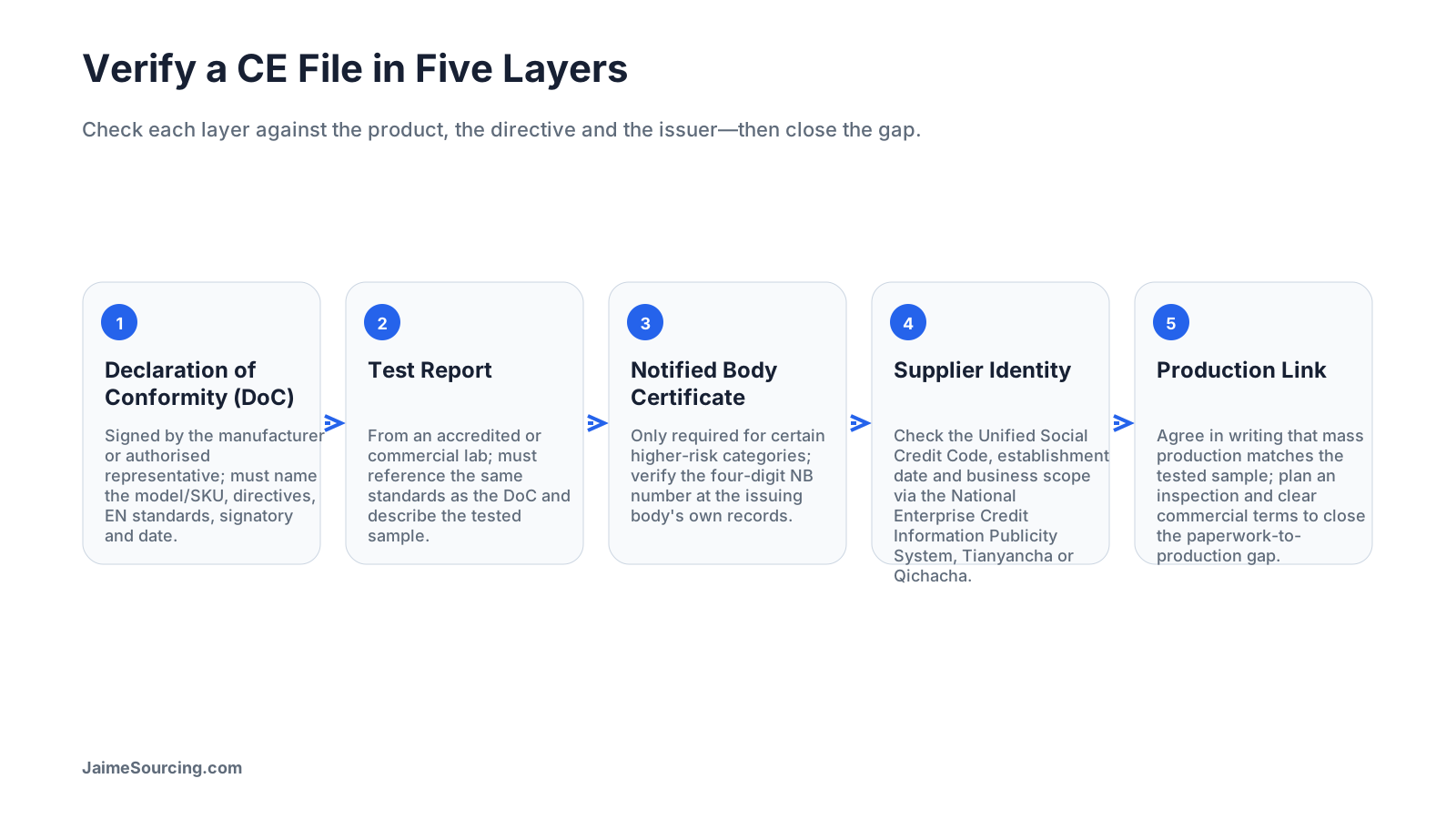
A CE certificate is not a single document, and a PDF with a red logo proves nothing on its own. To verify what a Chinese supplier sends you, separate the paperwork into three layers—the Declaration of Conformity (DoC), the test report, and any Notified Body certificate—then check each against the actual product, the correct EU directive, and the issuing body’s own records. If any layer is missing, mismatched or unverifiable, treat the product as unproven until you close the gap.
This guide is written for overseas buyers and Shopify resellers, not for exporters. It focuses on what you can check yourself, what you must ask the supplier to prove, and where the common fakes hide.
First, understand what “CE” actually is
CE marking (“Conformité Européenne”) is a safety declaration that a product meets the applicable EU directives and harmonised standards, allowing it to circulate across the EEA. It is not a general quality mark—CE addresses basic safety, health and environmental requirements, not overall product quality.
There is no single “CE certificate” issued by a central EU authority. Compliance is demonstrated through a combination of:
- A Declaration of Conformity (DoC) — a legal self-declaration signed by the manufacturer or their authorised representative, stating which directives and standards apply.
- A test report — evidence from a laboratory showing the product was tested against the relevant harmonised (EN) standards.
- A Notified Body (NB) certificate — only required for certain product categories and conformity-assessment routes, and only an NB can issue an EC-type examination certificate.
This distinction matters because suppliers often blur it. A “CE certificate” from a random testing company may be a voluntary VOC (Certificate of Compliance), not an NB certificate, and the two carry very different weight.
The three document types—and what each one proves
| Document | Who issues it | What it proves | Common red flag |
|---|---|---|---|
| Declaration of Conformity (DoC) | Manufacturer / authorised rep | Self-declared conformity to named directives and standards | Generic template with no model, no standards, no signatory |
| Test report (EN standards) | Accredited or commercial lab | Product was tested to specific harmonised standards | Report references wrong standard or an unrelated product |
| Notified Body certificate | EU Notified Body (NB) | Independent assessment for higher-risk categories | “NB number” that doesn’t match a real notified body |
A DoC is a self-declaration and does not require third-party issuance—so its validity depends on the buyer and the destination customs authority accepting it. An NB certificate, by contrast, is issued under EU rules and is the most authoritative tier where one is required. Match the document tier to the product’s risk category before you trust it.
Step-by-step: how to verify each document
1. Check the DoC against the product and the directive
Ask for the DoC as a signed document, not a screenshot. Confirm it names the exact product model/SKU you are buying, lists the specific EU directives (e.g. LVD, EMC, RoHS, Toy Safety) and the harmonised EN standards, and carries a signatory name and date. A DoC that lists no standards, or lists standards unrelated to your product, is a template—not evidence.
2. Validate the test report
The test report should reference the same standards as the DoC and describe the tested sample in enough detail to match your product. Check the lab’s name and accreditation. A testing body’s report is the basis for CE conformity, but the lab itself does not “grant” CE—so a report alone is not a certificate.
3. Verify any Notified Body certificate at the source
If an NB certificate is claimed, identify the Notified Body by its four-digit number and confirm the certificate through that body’s own verification channel. There is no single EU-wide public database for all CE certificates, so verification must go through the issuing body or an authorised body. Some national bodies and platforms offer certificate-verification services, but coverage varies.
4. Cross-check the supplier’s identity
Before trusting any document, confirm the company is real and stable. Use the Chinese National Enterprise Credit Information Publicity System (National Enterprise Credit Information Publicity System), Tianyancha or Qichacha to check:
- Unified Social Credit Code — the 18-character identifier that should match the entity named on the DoC and invoices.
- Establishment date — a company registered months ago is a different risk profile from one trading for years.
- Registered capital vs. paid-in capital — registered capital is a subscribed figure, not money in the bank; paid-in capital shows what has actually been contributed. Do not treat a large registered-capital number as proof of capability.
- Business scope — confirm manufacturing/testing claims sit within the registered scope.
These tools tell you the entity exists and is consistent; they do not certify product compliance.
Where fake or misleading CE documents hide
Several patterns recur in supplier documentation:
- The “certificate” is actually a VOC. A commercial lab’s Certificate of Compliance is not an NB certificate, and its acceptance depends on the buyer and destination customs.
- Wrong directive or standard. A report for a different product family is reused across SKUs.
- Expired or superseded standards. Harmonised standards are updated; an old report may no longer reflect current requirements.
- Borrowed NB numbers. The four-digit number belongs to a real body, but the certificate was never issued by it—verify at the source.
- No traceable signatory. A DoC with no named, contactable responsible person is weak evidence.
Because CE is a safety mark rather than a quality mark, a valid CE file also tells you nothing about cosmetic quality or consistency between the tested sample and mass production. That gap is closed by inspection, not paperwork.
What to Verify Before You Proceed
Run this checklist before you place a bulk order or list a product:
- Document tier matches risk. Confirm whether your product category legally requires a Notified Body, or whether a self-declared DoC is the correct route.
- DoC is product-specific. Model/SKU, directives, EN standards, signatory and date all present and consistent.
- Test report matches the DoC. Same standards, same product description, credible lab.
- NB certificate verified at source. Number traced to the issuing body, not just printed on a PDF.
- Supplier entity is real. Unified Social Credit Code, establishment date and business scope checked via the National Enterprise Credit Information Publicity System, Tianyancha or Qichacha.
- Sample-to-production link. Agree in writing that mass production matches the tested sample, and plan an inspection (AQL per ISO 2859-1 / ANSI/ASQ Z1.4, General Inspection Level II, with Critical/Major/Minor definitions—e.g. Critical 0 / Major 2.5 / Minor 4.0 as a common starting point, not a universal rule).
- Commercial terms are clear. Confirm whether quotes are EXW, FOB or DDP; under DDP the seller handles origin charges and customs, but “tax-inclusive” DDP arrangements can hide compliance risk if documentation is thin. For payment, agree T/T terms, who bears bank fees and FX exposure, and whether funds go to a corporate or personal account.
If any item fails, pause. A missing or mismatched document is cheaper to fix before production than after a customs hold or recall.
FAQ
Can I check a CE certificate in one official EU database?
No—there is no single EU-wide public database covering all CE certificates, so verification must go through the issuing Notified Body or an authorised body. Confirm the four-digit NB number at the source rather than trusting the PDF. Some national bodies and platforms offer partial verification services, but coverage is not universal.
Is a CE certificate the same as a test report?
No. A test report shows a lab tested the product against EN standards, while a CE certificate (where an NB is involved) is issued under EU conformity rules. The lab report is the basis for conformity but the lab does not itself grant CE. Ask for both, plus the DoC.
Does every product need a Notified Body certificate?
No. Many products use self-declaration via a DoC, while higher-risk categories require NB involvement under specific conformity-assessment modules. Confirm your product’s route before assuming a certificate is mandatory—or that a self-declaration is sufficient.
How do I know the supplier’s company is legitimate?
Check the Unified Social Credit Code, establishment date, paid-in capital and business scope on the National Enterprise Credit Information Publicity System, Tianyancha or Qichacha. Registered capital is a subscribed figure, not proof of capability. Consistency between the entity, the DoC and the invoice is the real test.
Manage the gap between paperwork and production
Documents prove intent; they don’t guarantee that the tenth container matches the tested sample. Quality drift, silent component substitutions and factory follow-up failures are the real risks once a compliant file is in hand—and they’re hardest to catch from another time zone. That is where a ground team helps. Jaime Sourcing supports overseas buyers with supplier research, verification, inspection, quality control, consolidation, packing and shipment coordination in China, closing the physical-distance and time-zone gap between your compliance file and what actually ships. Talk to Jaime Sourcing for a supplier check or a workflow review before your next order.
Turn your product and order requirements into a controlled sourcing brief.
Share the product, supplier link, quantity, destination and current order stage. We will identify the practical verification, quality-control, packing and shipping steps.