
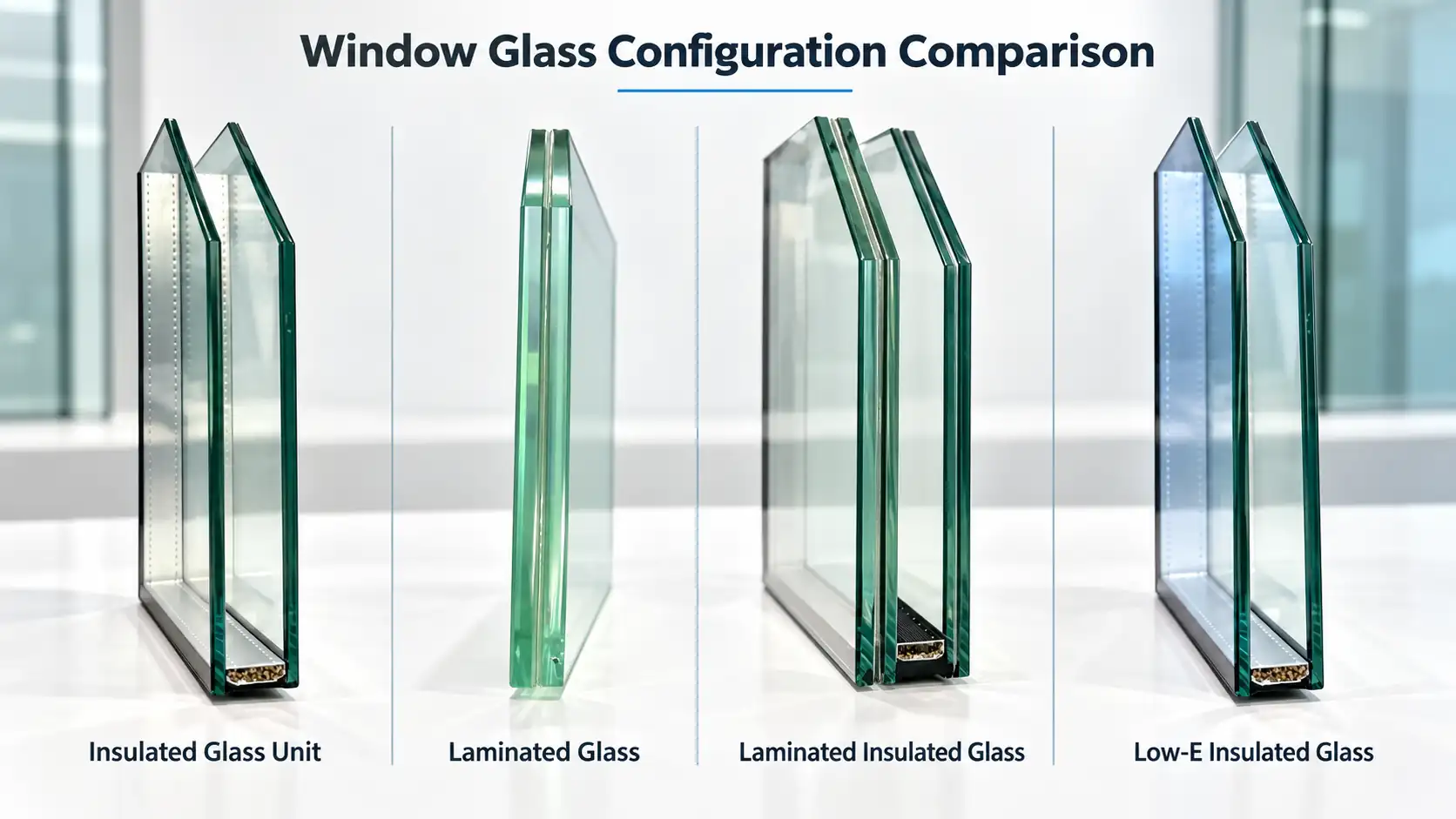
Glass normally occupies most of a window’s area, so it has a major influence on thermal performance, solar control, safety, and sound insulation. The best glass is not necessarily the thickest or the one with the most layers. It is the build-up that matches the building, window system, and performance target.
What Does 5 + 20A + 5 Mean?
The notation usually describes two 5 mm glass panes separated by an approximately 20 mm gas space. The letter A commonly identifies the cavity. A complete specification should also state whether the panes are tempered, whether one pane has a Low-E coating, whether the cavity is gas-filled, and which spacer and sealant system is used.
A wider cavity does not provide unlimited improvement. Beyond an effective range, convection inside the cavity may increase. The appropriate width depends on the gas, glass construction, spacer, and thermal design.
What Does an Insulated Glass Unit Do?
An insulated glass unit, or IGU, uses two or more panes separated by a sealed cavity. It is primarily used to reduce heat transfer and may also improve sound insulation at some frequencies.
Long-term IGU durability depends on:
- glass processing and edge quality;
- spacer and desiccant;
- primary and secondary seals;
- sealant compatibility;
- transportation, glazing, drainage, and edge protection.
Fogging inside the sealed cavity generally indicates seal failure and cannot be removed by cleaning the exposed glass surfaces.
When Is Laminated Glass Useful?
Laminated glass bonds two or more panes with an interlayer. After breakage, fragments are more likely to remain attached to the interlayer, which can reduce fallout hazards in appropriate applications.
The damping effect of the interlayer may also improve sound insulation over selected frequency ranges. For traffic or other low-frequency noise, an asymmetric laminated and insulated build-up may be considered, but the final decision should rely on complete-window acoustic data rather than a generic “soundproof glass” claim.
Tempered, laminated, and insulated describe different properties and can be combined. A phrase such as “tempered laminated IGU” must still be expanded into the exact pane-by-pane construction.
Double Glazing or Triple Glazing?
Triple glazing adds a pane and a second cavity. It may improve thermal performance, but it also increases thickness, weight, cost, and the demands placed on glazing pockets, beads, profiles, and sash hardware.
Compare whole-window U-values instead of glass-layer counts alone. For opening sashes, upgraded glass must be checked against hardware load and permitted sash dimensions.
How to Select Low-E Glass
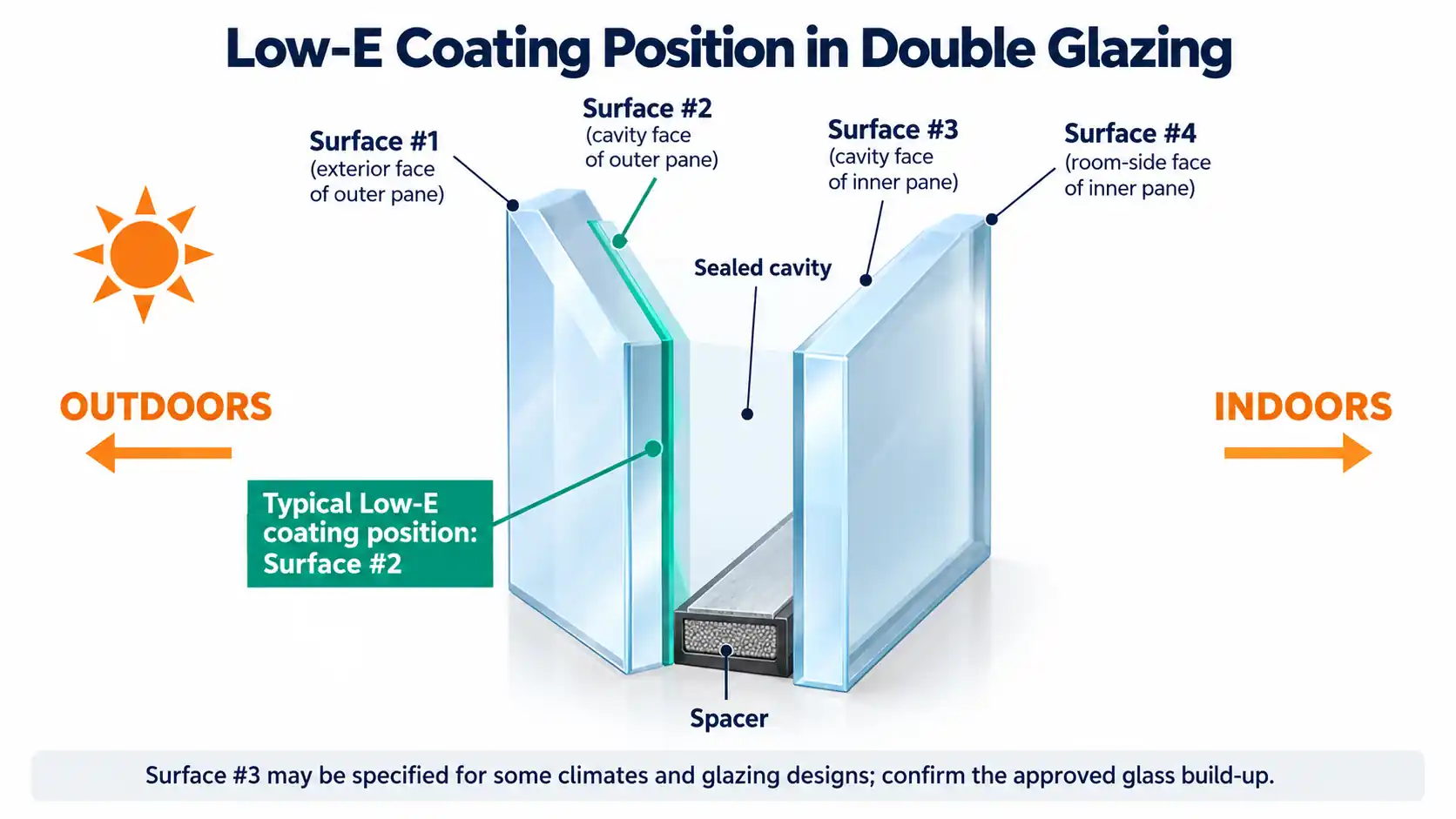
Low-emissivity coatings reduce radiative heat transfer. Single-, double-, and triple-silver products use different coating systems, but their names alone do not determine suitability.
Review:
- whole-window and glass U-values;
- solar heat gain or solar-control parameters;
- visible light transmission;
- color and exterior appearance;
- coating-surface position;
- climate and façade orientation.
A west-facing façade may prioritize solar heat-gain control, while a cold-climate project may balance insulation with useful winter solar gains. One coating specification should not automatically be copied to every orientation.
What Are Warm-Edge Spacers and 4SG?
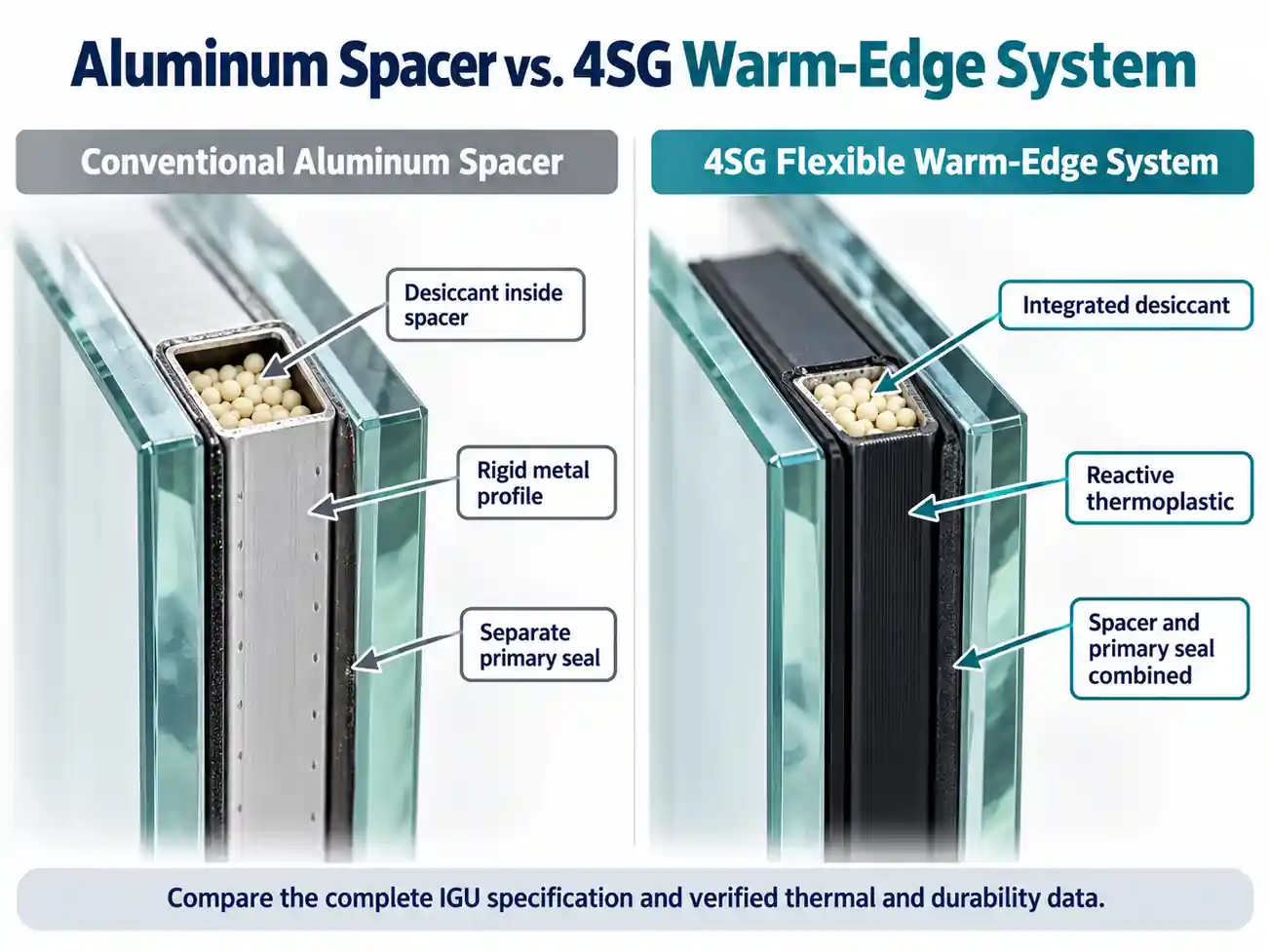
Conventional IGUs often use metal spacers. Warm-edge systems use lower-conductivity materials or composite constructions to reduce heat transfer at the glass edge and improve interior edge temperatures.
4SG generally refers to a flexible warm-edge spacer and sealing solution used around an IGU perimeter. It is not a separate glass type and does not replace tempering, lamination, or Low-E coatings.
When writing about 4SG, explain that:
- it is located at the IGU edge;
- performance depends on manufacturing and the complete window system;
- it does not independently determine acoustic or safety performance;
- claims about origin, invention, or patents should be checked against original manufacturer documentation.
Large Glass Requires Project-Specific Design
Glass thickness depends on pane dimensions, support conditions, design wind pressure, installation height, glass type, and applicable codes. Online rules based only on square meters should not replace engineering verification.
Large panes also affect transport, lifting, heat stress, replacement access, and ventilation layout. Before approving a large fixed pane, confirm how it will reach the opening and how it can eventually be replaced.
Glass Delivery Inspection
- construction matches the contract;
- required certification markings are verifiable;
- no obvious cracks, edge damage, scratches, or contamination inside the cavity;
- coating location and installation direction are correct;
- spacer and perimeter seals appear continuous;
- setting blocks and glazing engagement follow system requirements;
- temporary pressure-equalization devices, if used, are handled according to product instructions.
Conclusion
Insulated, laminated, Low-E, and warm-edge technologies perform different jobs and may be combined. Select the glass by balancing safety, thermal performance, solar control, acoustics, weight, and compatibility with the complete window system.
Suggested Internal Links:
- How to Choose Thermal Break Aluminum Profiles
- Casement vs Tilt-and-Turn vs Sliding Windows
- How to Choose Window Hardware, Gaskets, and Sealants
Technical References: Chinese standards GB/T 11944, GB 15763.2, GB 15763.3, GB/T 18915.2, JGJ 113, and JC/T 2453. Confirm current editions and project applicability.
Turn your requirements into a comparable supplier brief
Share dimensions, quantities, performance targets and destination. We will organize the key inputs before factories and quotations are compared.