
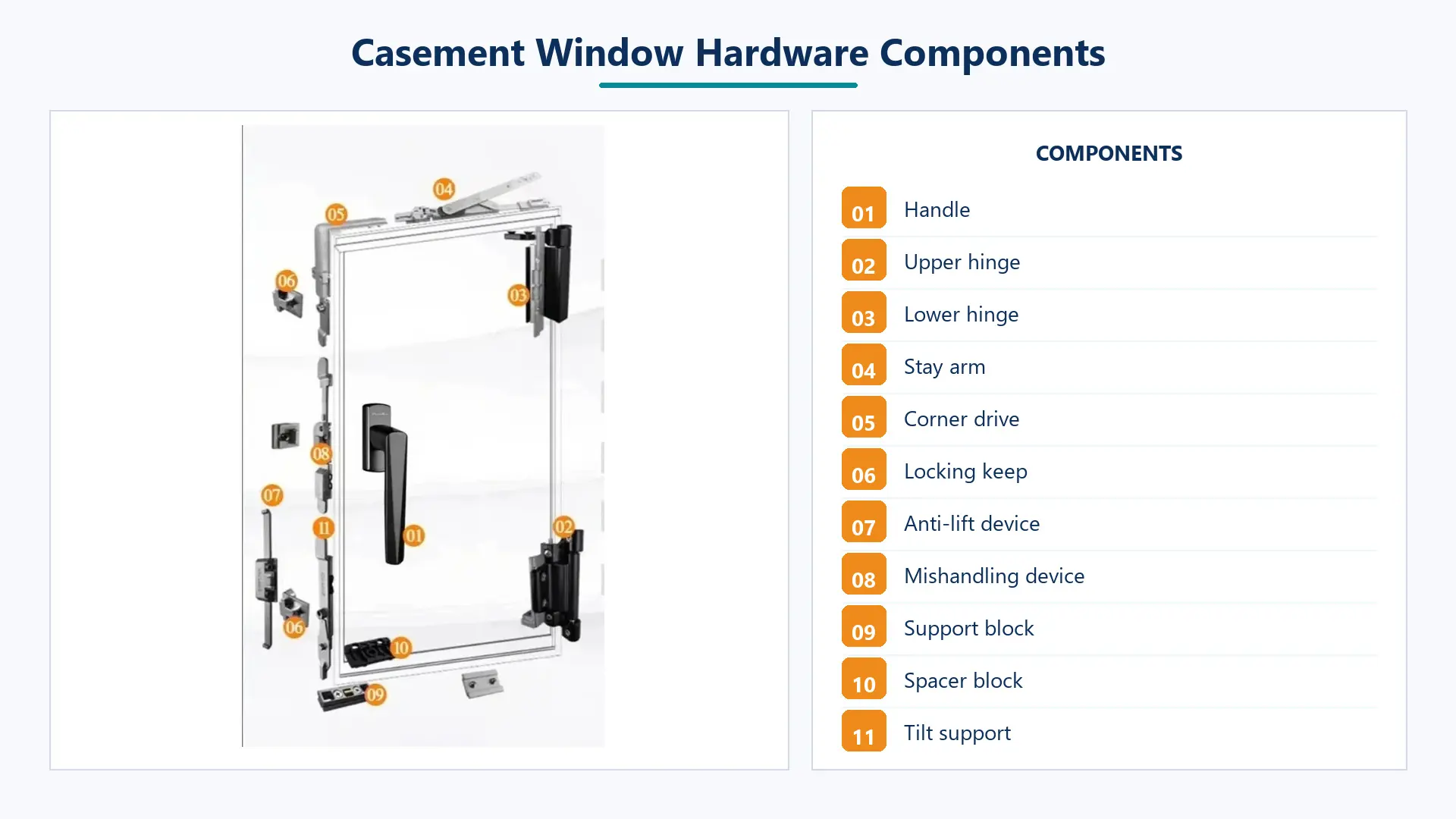
Profiles and glass receive most of the attention in a window quotation, while hardware, gaskets, sealants, fasteners, and corner connections are often described only as “premium accessories.” Yet these components carry the sash, create compression, seal joints, drain water, and connect the frame.
An incorrect component may lead to sash drop, difficult operation, air leakage, water penetration, or premature maintenance.
Window Hardware Is More Than a Handle
An opening window may use a handle, transmission mechanism, locking points and keeps, hinges or stays, restrictors, anti-mishandling devices, and secondary fall-protection components.
The handle initiates movement, the transmission moves the locking points, the locking system compresses the sash against its seals, and hinges or stays carry the sash. Every component must match the profile groove, opening function, dimensions, weight, and exposure conditions.
A brand name is not enough. The same manufacturer may offer several product series with different capacities, permitted dimensions, and corrosion classes.
Match Hardware to Complete Sash Weight
Sash weight includes glass, profiles, beads, spacer components, and hardware attached to the sash. Triple glazing and laminated IGUs can be substantially heavier than standard double glazing, so changing the glass may require different hardware.
Request:
- sash width, height, aspect ratio, and calculated weight;
- hardware brand, series, and exact model;
- permitted sash-size and load range;
- suitable safety margin and exposure conditions;
- fixing location and connection requirements.
A safety cable is an additional measure. It does not replace correctly selected load-bearing hardware, secure fixing, and any required anti-detachment design.
Are More Locking Points Always Better?
Multipoint locking can distribute gasket compression along a long sash. Too few points may leave areas under-compressed, but adding arbitrary points may increase operating force or distort components.
Use the layout specified by the compatible hardware system and confirm engagement after installation.
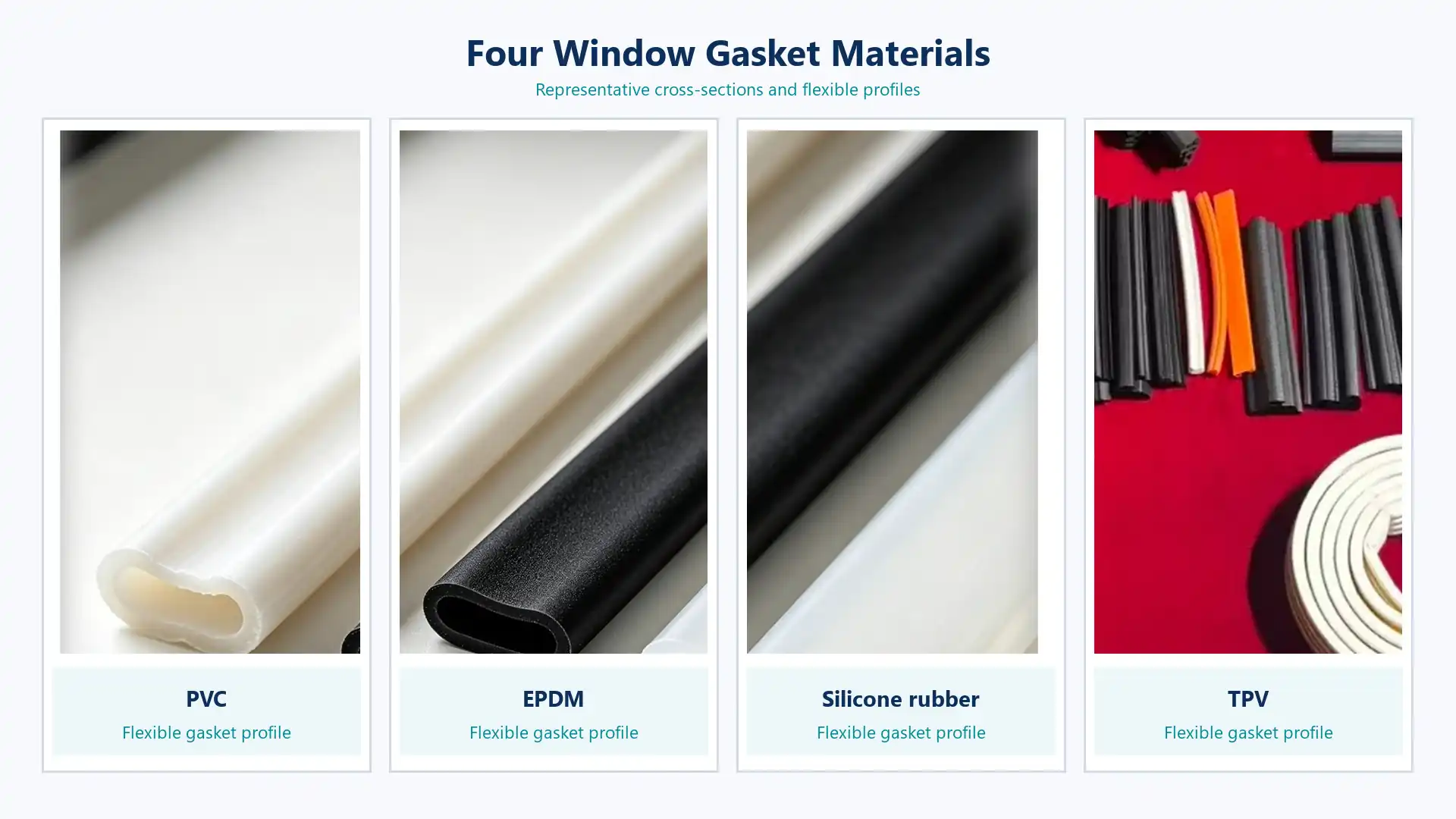
EPDM, Silicone, TPV, and PVC Gaskets
- EPDM: widely used for exterior windows because of its weathering and ozone resistance;
- silicone rubber: offers broad temperature and weather resistance but should be evaluated for tear strength, cost, and profile design;
- TPV and other thermoplastic elastomers: can offer convenient processing and recycling, with performance depending on formulation and grade;
- PVC: may be economical, but low-temperature flexibility, aging, and compression recovery require careful verification.
Material names alone do not establish finished-gasket quality. Review the relevant product standard, test report, cross-section, and fit with the profile groove.
Solid, Foamed, and Co-Extruded Gaskets
Solid sections provide stable geometry, foamed sections may offer softer compression, and co-extruded products can combine materials or hardness levels.
Check whether the gasket:
- fits the profile groove;
- reaches the intended compression;
- remains continuous at corners;
- recovers after long-term compression;
- resists shrinkage, detachment, and low-temperature hardening.
Claims of “three seals” or “five seals” should be supported by continuous, functional sealing planes. Counting visible strips is not enough.
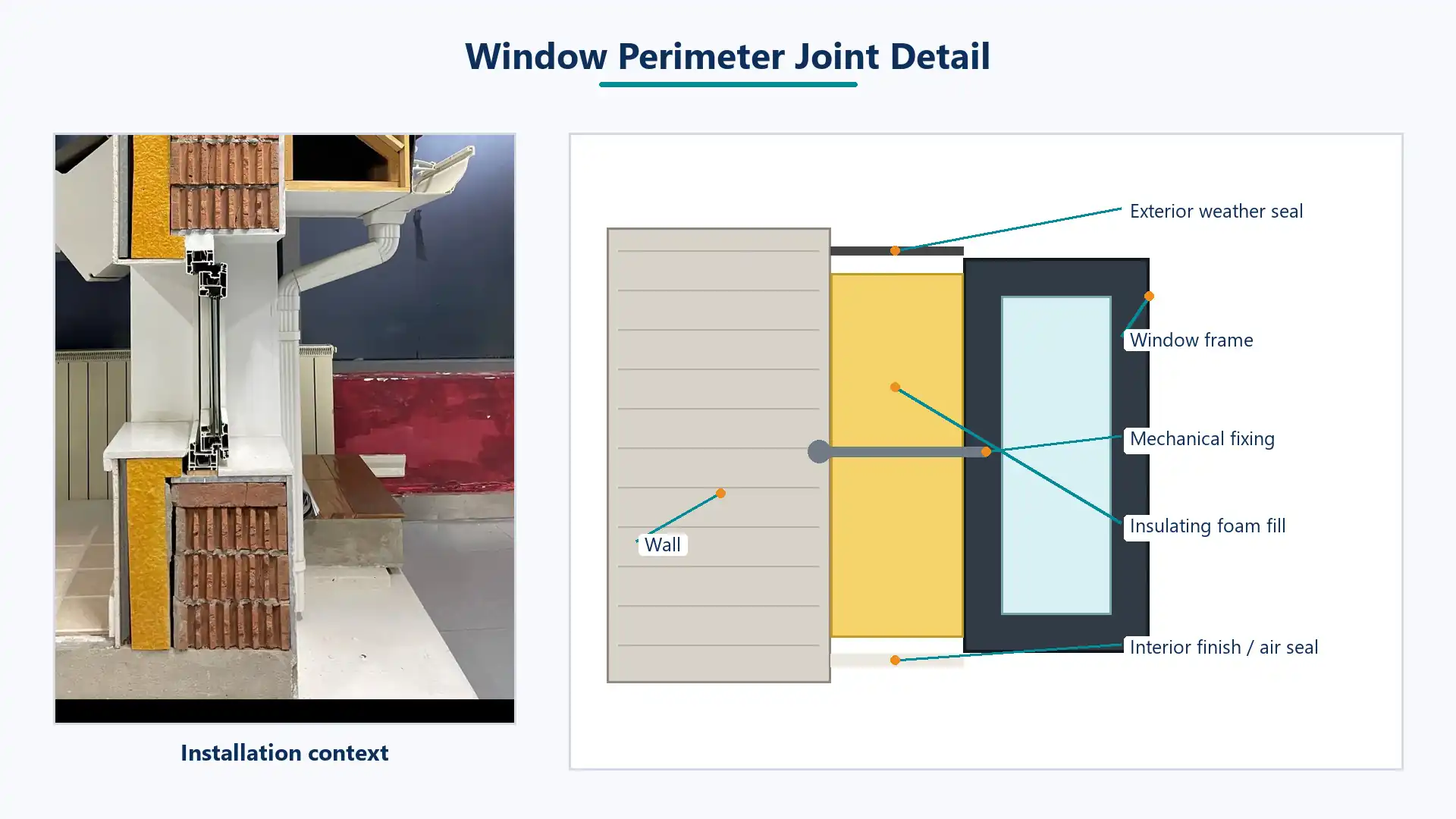
Weather Sealant, Structural Sealant, Foam, and MS Sealant
Weather Sealant
Weather sealant protects joints against air and water while accommodating movement. Selection depends on substrate, joint geometry, displacement, and exterior exposure.
Structural Sealant
Structural sealant is used where bonded joints transfer structural loads. It must not be substituted with a general weather sealant simply because both products are silicone-based.
Polyurethane Foam
Expanding foam may fill the perimeter gap and contribute to insulation, but it should not normally be treated as the exposed long-term exterior waterproof layer.
MS or Modified-Silicone Sealants
These materials may be appropriate for selected building joints, but the exact product must be verified for substrate adhesion, movement, weathering, and intended use.
When Is Compatibility or Adhesion Testing Needed?
Compatibility checks evaluate whether contacting materials cause discoloration, softening, cracking, migration, or adhesion loss. Adhesion testing evaluates whether the sealant bonds reliably to the actual substrate and surface treatment.
Pay particular attention when:
- introducing a new sealant, coating, gasket, backing material, or cleaner;
- the joint carries structural loads;
- sealant contacts Low-E coatings, IGU edge seals, or laminated-glass edges;
- porous or stain-sensitive materials are used;
- the design, applicable standard, consultant, or sealant manufacturer requires testing;
- new repair sealant may contact an unidentified existing sealant.
A hand peel performed on site does not replace a specified laboratory or project adhesion procedure.
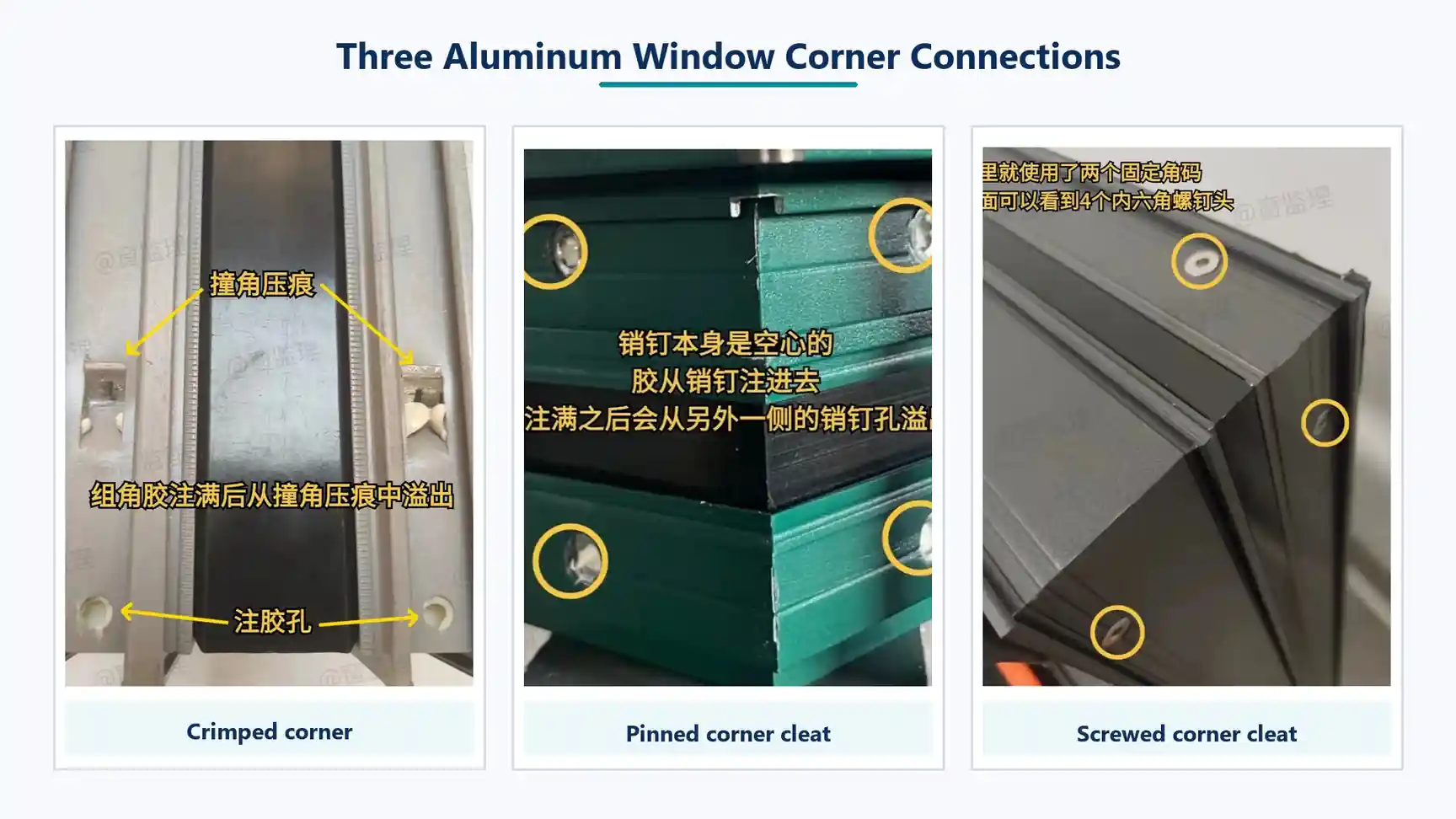
Corner Cleats, Screws, Pins, and Fasteners
Corner performance depends on the profile, cleat, fastening, corner adhesive, injection paths, machining, and production control. Crimped, pinned, and screwed connections can all be appropriate in compatible systems.
Inspect:
- fit between cleat and profile cavity;
- open joints, steps, or misalignment at 45-degree corners;
- specified adhesive or injection application;
- unobstructed drainage paths;
- fastener strength and corrosion protection;
- protection against incompatible-metal contact in coastal or humid environments.
Do not accept claims that one cleat type universally outperforms all others without relevant assembly testing.
Delivery and Operation Checklist
- hardware models match the contract;
- operation is smooth and locking points engage correctly;
- the sash does not show abnormal drop, friction, noise, or movement;
- gaskets are continuous, secure, and evenly compressed;
- sealant joints are continuous and free of obvious voids, cracks, and adhesion loss;
- drainage openings remain clear;
- maintenance instructions identify cleaning, lubrication, adjustment, and replaceable parts.
Conclusion
Hardware carries and operates the sash, gaskets seal moving joints, and sealants protect glass, frame corners, and the wall interface. Their materials and models must be compatible with the complete window design and installation process.
Suggested Internal Links:
- How to Choose Thermal Break Aluminum Profiles
- How to Choose Window Glass
- Casement vs Tilt-and-Turn vs Sliding Windows
Technical References: Chinese standards GB/T 32223, GB/T 24498, JG/T 386, GB/T 14683, GB 16776, GB/T 29755, JC/T 485, JC/T 914, and JC/T 2560. Confirm current editions and intended scope before publication.
Turn your requirements into a comparable supplier brief
Share dimensions, quantities, performance targets and destination. We will organize the key inputs before factories and quotations are compared.