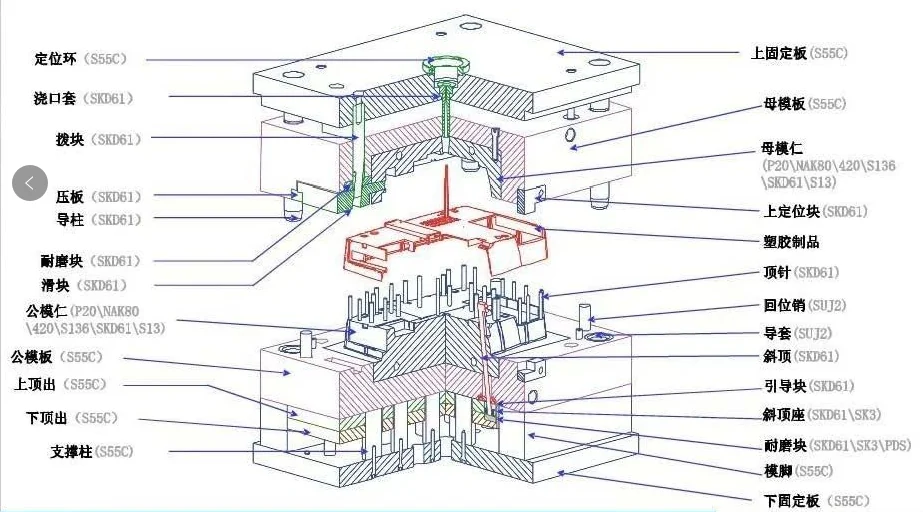
A mold is not compatible simply because its seller says it ran on a machine with the same tonnage. Physical dimensions, shot capacity, clamping requirement, opening stroke, ejection and controls must all match.
TL;DR
Collect the machine datasheet and mold drawing before purchase. Confirm tie-bar clearance, platen fit, mold thickness, opening stroke, ejector interface, locating ring, nozzle, shot requirement, projected area, hot-runner zones and utilities.
Five compatibility red flags
- Only machine tonnage is known.
- Mold dimensions are close to or larger than tie-bar clearance.
- Required shot approaches an unsuitable extreme of machine capacity.
- Ejector and nozzle interfaces are undocumented.
- Hot-runner voltage, thermocouples or connectors do not match.
1. Tie-bar spacing and platen fit
The mold must pass between the tie bars in the intended loading direction. Check width, height and protruding cylinders or connectors. Then verify platen size, clamping slots or bolt pattern and required support.
Do not use nominal mold width alone; external hydraulic cylinders, manifolds and junction boxes can determine whether installation is possible.
2. Mold thickness and daylight
Confirm that closed mold thickness falls within the machine’s minimum and maximum range. Check daylight and opening stroke against the distance required to release the part, runner and side actions.
3. Locating ring and nozzle
Verify locating-ring diameter, sprue-bushing radius, nozzle radius, nozzle opening and required contact. Poor alignment can cause leakage, damage or unstable material transfer.
4. Shot requirement
Calculate the total material per shot:
part weight × cavity count + sprue and runner weight
Then review resin density, machine shot specification and the recommended operating range for that machine and screw. Avoid selecting by a single theoretical maximum.
5. Clamping requirement
Clamping force depends on the projected area of all cavities and runners multiplied by the expected cavity pressure, with an appropriate engineering margin. A high-cavity mold can exceed the machine’s clamping capability even when individual parts are small.
6. Plasticizing and injection performance
Check screw diameter, plasticizing rate, injection pressure and residence time. Heat-sensitive materials and small shots in a large barrel can create processing problems.
7. Ejector interface
Confirm ejector-rod positions, quantity, stroke and force. Check whether the mold uses mechanical ejection, hydraulic core pulls, pneumatic valves or special sequences.
8. Hot-runner and utility interfaces
Record:
- supply voltage and frequency;
- heater zones and wattage;
- thermocouple type;
- connector type and pinout;
- controller capacity;
- hydraulic pressure and connections;
- pneumatic pressure;
- cooling-water connections and required flow.
Husky’s hot-runner resources illustrate why melt delivery and control should be treated as part of the molding system.
Compatibility worksheet
| Item | Mold requirement | Machine capability | Pass/Action |
|---|---|---|---|
| Mold width and height | |||
| Tie-bar spacing | |||
| Mold thickness | |||
| Opening stroke | |||
| Shot requirement | |||
| Clamping requirement | |||
| Ejector layout/stroke | |||
| Locating ring | |||
| Nozzle interface | |||
| Hot-runner controller | |||
| Water/hydraulic/air |
FAQ
Can an adapter solve every mismatch?
No. Some locating, nozzle, connector and mounting differences can be adapted. Insufficient tie-bar clearance, shot capacity, clamp force or opening stroke may require another machine.
Is a machine model enough?
It is a starting point. Obtain the actual datasheet and confirm any factory options or modifications.
Should compatibility be checked before the mold is purchased?
Yes. Otherwise the buyer may own a mold that cannot be installed or operated safely.
Request a compatibility check
Send the machine datasheet, platen and ejector drawings, mold dimensions, mold weight, product material, part weight and cavity count. Compatibility should be signed off before payment or modification begins.
Send the product, mold and machine information.
Share the part drawing or sample, material, target output, available mold details and injection-machine specifications. We will identify the checks needed before purchase, modification or trial.