
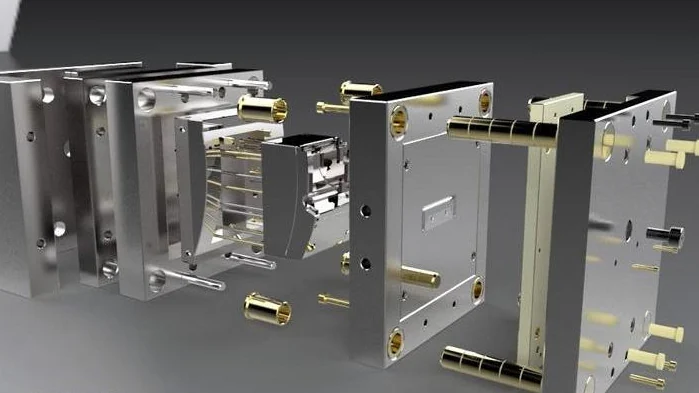
When no complete used mold matches the target product, a sound used mold base can sometimes be retained while new core and cavity inserts are manufactured. This approach sits between modifying an old cavity and building entirely new tooling.
TL;DR
Reuse a mold base only after checking plate condition, alignment, guiding, available insert space, cooling access, machine compatibility and standard-component availability. The saving is real only when the base requires limited restoration and supports the new mold design.
Five reasons to reject a used mold base
- Plates are distorted, cracked or severely corroded.
- Guide-pin and bushing locations are worn beyond economical repair.
- The base dimensions do not fit the buyer’s machine.
- Existing cooling, ejection or side-action layout conflicts with the new inserts.
- Restoration plus new inserts approaches the cost of a complete new mold.
What can be reused?
Depending on condition and design, reuse may include:
- clamp plates and main mold plates;
- guide pins, bushings and support pillars;
- ejector housing and plates;
- locating ring and standard interfaces;
- some cooling connections;
- hot half or runner plates, only after specialist evaluation.
Product-forming inserts, gates, ejection points and cooling near the part usually require new engineering.
Inspection sequence
- Clean and disassemble the base.
- Measure plate thickness, flatness and parallelism.
- Inspect threads, bores, leader pins and bushings.
- Check ejector-plate movement and return.
- Pressure- and flow-test reusable water circuits.
- Map all existing holes, channels and fasteners.
- Confirm the insert pocket can accept the new design.
- Compare mold dimensions with the target machine.
Design risks
The new core and cavity must fit around existing steel, ejector travel, cooling and structural support. A design that simply “fits inside the pocket” may still have poor cooling or insufficient backing steel.
Review:
- cavity pressure and plate support;
- insert retention and access;
- cooling-channel distance;
- gate and runner position;
- venting;
- ejector alignment;
- slides and lifters;
- maintenance access.
Cost comparison
Compare both options using the same acceptance scope:
Reused base: purchase + cleaning + measurement + restoration + new inserts + components + trial.
New mold: new base + inserts + components + design + trial.
A used base is not economical if it forces design compromises, extensive plugging or non-standard components.
Contract requirements
The quotation should identify exactly which parts are reused, repaired, replaced and newly manufactured. Require material specifications for new inserts, an updated assembly drawing, water-circuit diagram, spare-parts list and T1/FAI acceptance criteria.
FAQ
Does a used mold base reduce mold life?
Not necessarily. Remaining life depends on plate, guiding, support and mechanism condition. New product-forming inserts do not repair a distorted or worn base.
Can any mold base accept new inserts?
No. Size alone is insufficient; structure, cooling, ejection and machine interfaces must support the new design.
Is this better than welding the old cavity?
For large geometry changes, new inserts can provide more controlled steel and dimensions than extensive welding.
Request a reuse assessment
Provide base dimensions, photographs, plate and ejector layout, target product data and machine specifications. The assessment should compare reuse with a complete new-mold quotation.
Send the product, mold and machine information.
Share the part drawing or sample, material, target output, available mold details and injection-machine specifications. We will identify the checks needed before purchase, modification or trial.